Microscope: Types, Applications, and Importance in Modern Scientific Research
A microscope is one of the most important scientific instruments used in healthcare, biotechnology, pathology, microbiology, education, and industrial research. It allows scientists and researchers to observe microscopic structures that cannot be seen with the naked eye.
Modern microscope technologies have evolved significantly over the years. Today, laboratories use advanced systems such as fluorescence microscopes, confocal microscopes, digital microscopes, stereo microscopes, and inverted microscopes for highly accurate imaging and scientific analysis.
From cell culture research and pathology diagnostics to fluorescence imaging and molecular biology, microscopes continue to play a critical role in scientific discovery and healthcare innovation.
In this article, we will explore what a microscope is, how it works, the types of microscope systems, their applications, and the importance of advanced microscopy technologies in modern laboratories.
What Is a Microscope?
A microscope is an optical or digital instrument used to magnify and visualize tiny objects, cells, tissues, microorganisms, and biological samples.
The primary purpose of a microscope is to improve visibility and allow detailed examination of structures that are too small to be seen by the human eye.
Modern microscopy systems are widely used in:
- Healthcare laboratories
- Pathology labs
- Biotechnology research
- Cell biology studies
- Educational institutions
- Pharmaceutical industries
- Industrial testing laboratories
How Does a Microscope Work?
Many people ask, what is a microscope and how does it function?
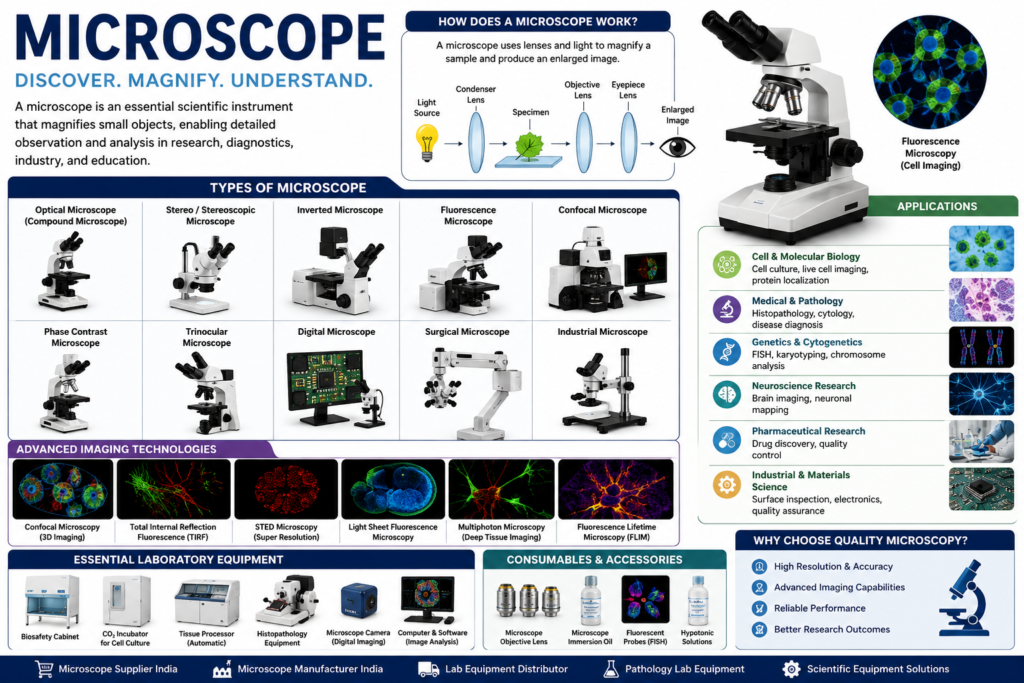
A microscope works by using lenses and light systems to magnify specimens. The objective lens collects light from the sample and creates an enlarged image that can be viewed through the eyepiece or digital display.
Advanced microscopy systems may also use:
- Fluorescent light
- Lasers
- Digital imaging sensors
- Optical scanning technologies
These technologies improve image quality, resolution, and scientific accuracy.
Types of Microscope Systems
There are several types of microscope technologies designed for specific scientific applications.
Compound Microscope
A compound microscope is commonly used in biology and pathology laboratories for viewing cells, tissues, and microorganisms.
Stereo Microscope
A stereo microscope or stereoscopic microscope provides a three-dimensional view of larger objects.
Applications include:
- Industrial inspection
- Surgical analysis
- Electronics testing
- Material examination
Digital Microscope
A digital microscope captures images electronically and displays them on computer systems.
Benefits include:
- Real-time imaging
- Data storage
- Image sharing
- Digital analysis
Fluorescence Microscope
A fluorescence microscope uses fluorescent dyes and light to visualize biological molecules and cellular structures.
Modern fluorescence microscopy applications include:
- Cancer diagnostics
- Molecular biology
- Cell imaging
- Genetic research
Confocal Microscope
A confocal microscope uses laser scanning technology to create highly detailed three-dimensional images.
The confocal microscopy principle improves image resolution by eliminating out-of-focus light.
Applications include:
- Neuroscience research
- Live cell imaging
- Biomedical analysis
- Fluorescence imaging
Inverted Microscope
An inverted microscope is designed for observing living cells and cell cultures from below the sample stage.
These systems are widely used in:
- IVF laboratories
- Cell culture research
- Biotechnology applications
Optical Microscope
An optical microscope uses visible light and lenses for magnification and sample visualization.
Surgical Microscope
Surgical microscopes help doctors perform highly precise medical procedures and microsurgeries.
Fluorescence Microscopy and Advanced Imaging
Fluorescence microscopy is one of the most advanced imaging techniques in modern biological research.
What Is Fluorescence Microscopy?
Many researchers ask, what is fluorescence microscopy?
It is a microscopy technique that uses fluorescent markers to study cellular structures, proteins, and biological interactions.
Types of Fluorescence Microscopy
Modern fluorescence systems include:
- Widefield fluorescence microscope
- Confocal fluorescence microscope
- Light sheet fluorescence microscopy
- Fluorescence lifetime microscopy
- Structured illumination microscopy
- Total internal reflection fluorescence microscopy
These technologies support advanced biomedical research and diagnostics.
Confocal Microscopy Applications
Confocal microscopy has become essential in life science research.
Major Applications Include:
- Live cell microscopy
- Tissue imaging
- Cancer research
- Neuroscience studies
- Molecular diagnostics
Laser scanning confocal microscopes provide highly accurate three-dimensional visualization for complex biological samples.
Microscope Components and Accessories
Modern microscope systems use several advanced components for accurate imaging.
Microscope Objective Lens
The microscope objective lens is responsible for magnifying the sample and improving image clarity.
Microscope Camera
A microscope camera captures digital images and videos for analysis and reporting.
Microscope Immersion Oil
Microscope immersion oil improves image resolution and optical performance at high magnifications.
Digital Microscope Camera
Digital cameras support high-resolution imaging and real-time scientific analysis.
Uses of Microscope Systems
The uses of microscope systems are extremely broad across healthcare and research industries.
Healthcare and Pathology
Microscopes are widely used in:
- Histopathology
- Cancer diagnostics
- Clinical pathology
- Cytology
- Hematology
Biotechnology Research
Biotechnology laboratories use microscopes for:
- Cell culture studies
- Molecular biology
- Genetic analysis
- Fluorescence imaging
Industrial Applications
Industrial microscopes support:
- Electronics inspection
- Semiconductor analysis
- Material testing
- Quality control
Educational Research
Schools and universities use microscopes for biology education and laboratory training.
Biosafety Cabinets and Laboratory Equipment
Modern laboratories require advanced laboratory instruments and safety systems.
What Is Biosafety Cabinet?
A biosafety cabinet is a laboratory safety enclosure designed to protect researchers, samples, and the environment from contamination.
Biosafety cabinets are essential for:
- Cell culture research
- Molecular diagnostics
- Pathogen handling
- Microbiology laboratories
CO2 Incubators for Cell Culture
A CO2 incubator maintains controlled environmental conditions for growing and maintaining cell cultures.
These systems are widely used in:
- IVF laboratories
- Biotechnology research
- Cancer research
- Stem cell studies
Pathology Laboratory Instruments
Modern pathology labs use advanced pathology laboratory instruments for diagnostic analysis.
Common pathology equipment includes:
- Tissue processors
- Automated tissue processors
- Histopathology systems
- Microscopy platforms
- Digital imaging systems
Automatic tissue processors improve laboratory workflow and diagnostic efficiency.
Light Microscope vs Electron Microscope
One common comparison is light microscope vs electron microscope.
Light Microscope
- Uses visible light
- Suitable for live cells
- Lower magnification
- Easier sample preparation
Electron Microscope
- Uses electron beams
- Extremely high magnification
- Greater structural detail
- Complex operation
Both systems are important for different research applications.
Inverted vs Upright Microscope
Researchers often compare inverted vs upright microscope systems.
Upright Microscope
- Objective lenses above the sample
- Ideal for slides and fixed specimens
Inverted Microscope
- Objective lenses below the sample
- Ideal for live cells and cell cultures
Each microscope type is designed for specific laboratory requirements.
Future of Microscopy
The future of microscopy is rapidly evolving through artificial intelligence, automation, and digital imaging technologies.
Emerging advancements include:
- AI-powered image analysis
- Super resolution microscope systems
- STED microscopy
- Multiphoton microscopy
- Automated laboratory equipment
- Real-time digital pathology
These innovations are transforming scientific research and healthcare diagnostics.
Conclusion
Microscopes remain one of the most essential scientific instruments in modern healthcare, biotechnology, pathology, and research laboratories.
From fluorescence microscopy and confocal imaging to digital microscopes and cell culture systems, advanced microscopy technologies continue improving scientific accuracy and laboratory efficiency.
As imaging systems become more advanced, microscopes will continue driving innovation in healthcare diagnostics, molecular biology, and biomedical research worldwide.
FAQs
What is a microscope?
A microscope is an instrument used to magnify and observe microscopic objects such as cells, tissues, and microorganisms.
What are the types of microscope systems?
Common types include compound microscopes, stereo microscopes, fluorescence microscopes, confocal microscopes, digital microscopes, and inverted microscopes.
What is fluorescence microscopy?
Fluorescence microscopy is an imaging technique that uses fluorescent dyes and light to visualize biological structures and molecules.
What is the use of microscope systems?
Microscopes are used in healthcare diagnostics, pathology, biotechnology research, industrial inspection, and scientific education.
What is the difference between stereo and compound microscope?
A stereo microscope provides a three-dimensional view of larger objects, while a compound microscope is used for high magnification of biological samples.
What is a confocal microscope?
A confocal microscope uses laser scanning technology to create highly detailed and high-resolution images of biological samples.
Why are biosafety cabinets important?
Biosafety cabinets protect laboratory workers and samples from contamination during microbiological and cell culture procedures.
What is an inverted microscope used for?
An inverted microscope is mainly used for observing live cells and cell cultures in biotechnology and IVF laboratories.