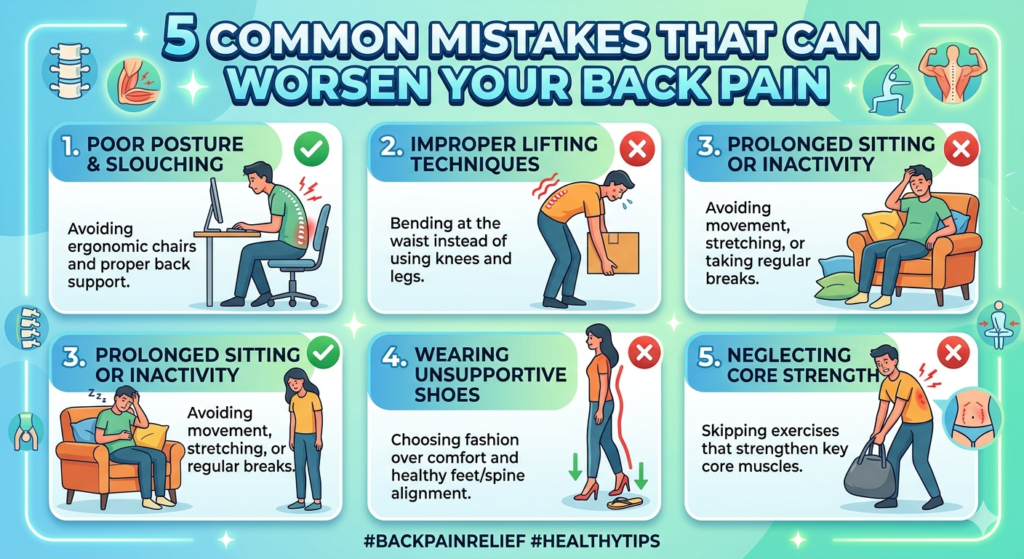
As a neurosurgeon, I meet patients every week who come to me frustrated. Their back pain started as a small nuisance, but somehow, over time, it has become unbearable. They have tried rest, painkillers, even some exercises they found online. Nothing works. And when I ask them to walk me through their daily routine, I notice the same five mistakes again and again.
Let me be clear. Most back pain does not need surgery. It needs you to stop doing things that make it worse. Here are the most common culprits I see, and how to fix them.
Mistakes That Can Worsen Your Back Pain
Mistake 1: Bed Rest for More Than a Day or Two
I understand the instinct. Your back hurts, so you lie down. You think rest will heal it. But here is the problem. For most back pain, bed rest beyond 24 to 48 hours does more harm than good. Your spine needs movement to pump fluid into the discs between your vertebrae. When you lie still for days, those discs become dehydrated and stiff. Your muscles weaken. And that weakness puts more strain on your spine when you finally get up.
The evidence is clear. People who stay active – within limits – heal faster than those who stay in bed. That does not mean you should run a marathon. It means gentle walking, getting up every hour, and avoiding prolonged sitting or lying down. If the pain is so severe that you cannot move at all, that is a red flag. You need to see a doctor, not stay in bed.
Mistake 2: Sitting in the Wrong Posture for Hours
Your spine has a natural S‑shape. When you sit on a soft couch or slump in an office chair, you flatten that curve. You put extra pressure on the discs in your lower back. Over hours and days, that pressure adds up. A minor muscle strain turns into a chronic disc problem.
What is the right way to sit? Your feet should be flat on the floor. Your knees should be level with or slightly lower than your hips. Your lower back should have a small inward curve – use a rolled towel or a lumbar support pillow if your chair does not provide it. And here is the most important part: get up every 30 to 45 minutes. Stand, stretch, walk for two minutes. Your spine is not designed for prolonged sitting, no matter how good your posture is.
Mistake 3: Using Your Back Instead of Your Legs
This sounds obvious, but I cannot tell you how many patients with back pain continue to lift things the wrong way. You bend at your waist, keep your legs straight, and use your lower back as a lever. That is a disaster waiting to happen. Your back muscles are not designed for heavy lifting. Your leg muscles are.
The correct way: stand close to the object. Keep your back straight. Bend at your knees and hips, not your waist. Tighten your stomach muscles. Lift with your legs, not your back. Keep the object close to your body. And if something is too heavy, do not be a hero. Ask for help or use a dolly.
Even light objects can hurt you if you lift them with a twisted spine. Turning your torso while holding a load is particularly dangerous. Move your feet, not your back.
Mistake 4: Sleeping on Your Stomach
I see this all the time. People with back pain sleep on their stomachs because it feels comfortable for the first few minutes. But spend a whole night like that, and you are asking for trouble. When you lie on your stomach, your neck is twisted to one side. Your lower back sags, pulling your spine out of alignment. By morning, that small disc bulge has been stressed for eight hours.
What is better? Sleeping on your side with a pillow between your knees. That keeps your hips and spine aligned. Or sleep on your back with a pillow under your knees. That maintains the natural curve of your lower back. If you absolutely cannot break the stomach‑sleeping habit, place a thin pillow under your hips to reduce the sag in your lower back.
Mistake 5: Ignoring the Pain and “Powering Through”
This is the mistake that turns treatable back pain into chronic disability. You feel a twinge. You ignore it. You keep doing the same activities – lifting, sitting, bending. The pain gets a little worse. You take a painkiller and push through. Over weeks and months, a simple muscle strain becomes a disc herniation. A disc herniation becomes nerve compression. Nerve compression becomes leg weakness or numbness.
Pain is not your enemy. Pain is a signal. It is your body telling you that something is wrong. When your back hurts during or after a specific activity, that activity is making your condition worse. Listen to that signal. Modify what you are doing. Take a break. Change your posture. If the pain persists for more than a week or two despite rest and over‑the‑counter medication, get evaluated.
When to See a Neurosurgeon
Most back pain improves within six weeks with conservative care – activity modification, gentle movement, and anti‑inflammatory medication. But some symptoms require urgent attention.
See a neurosurgeon in ranchi immediately if you have back pain with any of these: numbness or tingling in your groin area, difficulty urinating or losing control of your bladder or bowel, weakness in your legs that is getting worse, or a fever with your back pain. These can indicate cauda equina syndrome or an infection, both of which are emergencies.
For chronic back pain that has not improved with conservative care, or if you have leg pain that follows a specific nerve pattern (like sciatica down the back of your leg), it is wise to see the best neurosurgeon in ranchi for a proper evaluation. You may need an MRI to see if a herniated disc or spinal stenosis is pressing on a nerve. And remember, most back pain does not need surgery. A good neurosurgeon will try every non‑surgical option first – physical therapy, medications, injections – before even discussing an operation.
Final Thoughts from My Desk
Back pain is common. That does not mean you have to live with it. Most of the time, small changes in how you sit, sleep, lift, and move can make a huge difference. Stop resting for days. Stop slumping in your chair. Stop lifting with your back. Stop sleeping on your stomach. And please, stop ignoring pain that persists.
Your spine is the central pillar of your body. Take care of it, and it will take care of you. Ignore it, and it will let you know. Usually in the worst possible way.