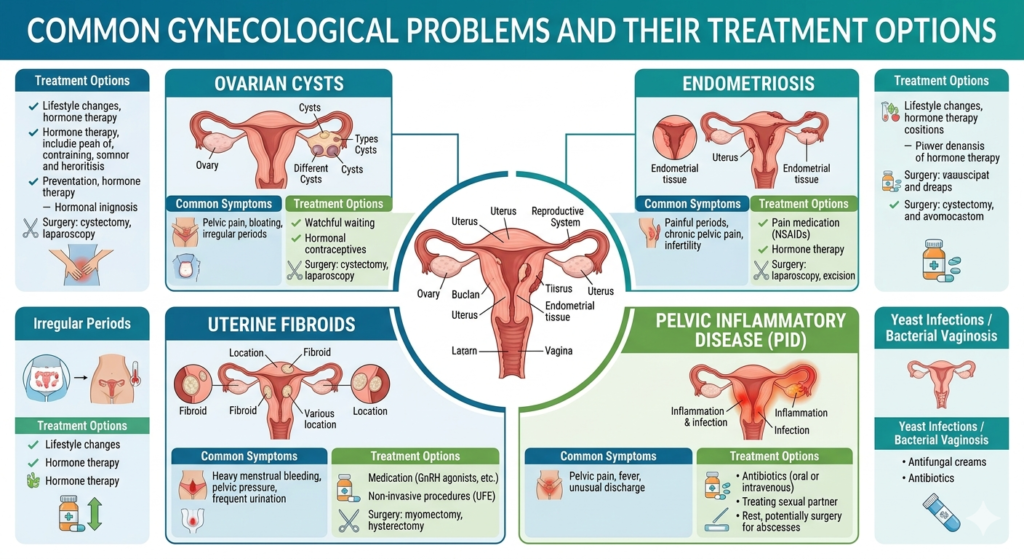
Let me start with a simple truth. Most women will face at least one gynecological issue in their lifetime. Some are mild annoyances. Others can disrupt your daily life, your relationships, and your peace of mind. The problem is that many women suffer in silence. They think their symptoms are normal, or they feel embarrassed to speak up. Or worse, they have been told by someone – a friend, a relative, even an old‑school doctor – to just “deal with it.”
Let me walk you through the most common gynecological problems, what they actually feel like, and what modern medicine can do about them. You do not need to suffer.
Heavy or Painful Periods
This is the number one complaint I hear. Heavy bleeding – soaking through a pad or tampon every hour, passing clots larger than a coin, periods lasting more than seven days. Painful periods – cramps that make you miss work or school, that don’t respond to over‑the‑counter painkillers, that leave you curled up with a hot water bottle unable to move.
The causes vary. Fibroids are non‑cancerous growths in the uterine muscle. They can make periods heavy and clotted. Adenomyosis is when the uterine lining grows into the muscle wall, causing deep, crushing pain. Polyps are small growths inside the uterus that can cause bleeding between periods. Sometimes, no cause is found – but that doesn’t mean nothing can be done.
Treatment options range from hormonal birth control (pills, IUD, implant) to non‑hormonal medications like tranexamic acid. For fibroids, there are medications to shrink them, uterine artery embolisation, or surgical removal (myomectomy). In severe cases where childbearing is complete, a hysterectomy may be an option – but only as a last resort.
PCOS (Polycystic Ovary Syndrome)
PCOS is one of the most common hormonal disorders in women of reproductive age, yet it is often missed or dismissed. The classic signs: irregular or absent periods, acne, excess facial or body hair, thinning hair on the scalp, and difficulty losing weight. Not every woman has all these symptoms. Some have only irregular periods. Others have the hair growth but normal cycles.
PCOS is linked to insulin resistance. Your body produces too much insulin, which triggers your ovaries to make excess androgens (male hormones). That disrupts ovulation.
Treatment depends on your goals. If you are not trying to conceive, hormonal birth control regulates cycles and reduces acne and excess hair growth. Metformin, a diabetes drug, helps with insulin resistance and can make cycles more regular. For fertility, ovulation induction with letrozole or clomiphene is often the first step. Lifestyle changes – losing even 5% of body weight – can dramatically improve symptoms.
Endometriosis
Endometriosis is often called the “missed diagnosis” because women suffer for an average of seven to ten years before anyone figures it out. The tissue that normally lines your uterus grows outside it – on ovaries, fallopian tubes, the outside of the bladder or bowel. Every month, that tissue bleeds just like your uterine lining, but the blood has nowhere to go. It causes inflammation, scarring, and intense pain.
The pain often starts before your period and lasts after it ends. It can hurt during ovulation, during sex, when you pee, or when you have a bowel movement. Over‑the‑counter painkillers do very little.
Treatment options include hormonal suppression (birth control pills, injections, or IUD) to stop the tissue from growing. Laparoscopic surgery can remove the misplaced tissue and is often very effective, though the condition can return over time. For women who are not planning pregnancy, more aggressive hormonal suppression or even hysterectomy may be considered.
Uterine Fibroids
Fibroids are incredibly common – up to 80% of women develop them by age 50. Most cause no trouble. But when they do, the symptoms are hard to ignore. Heavy, prolonged periods with large clots. Pelvic pressure or fullness. Frequent urination because the fibroid presses on your bladder. Constipation if it presses on your bowel. Pain during intercourse.
Treatment depends on the size, location, and your symptoms. For mild cases, monitoring is fine. For heavy bleeding, hormonal medications or a progesterone IUD can help. For larger or more symptomatic fibroids, options include uterine artery embolisation (blocking the blood supply to the fibroid), myomectomy (surgical removal of just the fibroids, preserving the uterus), or hysterectomy (removal of the uterus).
Vaginal Infections
Yeast infections, bacterial vaginosis, trichomoniasis – these are incredibly common and treatable. Yeast infections cause intense itching, thick white discharge that looks like cottage cheese, and burning. Bacterial vaginosis causes a thin grey or white discharge with a strong fishy smell, especially after sex. Trichomoniasis causes a frothy yellow‑green discharge with a foul odour, along with itching and pain during urination or intercourse.
The mistake women make is self‑treating with over‑the‑counter yeast infection creams when the problem may be bacterial. The wrong treatment does nothing and delays the right one. A simple swab test can identify the cause. Yeast infections are treated with antifungal creams or pills. Bacterial vaginosis and trichomoniasis require prescription antibiotics.
Pelvic Organ Prolapse
This is more common than most women realise, especially after childbirth or with age. The pelvic floor muscles weaken, and one or more pelvic organs – bladder, uterus, rectum – slip down from their normal position. Symptoms include a feeling of heaviness or pressure in the vagina, a visible bulge, difficulty emptying the bladder or bowel, and discomfort during sex.
Mild prolapse may not need treatment. Pelvic floor physical therapy (Kegel exercises done correctly) can help. A vaginal pessary – a removable device that supports the organs – is a non‑surgical option. For severe prolapse, surgery to repair the pelvic floor or remove the uterus may be recommended.
When to See a Gynecologist
Here is my simple rule. If a symptom is affecting your quality of life – if you are missing work, avoiding sex, feeling anxious about your body, or in pain that doesn’t go away – see a doctor. You do not need to wait for your annual exam. You do not need to feel embarrassed.
If you live in South Delhi, you can find excellent care close to home. A good Gynecologist in Lajpat Nagar New Delhi will listen without judgment, run the necessary tests, and explain your options clearly. For ongoing or complex issues – like recurrent endometriosis, large fibroids, or PCOS that hasn’t responded to basic treatment – finding the Best Gynecologist in Lajpat Nagar New Delhi ensures you get a thorough evaluation and a treatment plan that fits your life, not just a quick prescription.
Final Thoughts from a Guide’s Desk
Your body is not a mystery. It has patterns, signals, and symptoms. Learning to read those signals is the first step to good health. If something feels off, it probably is. Do not let embarrassment or fear stop you from asking questions. Gynecological problems are medical problems, not moral failings. They have names, causes, and treatments. You just need to take that first step and walk through the door.