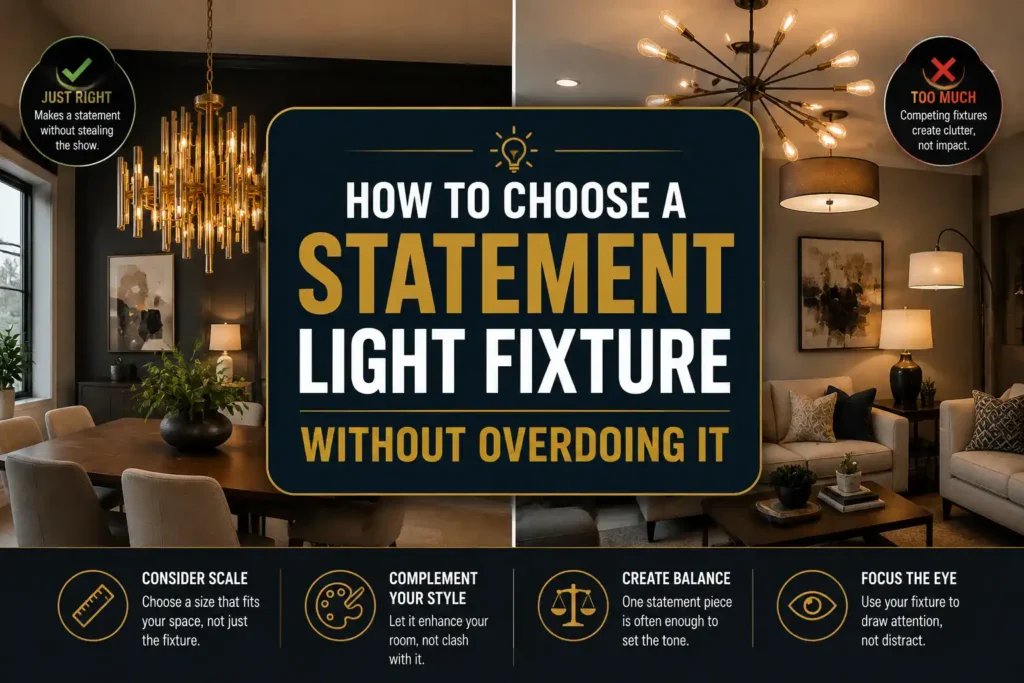
There’s a specific kind of confidence a great light fixture gives a room. Walk into a space with a striking chandelier or an unexpected pendant, and your eye goes there first before the furniture, before the artwork, before anything else. That’s the whole point of a statement fixture. But there’s a real skill to picking one that elevates a room instead of overwhelming it, and it’s not as simple as “bigger is better” or “if it’s beautiful, it’ll work.”
Start With the Room’s Job, Not Its Square Footage
The most common mistake people make is choosing a fixture based purely on the size of the room, without thinking about what actually happens in that space. A formal dining room that hosts dinner parties can handle and often benefits from a bold, dramatic chandelier that draws the eye downward and anchors the table. A home office or reading nook usually calls for something quieter, since the fixture isn’t meant to be the focal point of the room; it’s meant to support the work happening underneath it.
Before shopping, it helps to ask what the room is actually for and how much visual attention it can reasonably hold before it starts to compete with everything else you’ve already invested in the furniture, the art, the view.
Scale Still Matters More Than Style
Even the most beautifully designed fixture will feel wrong if it’s the wrong size for the space. A general rule that holds up well: for a room’s general lighting fixture, add the room’s length and width together in feet, and that number roughly translates to the fixture’s diameter in inches. A 12-by-14-foot room, for example, points toward a fixture around 26 inches across.
For a dining table specifically, the fixture should typically span about half to two-thirds the width of the table, so it feels proportionate rather than lost or overwhelming when you’re seated underneath it.
Getting scale right first means almost any style modern, traditional, industrial will read as intentional. Getting it wrong means even a gorgeous fixture will feel like it doesn’t belong.
Let One Fixture Actually Be the Statement
A common instinct is to make every fixture in an open floor plan equally bold a big chandelier over the dining table, an equally dramatic pendant over the kitchen island, a large statement piece in the entryway, all visible from the same sightline. The effect usually isn’t more dramatic; it’s more chaotic. Each piece competes for attention instead of letting the eye rest anywhere.
A more effective approach is choosing one true statement piece per sightline, and letting everything else in view play a supporting role simpler, quieter, and more functional. That contrast is actually what makes the statement piece read as special in the first place.
Material and Finish Should Talk to the Rest of the Room
A fixture doesn’t need to match every other metal finish in a room, but it should have some kind of relationship to what’s already there. If your cabinet hardware and faucet are brushed brass, a fixture in aged bronze can still work but a stark, cold chrome piece might feel like it wandered in from a different house. Look for at least one material or tone that echoes something already in the space, whether that’s a wood tone, a metal finish, or even a color picked up from art or textiles nearby.
Where to Actually Start Looking
If you’re at the stage of browsing rather than committing, it helps to look at fixtures grouped by scale and drama rather than by room type alone, since a dramatic pendant can work equally well in a dining room, an entryway, or above a kitchen island depending on the space. Circ’s decorative lighting collection is organized this way, with everything from oversized chandeliers to sculptural pendants, which makes it easier to compare scale and material side by side instead of hunting room by room.
The Bottom Line
A great statement fixture doesn’t just fill space overhead it sets the tone for the whole room. The fixtures that actually succeed at this aren’t necessarily the biggest or boldest available; they’re the ones chosen with the room’s proportions, purpose, and existing materials in mind. Get those fundamentals right, and almost any style choice will feel like it belongs.