Introduction
A DFT meter is an important testing instrument used to measure the thickness of a dry coating layer on a surface. DFT stands for Dry Film Thickness. In simple words, it shows how thick the final dry coating is after paint, powder coating, galvanizing, anodizing, chrome, or protective coating has been applied.
Coating thickness plays a major role in surface protection. If the coating is too thin, the surface may not get proper protection against corrosion, moisture, chemicals, and wear. If the coating is too thick, it may lead to cracking, peeling, uneven finish, extra material cost, or rejection during quality inspection.
For industries such as fabrication, automotive, oil and gas, shipbuilding, infrastructure, pipelines, storage tanks, bridges, towers, and quality control, a DFT meter helps ensure that coatings meet required specifications.
What Is a DFT Meter?
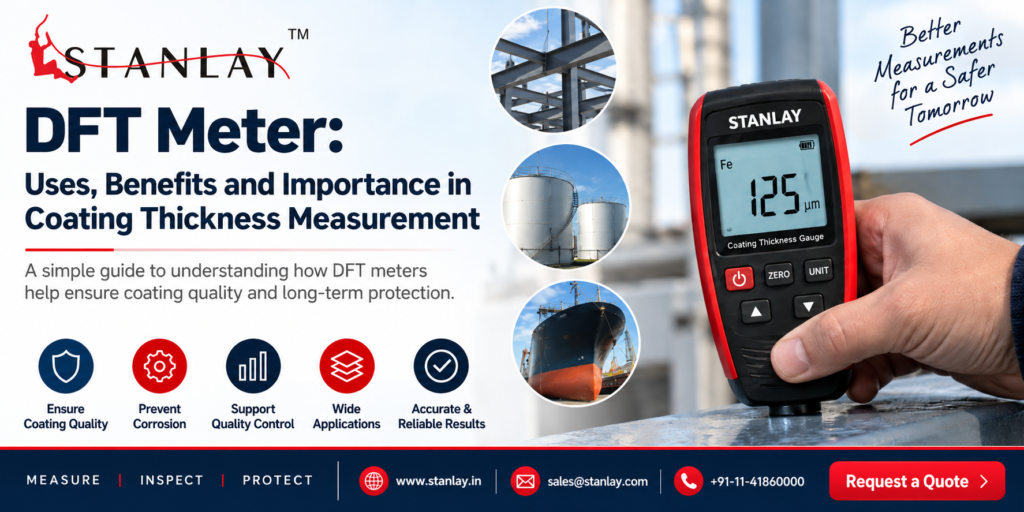
A DFT meter is a coating thickness measuring device used to check dry film thickness on metal surfaces. It is also commonly known as a coating thickness gauge or paint thickness gauge.
The main purpose of a DFT meter is to measure coating thickness without damaging the coated surface. This makes it useful for both factory inspection and on-site quality checks.
A DFT meter is commonly used to measure:
- Paint coating thickness
- Powder coating thickness
- Galvanized coating thickness
- Chrome coating thickness
- Anodized coating thickness
- Protective industrial coating thickness
- Corrosion protection coating thickness
Stanlay offers DFT meter solutions for coating thickness measurement applications where accuracy, ease of use, and reliable inspection are important.
Why Is a DFT Meter Important?
A DFT meter is important because coating thickness directly affects coating performance. A coated surface may look good from outside, but without proper thickness measurement, it is difficult to know whether the coating will provide long-term protection.
Using a DFT meter helps in:
- Maintaining coating quality
- Checking coating uniformity
- Avoiding under-coating and over-coating
- Reducing corrosion risk
- Supporting quality control documentation
- Improving inspection accuracy
- Reducing coating failure and rework
- Meeting project and industry specifications
For protective coatings, the correct dry film thickness is essential. Poor coating thickness can reduce the life of metal structures and increase maintenance costs.
How Does a DFT Meter Work?
A DFT meter works by using measurement technology based on the surface material.
For ferrous metals such as iron and steel, many DFT meters use magnetic induction technology. For non-ferrous metals such as aluminium, copper, or stainless steel, eddy current technology is commonly used.
In simple terms:
- On steel or iron, the meter detects coating thickness using magnetic response.
- On aluminium or other non-ferrous metals, the meter measures coating thickness using eddy current response.
Modern DFT meters may support both ferrous and non-ferrous measurement modes. Some advanced models also include automatic substrate detection, which helps the device identify the surface type and choose the correct measuring method.
Common Applications of a DFT Meter
A DFT meter is used in many industries where coating protection and surface quality matter.
1. DFT Meter for Paint Thickness Measurement
A DFT meter is widely used to measure paint thickness on metal surfaces. This is useful in fabrication, automotive, industrial coating, and maintenance work.
2. DFT Meter for Powder Coating Inspection
Powder coating should be applied at the correct thickness to ensure proper finish, adhesion, and durability. A DFT meter helps check whether the coating thickness is within the required range.
3. DFT Meter for Galvanizing Inspection
Galvanized coatings protect steel from corrosion. A DFT meter can help inspect coating thickness to ensure that the protective layer is suitable for the application.
4. DFT Meter for Pipeline Coating
Pipelines often require protective coatings to prevent corrosion. A DFT meter helps inspectors verify coating quality before the pipeline is installed or commissioned.
5. DFT Meter for Storage Tanks and Structures
Storage tanks, bridges, towers, and steel structures are exposed to tough conditions. Proper coating thickness measurement helps improve their service life.
Key Features to Look for in a DFT Meter
Before choosing a DFT meter, it is important to check whether the instrument matches your inspection requirement.
1. DFT Meter Measuring Range
The measuring range tells the minimum and maximum coating thickness the meter can measure. For general paint inspection, a standard range may be enough. For heavy protective coatings, a higher measuring range may be required.
2. DFT Meter Accuracy
Accuracy is one of the most important factors. A good DFT meter should provide reliable readings so that inspection decisions can be made confidently.
3. Ferrous and Non-Ferrous Measurement
A useful DFT meter should support measurement on both ferrous and non-ferrous metal surfaces. This is especially important when working with mixed materials.
4. Automatic Substrate Detection
Automatic substrate detection helps the meter identify whether the surface is ferrous or non-ferrous. This reduces manual setting errors and improves ease of use.
5. Clear Display
A large and clear display helps users read values easily during inspection. Backlight and auto-rotate display features can be helpful in field conditions.
6. Data Storage
For quality control and reporting, data storage is useful. It allows inspectors to save readings and prepare inspection records.
7. Calibration Support
Calibration is important for accurate measurement. A DFT meter with zero calibration and multi-point calibration support can improve measurement reliability.
8. Connectivity
USB or Bluetooth connectivity can help transfer inspection data for reporting, record keeping, and analysis.
Benefits of Using a DFT Meter
A DFT meter offers several benefits for inspection teams and industries.
Improves Coating Quality
It helps confirm whether the coating has been applied at the correct thickness.
Reduces Rework
Early measurement helps identify coating problems before final approval, reducing costly rework.
Supports Corrosion Protection
Correct coating thickness improves protection against corrosion and surface damage.
Saves Time
Quick non-destructive readings help inspectors check multiple points efficiently.
Supports Documentation
Saved readings can be used for inspection reports and quality records.
Helps Meet Specifications
A DFT meter supports compliance with coating thickness requirements mentioned in project or quality standards.
How to Use a DFT Meter Correctly
To get accurate results, the DFT meter should be used properly.
First, clean the surface before measurement. Dust, oil, moisture, or loose particles can affect readings. Then select the correct measurement mode or allow the meter to detect the substrate automatically if the feature is available.
Place the probe flat on the coated surface and avoid tilting it. Take multiple readings from different points instead of depending on a single reading. This helps understand coating uniformity across the surface.
Basic steps include:
- Clean the coated surface
- Select the correct measurement mode
- Calibrate the meter if required
- Place the probe properly on the surface
- Take readings at multiple points
- Save or record the readings
- Compare values with the required specification
Proper handling and calibration help improve measurement accuracy.
DFT Meter for Quality Control
In coating inspection, visual checking is not enough. A coating may appear smooth and uniform, but its thickness may still be below or above the required level. A DFT meter helps quality teams verify the actual coating thickness.
It is useful during:
- Incoming material inspection
- Coating application checks
- Final product inspection
- Site inspection
- Maintenance inspection
- Client reporting
- Corrosion protection audits
For manufacturers, contractors, coating applicators, and inspection teams, DFT measurement improves confidence in coating quality.
Difference Between DFT Meter and Coating Thickness Gauge
A DFT meter and a coating thickness gauge are often used for the same purpose. Both are used to measure coating thickness. The term DFT meter is commonly used when measuring dry film thickness after the coating has dried.
So, when someone talks about a DFT meter, they usually mean a coating thickness gauge used for dry coating inspection.
Industries That Use DFT Meters
A DFT meter is useful in many industries, including:
- Fabrication industry
- Automotive industry
- Oil and gas industry
- Shipbuilding industry
- Infrastructure projects
- Pipeline projects
- Paint and coating industry
- Galvanizing plants
- Manufacturing units
- Quality control labs
- Maintenance departments
Wherever coating quality and corrosion protection are important, a DFT meter can be a valuable tool.
Why Choose Stanlay for DFT Meter Solutions?
Stanlay provides inspection and testing equipment for industrial, infrastructure, and quality control applications. For coating thickness measurement, Stanlay offers DFT meter solutions designed to help users check dry film thickness on metal surfaces.
A suitable Stanlay DFT meter can help professionals measure paint, powder coating, galvanizing, anodizing, chrome, and protective coatings with ease. The right model should be selected based on measuring range, substrate type, accuracy needs, calibration requirements, and reporting features.
Conclusion
A DFT meter is an essential tool for coating thickness measurement. It helps inspectors check dry film thickness without damaging the coating. This supports better coating quality, corrosion protection, maintenance planning, and quality control reporting.
Whether the application is paint inspection, powder coating, galvanizing, pipeline coating, tank inspection, bridge maintenance, or industrial quality control, a DFT meter helps ensure that the coating thickness is correct and consistent.
Choosing a reliable DFT meter with proper measuring range, accuracy, substrate detection, calibration support, display quality, and data storage can improve inspection speed and accuracy.
FAQs
1. What is a DFT meter?
A DFT meter is a device used to measure Dry Film Thickness, which means the thickness of a dry coating layer on a surface.
2. What does a DFT meter measure?
A DFT meter measures coating thickness such as paint, powder coating, galvanizing, chrome, anodizing, enamel, and protective coatings.
3. Why is a DFT meter important?
A DFT meter is important because coating thickness affects corrosion protection, coating quality, surface durability, and compliance with project specifications.
4. Can a DFT meter measure coating without damaging the surface?
Yes, many DFT meters measure coating thickness using non-destructive methods, so the coating does not need to be cut or removed.
5. Where is a DFT meter commonly used?
A DFT meter is commonly used in fabrication, automotive, oil and gas, shipbuilding, galvanizing plants, infrastructure projects, pipelines, tanks, and coating inspection.
6. Is a DFT meter the same as a coating thickness gauge?
Yes, both terms are often used for coating thickness measurement. A DFT meter is commonly used for measuring dry film thickness after coating has dried.
7. How do you choose the right DFT meter?
Choose a DFT meter based on measuring range, accuracy, ferrous/non-ferrous support, calibration options, display quality, data storage, and application requirement.