Website design cost in dubai
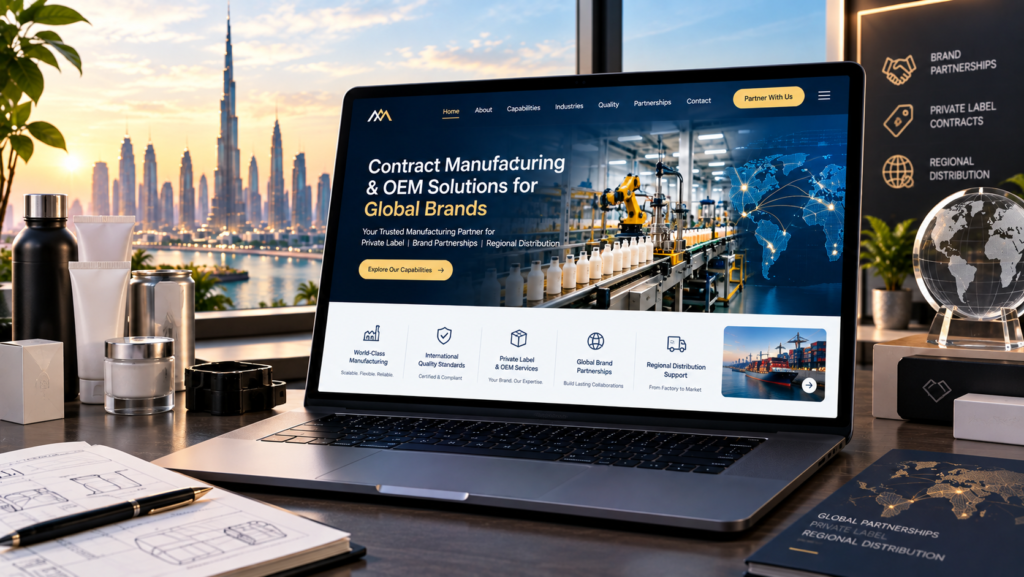
For Dubai contract manufacturers and OEM suppliers evaluating website design cost in Dubai, the website must serve a buyer who is making a considerably more consequential decision than a standard procurement manager. A brand owner considering a contract manufacturing partnership is evaluating whether to entrust their product formulation, their quality standards, and ultimately their brand reputation to an external manufacturer, often for a multi-year relationship worth millions of dirhams annually. A website that builds that level of trust before the first meeting is the specific commercial asset this blog explains how to create.

Dubai’s contract manufacturing and OEM supply sector spans a remarkably wide range of product categories. JAFZA and Dubai Industrial Park host contract manufacturers in personal care and cosmetics, food and beverage, nutraceuticals, cleaning products, industrial chemicals, printed packaging, and consumer electronics accessories, all serving both UAE-market brands and international brands using Dubai’s free zone infrastructure as their GCC and wider regional manufacturing base. The common thread across all of these categories is that the buyer, a brand owner, a private label retailer, or an OEM customer, is not buying a product. They are buying a manufacturing capability and a quality management system they can trust to consistently produce to their specification without requiring their constant oversight.

That trust relationship begins on your website, often before any direct contact has been initiated.

What a brand owner or private label buyer evaluates on a contract manufacturer website

A cosmetics brand director evaluating contract manufacturers for their UAE-produced private label skincare range runs a mental checklist during the first website visit: Does this manufacturer have experience with my product category? Do they hold the certifications required for my specific product type: GMP for cosmetics, Halal certification if I’m targeting GCC retail, organic certification if I’m targeting premium channels? What is their minimum batch size, and can they scale with my growth? Can I see evidence of the quality of their output, packaging standards, filling accuracy, and labelling compliance? And critically: have they worked with comparable brands whose quality expectations match mine?

Each of these questions corresponds to a specific website element. The contract manufacturer whose website answers all of them retains the brand director through the research process and earns the factory visit request that eventually becomes a partnership agreement.

8 elements every Dubai contract manufacturer website must have

Element 01
Manufacturing capabilities by product category – with specific process details
A contract manufacturer website organised by product category, Liquid Filling and Packaging, Powder Blending and Encapsulation, Cream and Lotion Manufacturing, Food Processing and Packaging, with specific process capability descriptions for each category provides brand owners with the immediate confirmation or elimination of fit that drives their shortlist decision. Within each category, specify: batch size range (minimum and maximum), primary packaging formats accommodated, filling accuracy specifications, clean room classification if applicable, and any regulatory or certification requirements specific to that product category. This specificity is the commercial intelligence that separates a serious contract manufacturer from a generic facility claiming broad capability.

Element 02
GMP, halal, organic, and product-specific certifications – with scope and validity
Good Manufacturing Practice certification, whether EU GMP, WHO GMP, or UAE Ministry of Health GMP for pharmaceutical and quasi-pharmaceutical products, is the baseline quality credential for any contract manufacturer handling products that enter regulated categories. Halal certification is non-negotiable for contract manufacturers supplying GCC retail. Organic certification is increasingly required for products marketed as natural or organic in premium retail channels. Each certification should be displayed with its scope (which product categories are covered), issuing body, current validity period, and, where possible, a QR code or link to verify the certificate in the issuing body’s public register.

Element 03
Formulation and R&D capability – for manufacturers offering product development
A contract manufacturer that offers formulation development alongside manufacturing capacity is providing a significantly more valuable service to a brand owner than one that requires the client to supply a complete specification. A dedicated R&D capability page, describing your formulation laboratory, the ingredient library you maintain, regulatory compliance knowledge for target markets (EU Cosmetics Regulation, GCC Standards), stability testing capability, and the typical timeline from brief to approved formulation, positions your facility as a development partner rather than a pure production subcontractor. This positioning commands higher margins and generates more durable client relationships.

Element 04
Quality control – testing equipment, methods, and release standards
A brand owner whose product is manufactured by a contract facility needs confidence that every batch released meets their specification. A quality control page that describes your in-process testing equipment, raw material incoming quality inspection procedures, finished product release testing standards, retained sample protocols, and certificate of analysis format provides the QC process transparency that sophisticated brand owners specifically evaluate. Contract manufacturers that can demonstrate their QC processes in detail, rather than simply asserting “high quality”, consistently win the partnerships that the most demanding brand owners award.

Element 05
Private label and white label services – what is included and what is not
Private label clients frequently arrive at contract manufacturer websites uncertain about what is included in a private label service. Does the manufacturer source and print the label? Do they provide stock formulations for rapid brand launch or only manufacture to custom specification? Do they manage regulatory documentation for the client’s target markets, or does the client handle this? Do they offer design services for packaging development, or does the client supply artwork ready for print? A clear, specific private label services page that answers each of these questions- what is included in the manufacturing service, what additional services are available at additional cost, and what the client is responsible for- reduces pre-contract scope misalignment that is the most common source of client dissatisfaction in contract manufacturing relationships.

Element 06
Client categories and brand tiers – communicating the partnership level you serve
A contract manufacturer that primarily serves regional startup brands has different capacity, quality infrastructure, and partnership expectations than one serving global consumer goods multinationals. Communicating the tier of client your facility is structured to serve, through the named brand references you display, the minimum batch sizes you specify, and the quality infrastructure you describe, helps prospective clients self-assess fit before initiating contact. A startup brand that approaches a manufacturer clearly structured for multinational clients will receive a minimum batch size requirement they cannot meet. A multinational brand that approaches a manufacturer whose quality infrastructure is insufficient for their regulatory requirements will identify the misfit during due diligence. Better to communicate fit clearly on the website than to discover misalignment after weeks of commercial conversation.

Element 07
Regulatory export capability – GCC, EU, USA, and emerging market compliance
A brand owner manufacturing in Dubai for export to Saudi Arabia, the European Union, the United States, or Sub-Saharan African markets needs a contract manufacturer that understands the regulatory compliance requirements for each target market, not one that produces to UAE standards and leaves the export compliance to the client. A regulatory capability page that specifies which export markets your facility is equipped to produce for, which regulatory frameworks you comply with for each (SFDA for Saudi Arabia, EU Cosmetics Regulation for European export, FDA 21 CFR for USA-bound products), and what documentation you can provide to support market registration in each territory positions your facility as a genuine export manufacturing partner.

Element 08
Partnership enquiry – structured for brand owner and private label evaluation
A brand owner or private label buyer enquiring about contract manufacturing services needs to provide specific information for a meaningful initial response: product category, target annual volume, packaging format, certifications required, target markets, and timeline to first production run. A structured partnership enquiry form that captures this information, alongside the enquirer’s brand or company name and their current manufacturing situation, delivers commercially actionable intelligence to your business development team and signals to the prospective client that your company is organised for professional partnership conversations rather than ad hoc production requests.

What a Dubai contract manufacturer website typically costs

  • Basic contract manufacturer site, capabilities, certifications, enquiry: AED 7,000–14,000
  • Full contract manufacturer site, category pages, QC section, private label, Arabic: AED 14,000–28,000
  • Premium OEM site, R&D capability, export compliance, brand partner section: AED 25,000–50,000
  • Annual content updates, certification renewals, and maintenance: AED 4,000–10,000/year

A real Dubai contract manufacturer result

A JAFZA-based contract manufacturer specialising in personal care and cosmetics, halal certified, EU GMP compliant, with export capability to 12 markets, had a website that listed “contract manufacturing and private label services” in a single paragraph with no category-specific capability detail, no certification display beyond a logo in the footer, no quality control description, and no private label service scope explanation. International brand owners conducting remote due diligence during COVID-era sourcing diversification found nothing on the website to distinguish the facility from lower-cost Asian alternatives. BootesNull rebuilt the site with capability pages for each of the four product categories the facility specialised in, EU GMP and halal certification display with validity dates, a QC process page with testing equipment specifics, a private label services page clarifying what was included versus client-supplied, a regulatory export capability section covering GCC and EU requirements, and a structured brand partnership enquiry form. Within 6 months, international partnership enquiries increased from 1 to 12 per month. Two European private label brands initiated factory visits based entirely on website research, both progressing to long-term manufacturing agreements within the following year.

FAQs

Q1. What is EU GMP certification and why does it matter for a Dubai contract manufacturer?
EU Good Manufacturing Practice certification, issued under EU Directive 2003/94/EC for pharmaceutical and cosmetics manufacturing, demonstrates that a facility meets the stringent quality management, documentation, validation, and hygiene standards required for products sold in the European Union and in markets that recognise EU GMP as a quality benchmark. For a Dubai contract manufacturer supplying brands that export to European markets, EU GMP certification removes a significant regulatory barrier that non-certified facilities cannot overcome. It also signals to brands targeting premium retail globally that the facility’s quality infrastructure exceeds UAE domestic standards, a meaningful commercial advantage in attracting quality-sensitive international clients.

Q2. How do Dubai contract manufacturers protect client formulations and intellectual property?
Through non-disclosure agreements executed before any formulation information is shared, access control to formulation records within the facility’s quality management system, dedicated production scheduling that prevents competing client products from being manufactured simultaneously on the same equipment without appropriate cleaning validation, and contractual IP ownership clauses that explicitly assign ownership of client-developed formulations to the client. A contract manufacturer website that describes its IP protection approach, even briefly, addresses a concern that every brand owner carries into a contract manufacturing evaluation, particularly those sharing proprietary formulations developed with significant R&D investment.

Q3. What minimum batch sizes are realistic for a Dubai personal care contract manufacturer?
Minimum batch sizes for liquid and cream products in Dubai’s contract manufacturing market typically range from 500 to 2,000 litres depending on the facility’s equipment and production planning economics. For powder products, nutritional supplements, dry cosmetics, minimums of 50 to 200 kilograms are common. These minimums are economically determined by cleaning validation costs, raw material ordering minimums, and production scheduling efficiency rather than by arbitrary policy. A contract manufacturer whose website specifies realistic minimum batch sizes by product category helps brand owners self-qualify before initiating commercial conversations that ultimately fail on minimum volume incompatibility.

Q4. How should a Dubai contract manufacturer handle requests for product formulation samples before a formal contract is signed?
Sampling requests before contract execution are standard in contract manufacturing evaluation, but should be managed within a clear framework: a signed NDA before any formulation information is exchanged, a sample development fee for custom formulation work (which may be credited against the first production run), and a written sample request that specifies the product category, target performance parameters, and intended market. Managing this process through a structured website pathway, rather than informally through a sales team, signals operational organisation and protects both parties’ interests from the earliest stage of the relationship.

Q5. Is GITEX or Beautyworld Middle East more relevant for a Dubai personal care contract manufacturer seeking new brand partnerships?
Beautyworld Middle East, held annually in Dubai, is the more directly relevant event for personal care contract manufacturers, as it attracts the brand owners, distributors, and retail buyers who are the primary audience for contract manufacturing partnerships in this category. In-Cosmetics, when it visits the region, reaches cosmetic ingredient suppliers and formulation specialists. GITEX is more relevant for manufacturers of technology-adjacent products. Attending the most relevant industry events and ensuring your website can be found and evaluated by event contacts immediately after meeting, through prominent Google rankings for your key capability searches, makes event investment compound far beyond the exhibition floor.

Dubai’s contract manufacturing market rewards facilities whose websites communicate the same precision and reliability their production lines are built to deliver. A brand owner considering a multi-year, high-volume manufacturing partnership makes that decision based on the evidence they can find about your quality systems, certifications, and client track record, long before they set foot in your facility. The right website design cost in Dubai investment for a contract manufacturer makes every piece of that evidence specific, current, and independently verifiable, so that the factory visit that follows is a confirmation of what the website already established, not a discovery process that the website should have completed.

Leave a Reply

Your email address will not be published. Required fields are marked *