Choosing the right grout is an important part of a durable and clean-looking kitchen. While grout may appear to be a small detail between tiles, it helps protect joints from moisture, stains, dirt, and everyday wear. Two commonly considered options are epoxy grout and cement-based grout.
For homeowners, contractors, and tile installers, the question is simple: which is better—epoxy grout or cement grout for a kitchen?
The answer depends on where the grout will be used, the expected exposure to moisture and stains, maintenance requirements, budget, and installation conditions. In many demanding kitchen applications, epoxy grout for kitchen areas can provide advantages because of its low porosity and resistance to stains and moisture. However, cementitious options can still be practical for suitable applications when correctly selected and installed.
This guide explains the differences between the two, their advantages and limitations, and how to choose the right grout for different kitchen surfaces.
What Is Grout and Why Does a Kitchen Need It?
Tile grout is the material used to fill the joints between tiles. It helps create a finished tiled surface while reducing the amount of dirt and moisture that can accumulate in open joints.
Kitchen surfaces can experience frequent exposure to:
- Water and steam
- Cooking oils and food spills
- Cleaning chemicals
- Grease and stains
- Temperature changes
- Regular foot traffic on kitchen floors
Because of these conditions, selecting an appropriate grout is particularly important around sinks, countertops, backsplashes, walls, and floors.
Products such as polymer modified grout can improve certain performance characteristics of traditional cement-based grout, while epoxy formulations provide a different approach based on resin and hardener components.
What Is Epoxy Grout?
Epoxy grout is generally a two- or three-component system containing epoxy resin, hardener, and aggregate/filler. Unlike conventional cement-based grout, it does not rely primarily on cement hydration to develop its properties.
One of its important characteristics is low water absorption after proper curing. This can make epoxy grout for kitchen applications particularly useful in areas where resistance to stains and moisture is important.
Key Characteristics of Epoxy Grout
- Low porosity
- High resistance to many common stains
- Good moisture resistance
- Strong adhesion when properly installed
- Easier cleaning in many applications
- Suitable for demanding tiled areas
However, epoxy grout also requires careful mixing, application, and cleaning. Once it begins curing, removing excess material from tile surfaces can become considerably more difficult.
What Is Cement Grout?
Cement-based grout, often called cementitious grout, consists primarily of cement, aggregates, and other additives. Depending on the formulation, it may be modified with polymers to improve flexibility, adhesion, water resistance, or durability.
A polymer modified grout can therefore offer better performance than a basic unmodified cement grout.
Cement grout remains widely used because it is relatively easy to work with, available in different grades and colors, and generally more economical than epoxy alternatives.
What Does “Cementitious Grout Unsanded” Mean?
Cementitious grout unsanded refers to a fine cement-based grout without sand as the primary aggregate. It is generally associated with narrower tile joints and applications where a smoother grout texture is desirable.
The appropriate grout should always be selected according to the manufacturer’s stated joint-width range and the tile installation requirements rather than choosing solely based on appearance.
Epoxy Grout vs Cement Grout: Key Differences
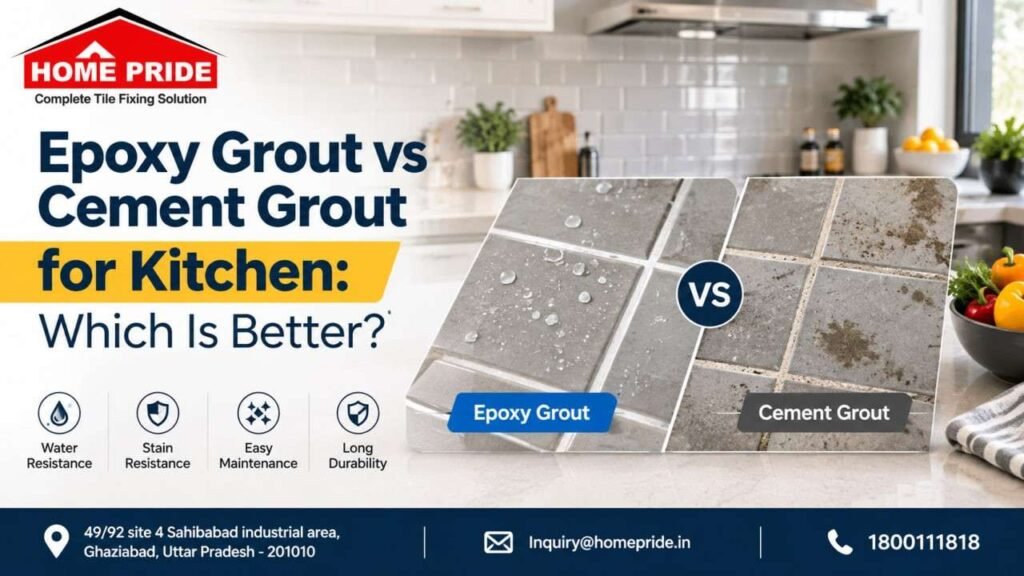
The biggest differences involve moisture absorption, stain resistance, maintenance, application, and cost.
| Feature | Epoxy Grout | Cement-Based Grout |
| Water absorption | Very low after curing | Generally higher |
| Stain resistance | High | Depends on formulation and sealing |
| Cleaning | Generally easier | Can require more maintenance |
| Installation | Requires careful handling | Generally easier |
| Cost | Usually higher | Usually lower |
| Maintenance | Lower in many applications | May require sealing/maintenance |
| Chemical resistance | Generally strong | Varies by product |
| Suitable for kitchen | Excellent for demanding areas | Suitable for many standard areas |
The exact performance depends on the specific product formulation, tile type, joint width, substrate, installation method, and manufacturer’s instructions.
Why Consider Epoxy Grout for Kitchen Areas?
A kitchen is one of the places where grout can face repeated staining and moisture exposure. This is one reason homeowners and professionals consider epoxy grout for kitchen installations.
1. Better Resistance to Stains
Cooking areas can be exposed to oil, sauces, beverages, spices, and food particles. Porous grout can absorb certain substances if it is not adequately protected.
Properly installed epoxy grout has low porosity, which can make it easier to clean after common kitchen spills.
2. Lower Water Absorption
Areas near sinks and wet countertops can experience repeated water exposure. Epoxy grout’s low absorption can help reduce moisture penetration through the grout joints.
This does not mean that epoxy grout makes an entire tiled assembly waterproof. Waterproofing must be addressed separately through the correct substrate preparation and waterproofing system where required.
3. Easier Routine Maintenance
Because cured epoxy grout is generally less porous, dirt and stains may be less likely to penetrate deeply into the grout surface.
Regular cleaning is still necessary, but the grout can be easier to maintain in heavily used kitchen areas.
4. Good Durability
A properly selected and installed epoxy grout can provide durable joints in demanding applications. This can be particularly useful for kitchen floors and areas that experience frequent cleaning.
5. Useful for Backsplashes and Wet Zones
Kitchen backsplashes around sinks and preparation areas can benefit from a grout with good resistance to moisture and staining.
For these areas, epoxy grout can be considered when its performance characteristics justify the additional installation effort and cost.
When Is Cement Grout a Practical Choice?
Epoxy is not automatically necessary for every kitchen.
A quality polymer modified grout can be suitable for many residential tile installations, particularly where exposure to severe staining or constant moisture is limited.
Cement-based grout may make sense when:
- The project has a tighter budget.
- The area has relatively normal moisture exposure.
- The installer is more experienced with cementitious materials.
- The grout will be properly sealed when required.
- The product matches the tile joint width and application.
For example, a dry kitchen wall with limited exposure may not require the same grout specification as a frequently wet area around a sink.
What About Grout Admixture?
A grout admixture is an additive or liquid component used with certain cement-based grout systems to modify specific properties. Depending on the product, admixtures may improve characteristics such as flexibility, adhesion, water resistance, or workability.
However, admixtures should not be added randomly to cement grout. Always follow the manufacturer’s formulation and mixing instructions. Using incompatible additives can negatively affect grout performance.
This is an important distinction between selecting a ready-formulated grout and attempting to modify a basic material on site.
Epoxy Grout vs Cement Grout for Kitchen Floors
Kitchen floors experience foot traffic, food spills, regular mopping, and abrasion. Grout selection should therefore consider both durability and maintenance.
Epoxy grout for kitchen floors can be advantageous where stain resistance and easy maintenance are priorities.
Cement-based grout can also perform well when the correct grade is selected, joints are properly prepared, and the grout is installed according to specifications.
For flooring, don’t select grout based only on its name. Consider:
- Tile type
- Joint width
- Expected traffic
- Moisture exposure
- Cleaning frequency
- Manufacturer’s application recommendations
Epoxy Grout vs Cement Grout for Kitchen Backsplash
Backsplashes typically have less mechanical stress than floors but can have significant exposure to cooking splashes, oils, sauces, and water.
This makes stain resistance particularly relevant.
Epoxy grout for kitchen backsplashes can be useful where the homeowner wants grout joints that are easier to maintain and less susceptible to staining.
Cement-based grout remains a viable alternative when properly specified and maintained.
Is Epoxy Grout Always Better?
Not necessarily.
The word “better” depends on the application’s requirements.
Epoxy grout can offer superior resistance to moisture and staining, but it typically costs more and requires greater installation precision. Cement grout is generally more forgiving during application and can be a cost-effective choice for many standard installations.
For example, using epoxy grout in every area purely because it has higher performance characteristics may increase project cost without providing a meaningful benefit in a low-exposure area.
The better approach is to match grout performance to actual site conditions.
How to Choose the Right Grout for Your Kitchen
Before purchasing grout, check these factors:
1. Identify the Tile Location
Determine whether the grout will be used on a floor, backsplash, wall, countertop, or near a sink.
2. Check Joint Width
Different grout products are designed for different joint widths. Follow the manufacturer’s technical specifications.
3. Consider Moisture Exposure
Areas regularly exposed to water may require a grout with stronger moisture-resistance characteristics.
4. Consider Staining
If the kitchen frequently handles oils, sauces, and food products, stain resistance becomes more important.
5. Check Cleaning Requirements
For busy kitchens, easy maintenance can be a major consideration.
6. Follow Installation Instructions
Even high-performance grout can fail if the joints are contaminated, incorrectly mixed, improperly filled, or inadequately cured.
7. Consider Total Project Cost
Don’t compare only the price of a bag or kit. Consider material quantity, labor, preparation, installation difficulty, maintenance, and expected service life.
Home Pride’s range of construction and tile-related solutions can be evaluated according to the specific requirements of the installation rather than selecting a product simply because it is labeled as epoxy or cement-based.
Common Mistakes to Avoid
Several mistakes can reduce grout performance regardless of the product type.
Using the wrong grout for the joint width: Every grout has application limitations.
Adding too much water: Incorrect water ratios can affect cementitious grout strength, consistency, and appearance.
Skipping surface preparation: Dirty or improperly prepared joints can compromise bonding and finishing.
Leaving epoxy residue on tiles: Epoxy must be cleaned according to the manufacturer’s instructions before it fully cures.
Ignoring curing requirements: Grout needs appropriate time and environmental conditions to develop its intended properties.
Assuming grout is waterproofing: Grout alone should not be treated as a substitute for a proper waterproofing system.
Final Verdict: Epoxy or Cement Grout for Kitchen?
For kitchens where stain resistance, low water absorption, durability, and easy maintenance are major priorities, epoxy grout for kitchen applications can be a strong option.
For standard installations where budget, ease of application, and normal service conditions are more important, a properly selected polymer modified grout or other suitable cement-based grout can be appropriate.
The right choice ultimately depends on the tile type, joint width, exposure conditions, expected traffic, maintenance requirements, and manufacturer’s technical recommendations.
Rather than asking which grout is universally better, ask: which grout provides the performance required for this specific kitchen installation?
That approach leads to a more reliable and cost-effective tile installation. Home Pride emphasizes the importance of selecting construction materials according to application requirements, installation conditions, and technical specifications rather than relying on a one-size-fits-all solution.
Frequently Asked Questions
1. Is epoxy grout better than cement grout for kitchen tiles?
Epoxy grout can provide advantages in kitchen applications because of its low porosity, stain resistance, and moisture resistance. Cement-based grout can still be suitable for many kitchens when the correct product is selected and properly installed.
2. Is epoxy grout for kitchen floors worth the extra cost?
It can be worth considering when the floor experiences frequent spills, heavy cleaning, or demanding use. Its higher initial cost should be compared with its maintenance requirements and expected performance.
3. Can epoxy grout be used for a kitchen backsplash?
Yes. Epoxy grout for kitchen backsplashes can be suitable, particularly where resistance to stains, water, and frequent cleaning is important. Always check compatibility with the tile and follow the grout manufacturer’s instructions.
4. What is the difference between polymer modified grout and epoxy grout?
Polymer modified grout is generally cement-based with polymer additives that improve selected properties. Epoxy grout uses epoxy resin and a hardener system. They differ in formulation, application, maintenance, and performance characteristics.
5. Can cement grout be used in a kitchen?
Yes. Suitable cementitious grout can be used in many kitchen applications. Product selection should consider joint width, moisture exposure, tile type, traffic, and the manufacturer’s recommendations. Where required, sealing and regular maintenance can help protect cement-based grout.
Home Pride recommends evaluating the complete tile installation—including substrate, tile, joint dimensions, grout type, and installation conditions—to achieve consistent and durable results.
For More Information Click Here:- https://homepride.in/