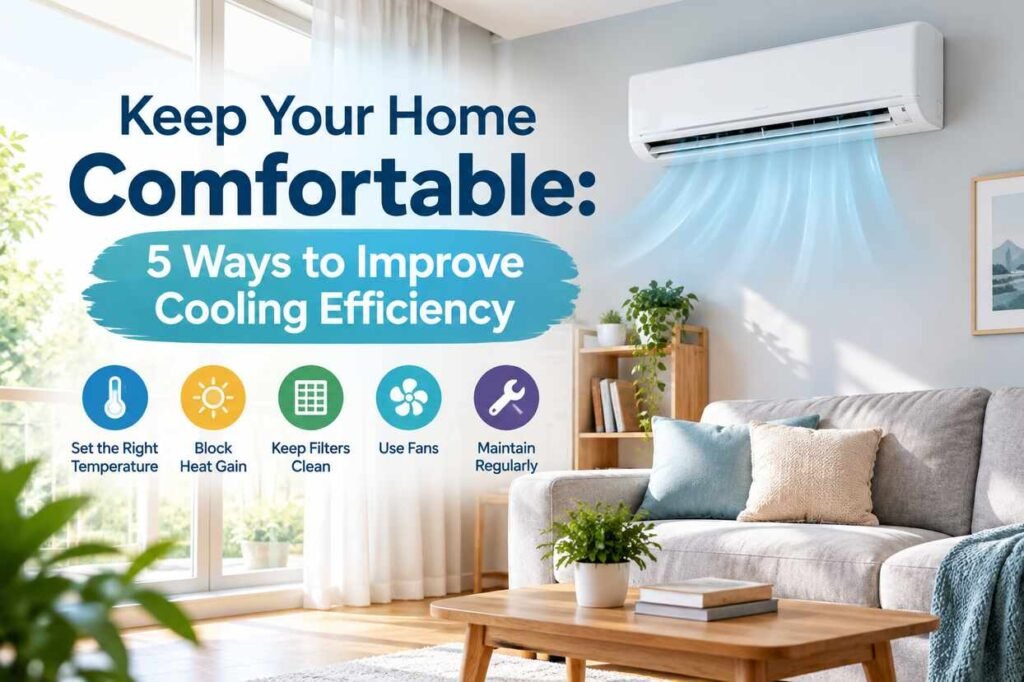
Keep Your Home Comfortable: 5 Ways to Improve Cooling Efficiency
Keep Your Home Comfortable: 5 Ways to Improve Cooling Efficiency – Keeping your home cool and comfortable does not always mean running the air conditioner at its lowest temperature. In fact, cooling efficiency depends on several factors, including how well your home prevents heat from entering, how effectively your AC circulates air, and how regularly the system is maintained. Smart cooling habits can improve comfort while helping reduce unnecessary energy consumption. For homeowners who rely on air conditioning during hot weather, improving efficiency can be as simple as making a few changes to daily routines. Here are five practical ways to keep your home comfortable while getting more from your cooling system.


1. Set the Air Conditioner to a Practical Temperature

One of the easiest ways to improve cooling efficiency is to avoid setting the thermostat unnecessarily low. Many homeowners assume that choosing a very low temperature will cool a room faster, but an AC still has a specific cooling capacity. A lower setting generally means the system needs to operate longer to reach that target. A moderate temperature can provide a better balance between comfort and energy use. Depending on your climate, personal comfort, and humidity level, a setting around 25°C to 27°C can be a practical starting point. Energy-saving guidance from Australia’s Department of Energy recommends operating air conditioners within this range and notes that higher temperature settings can reduce energy consumption. You can also use a timer or programmable thermostat to reduce cooling when the room is unoccupied. This prevents the AC from operating unnecessarily for long periods.

2. Reduce Heat Gain Through Windows and Doors

Even an efficient air conditioner has to work harder when a home continuously absorbs heat from outside. Windows are a major source of solar heat gain, particularly when direct sunlight enters rooms during the hottest part of the day. Use curtains, blinds, shades, or solar-control window film to reduce the amount of heat entering your home. Closing window coverings during periods of intense sunlight can make the indoor environment more comfortable and reduce the cooling load. Doors and windows should also remain closed while the AC is operating. Gaps around frames can allow warm outdoor air to enter and conditioned air to escape. Sealing obvious air leaks and improving insulation can therefore support more efficient cooling. The U.S. Department of Energy recommends combining insulation, efficient windows and doors, shading, and appropriate ventilation to reduce cooling requirements.

3. Keep AC Filters and Components Clean

Regular maintenance is essential for maintaining efficient air conditioning performance. A dirty filter can restrict airflow, forcing the system to work harder while potentially reducing its ability to cool the room effectively. Check your AC filter regularly, especially when the unit is used frequently. ENERGY STAR recommends checking filters monthly during periods of heavy use and replacing or cleaning them when necessary; at minimum, filters should generally be changed according to the manufacturer’s instructions and usage conditions. Other components also deserve attention. Dust and debris around outdoor condenser units can restrict airflow, while dirty coils may reduce heat transfer. Drain lines should remain clear so condensation can leave the system properly. For more complex maintenance, such as coil cleaning, refrigerant issues, electrical inspection, or unusual system performance, professional AC servicing is preferable to attempting repairs without the appropriate knowledge.

4. Improve Air Circulation With Fans

An air conditioner does not necessarily need to do all the work. Fans can improve air movement and help distribute cooled air throughout a room. Ceiling fans, wall fans, and portable fans can make occupants feel more comfortable by increasing air movement across the skin. The U.S. Department of Energy explains that fans create a cooling effect for people rather than actually lowering the temperature of the room. Therefore, fans should be switched off when nobody is using the space. Using a fan together with an AC can also help circulate conditioned air more effectively. This may allow you to maintain comfort without relying on an extremely low thermostat setting. However, fan placement matters. Avoid blocking the airflow path with large furniture, and position fans so that they circulate air toward occupied areas rather than simply blowing against walls.

5. Schedule Regular AC Maintenance

Even if an air conditioner appears to be working normally, periodic maintenance can help preserve efficiency and reliability. Over time, dust, dirt, restricted airflow, worn components, and drainage problems can affect cooling performance. A professional inspection can identify problems before they become more serious. Routine maintenance may include checking filters, indoor and outdoor coils, electrical components, airflow, drainage, and other important parts of the system. Annual HVAC maintenance is recommended by ENERGY STAR as part of an efficient heating and cooling strategy. Regular maintenance can also help identify declining performance early, potentially reducing the likelihood of unexpected breakdowns during periods of heavy use.

Build a More Efficient Cooling Routine

Improving home cooling efficiency does not require complicated changes. Start by using a reasonable thermostat setting, blocking excessive sunlight, keeping doors and windows closed while the AC is operating, maintaining clean filters, and using fans to improve air circulation. It is equally important to understand that cooling efficiency is influenced by the entire home, not just the air conditioner. Insulation, windows, shading, ventilation, room layout, and appliance use can all affect indoor temperatures. Ac 1/2 pk – By combining good home design practices with responsible AC operation and regular maintenance, homeowners can create a more comfortable indoor environment without unnecessarily increasing energy use. The goal is not simply to make a room colder, but to create consistent comfort through smarter and more efficient cooling.

Leave a Reply

Your email address will not be published. Required fields are marked *