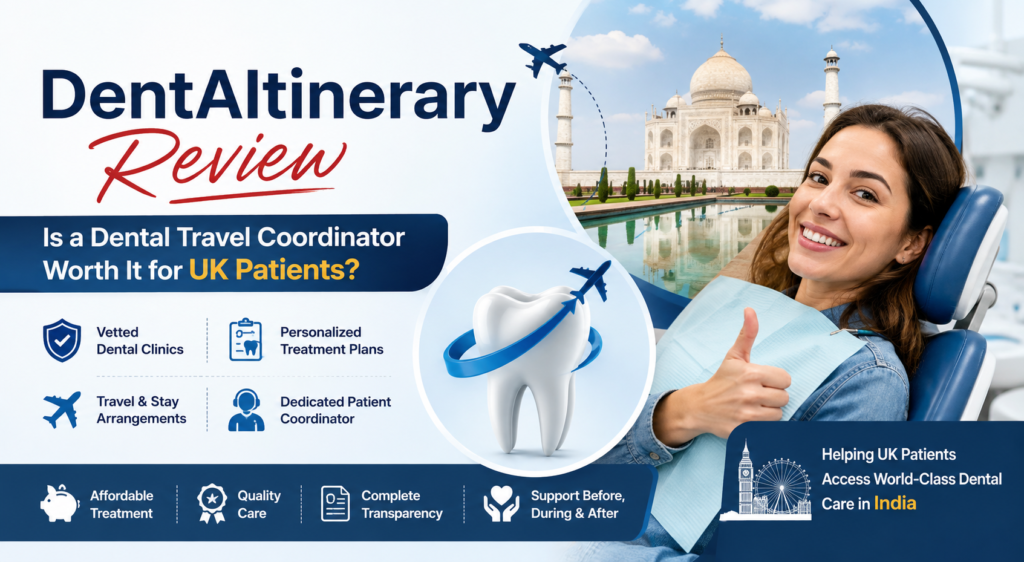
DentAItinerary is a technology platform and concierge service (not a dental clinic) that connects international patients – here, UK residents – with independent, accredited dental clinics in India. Founded to bridge the gap between India’s high-quality, low-cost dentistry and foreign demand, the company offers an AI-driven itinerary planner and a live human coordinator.
Patients use DentAItinerary’s online tool to request specific treatments (e.g. implants, crowns). The platform then matches the case with up to three vetted partner clinics, arranging quotes based on the patient’s records. If the patient proceeds, DentAItinerary holds the treatment slot and manages bookings. From first inquiry to aftercare, each patient gets a dedicated WhatsApp coordinator who handles flights, hotels, transfers, and clinic scheduling. Crucially, DentAItinerary fixes the price in writing before travel, eliminating post-arrival “surprise billing”. Payment (in GBP) is collected in two stages (30% deposit, then 70% before travel), with a modest non-refundable coordination fee (~USD150) included.
In short, DentAItinerary bills itself as a full-service facilitator: it does not provide any dental treatment or employ dentists. All clinical decisions remain with the treating dentist at the chosen clinic. DentAItinerary’s role is to plan and coordinate the trip – from creating a preliminary travel itinerary (often in just 60 seconds of input) to ensuring paperwork, visas, and aftercare instructions are handled.
How DentAItinerary Works
The typical process starts with the patient describing their needs online. DentAItinerary’s AI itinerary tool generates a provisional schedule (treatment steps, clinic suggestions, travel plan). Submitting this request is non-binding and triggers DentAItinerary to share the patient’s anonymized clinical records with partner clinics. Clinics then review the case (x‑rays, history) and provide treatment proposals. DentAItinerary assembles a detailed quotation with day-by-day itinerary, itemized costs, and clinic profiles.
Once a quote is accepted, the patient pays a confirmation fee (credited toward the total), and an introductory call with the surgeon is arranged. Within 15 days the patient completes a 30% deposit, at which point the booking is confirmed and clinic details are disclosed. The price is then locked. All further arrangements – flights, hotels, local transfers, and scheduling – are coordinated by DentAItinerary. The remaining 70% is paid before flying, so that the patient arrives in India knowing the itinerary and full cost.
During the trip, DentAItinerary’s coordinator is available (by WhatsApp) to handle any logistics or questions. Notably, DentAItinerary enforces its Deviation Protocol for unexpected findings: if the dentist discovers new issues mid-treatment (e.g. hidden infection or bone loss), treatment is paused and the coordinator presents fixed-price options, giving the patient up to 6 hours to choose without pressure. This is designed to avoid last-minute upselling and ensure consent for any extra work.
In sum, DentAItinerary functions as an end-to-end planner: it collects your case, secures a pre-agreed price, books your trip, and stays by your side – but it does not practice dentistry itself. All care is delivered by the partner clinic and their staff, and DentAItinerary is not a healthcare provider.
Clinic Vetting & Safety
Patient safety depends heavily on clinic quality. DentAItinerary claims a strict vetting process: only the top ~1% of Indian clinics join their network. Key criteria, overseen by a medical advisory board, include dentist qualifications and accreditation. Every partner clinic must have lead dentists with a Master of Dental Surgery (MDS) degree in the relevant specialty (e.g. prosthodontics for implants) and at least 10 years’ experience. Clinics must possess on-site imaging (e.g. CBCT) and lab facilities, and a track record of international patient treatments (with documented outcomes).
Importantly, DentAItinerary emphasizes NABH accreditation. NABH (National Accreditation Board for Hospitals) is India’s healthcare quality authority; a dental clinic meeting NABH standards has high-level protocols for sterilization, record-keeping, and patient safety. (For context, some other popular dental-tourism countries have no equivalent body, making NABH a useful benchmark.) The website advises patients to verify any NABH claim on the official portal, since accreditation is time-limited.
In practice, this means DentAItinerary’s clinics are often comparable to Western private practices. They use premium implant brands (Nobel Biocare, Straumann, etc.) and follow global surgical protocols. Many of their dentists have international training (e.g. fellowships in the UK or Europe). The advisory board itself includes former NABH chairman Prof. Mahesh Verma, lending institutional rigor to vetting.
For UK patients, it is reassuring that both the NHS and General Dental Council (GDC) recognize planned dental care abroad as a valid option if done properly. NHS guidance encourages patients to confirm that any foreign clinic “meets standards equivalent to UK practice” and to arrange home follow-up. DentAItinerary’s focus on NABH and specialist dentists aligns with these recommendations. In short, the platform claims that by using their service you get accredited clinics and transparent records – but patients should still do their own due diligence (checking credentials, licenses, and patient reviews) before booking, as with any cross-border care.
Cost Comparison: UK vs India
A main attraction of dental tourism is lower fees in India. The figures below (Table 1) give illustrative ranges for common procedures in 2026, drawing on DentAItinerary’s research and industry data. All amounts are per procedure/patient, and UK figures are for private clinics (NHS generally does not fund implants or cosmetic work).
| Treatment | India (approx.) | UK Private (approx.) |
|---|---|---|
| Single implant + crown | £160–£800 | £1,500–£3,800 |
| All-on-4 (per arch) | £3,400–£4,800 | £10,000–£18,000 |
| Full-mouth (both arches) | £6,200–£9,200 | £20,000–£36,000 |
| Porcelain veneer (per tooth) | £145–£210 | £500–£1,800 |
| Zirconia crown (per tooth) | £80–£180 | £400–£1,200 |
Table 1: Indicative cost ranges for dental procedures in India vs the UK (2026). Sources: DentAItinerary data and UK dental industry surveys.
These numbers align with multiple analyses: for example, DentAItinerary notes single implants (with crown) run only a few hundred pounds in India vs up to ~£3,800 in London. All-on-4 arch treatments (whole jaw) may cost £3–5k in India versus over £10k in the UK. Savings are similarly steep for veneers and crowns.
Table 1 does not include travel expenses. A typical quote from India for four implants might be £3,000–£6,500 all-in (including flights ~£500–£900, hotel ~£400–£900, plus visa, insurance and contingencies). The equivalent UK private treatment alone would be roughly £8,000–£14,000. Thus, even with trip costs, patients often see 50–65% net savings on multiple-implant cases. For very extensive cases (full-mouth restoration), the difference can reach tens of thousands (£15k–£25k saved on a full set of implants).
That said, smaller procedures (e.g. a single filling or crown) usually don’t justify travel: the flight and hotel could cost more than the treatment itself. DentAItinerary’s own guidance cautions that only “multi-unit” cases (multiple implants, full smile makeovers, etc.) typically justify the trip.
Treatment Timelines
Dental treatments in India generally follow a two-phase timeline. Phase 1 (surgical trip): Patients fly to India and spend around 7–14 days undergoing the main treatment and initial recovery. For implants, this might involve 1–2 days of surgical procedures followed by a week of healing and any temporary prosthesis placement. For example, one illustrative itinerary might be:
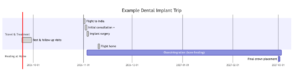
After the first trip, implants must osseointegrate, which takes roughly 3–6 months. Patients usually return home during this period. According to DentAItinerary, most implant patients need a second short visit for final prosthetic work once healing is complete. These steps mirror standard implant protocols worldwide: the difference is simply that travel is split into multiple phases. DentAItinerary coordinators typically help schedule the timing so that home dentists can follow up in between, if necessary.
For procedures not involving implants (e.g. crowns or veneers only), the schedule may involve one trip of about a week. All timelines assume no unexpected delays; any added treatments would follow the same protocols (and invoke the Deviation Protocol if beyond the original plan). In practice, patients should plan for up to two trips if they want a “complete” outcome, and build 4–6 months into their overall timeline.
Deviation & Aftercare Policy
DentAItinerary places strong emphasis on transparency if the clinical plan changes. Its formal Deviation Protocol defines a deviation as “any additional procedure” discovered necessary during treatment that was not identifiable beforehand. In such cases, the clinic pauses non-emergency work and promptly alerts the coordinator. The coordinator then reviews the finding with you and presents the fixed-price additional procedure along with the choice to accept or decline. You have up to six hours to decide. If you accept, you pay only that pre-agreed price and treatment resumes. If you decline, the clinic continues with the original plan only.
This protocol means there are no “surprise bills” mid-procedure, as long as you follow DentAItinerary’s process. Patients are explicitly instructed not to agree to any extras without coordinator involvement. By design, this echoes NHS advice to get any changes in writing.
For aftercare, DentAItinerary’s Terms guarantee that complete records are provided before you leave India. This includes pre- and post-op X-rays, treatment notes, implant lot numbers, prescriptions, and a written aftercare plan. These digital records are uploaded to your portal and meant to be shared with your UK dentist. The platform also commits to 12 months of free remote follow-up: if any concerns arise within a year, they will arrange a tele-consultation with the treating clinic (at no extra coordination fee).
Clinics typically offer their own warranties on implants and prosthetics, but these usually do not cover travel for re-treatment. If a return trip is clinically needed under warranty, DentAItinerary says it will coordinate a reduced-fee booking, but you pay the airfare/hotel. Notably, DentAItinerary itself does not fund complications or new travel – its liability is limited to the coordination fee. Patients are explicitly advised to carry travel insurance that covers dental issues abroad.
In short: DentAItinerary provides structured provisions for aftercare and documentation that many independent dental-tourism packages lack. However, the ultimate clinical responsibility remains with the treating dentist, and patients must plan for the possibility of arranging UK follow-up (and additional travel) if problems occur.
Pros and Cons
Pros:
- Cost Savings: Major advantage is affordability. By using Indian clinics, patients can often save 60–80% off equivalent UK prices. For cases like multiple implants or smile makeovers, these savings can be life-changing.
- Vetted Specialists: DentAItinerary’s clinics have credentialed, internationally trained dentists using top implant brands. NABH accreditation and modern facilities are common, giving UK patients confidence in clinical standards.
- Fixed Pricing & No Hidden Fees: Prices are locked in writing before travel. The coordination fee is transparent and non-refundable only under limited conditions.
- Dedicated Coordination: A single point of contact (often 1-on-1 via WhatsApp) manages everything, from flights to clinic appointments. This reduces the risk of the common pitfalls noted in uncoordinated travel (missing records, unapproved extra work, lack of follow-up).
- Applicable UK Guidance: NHS and GDC encourage verification of credentials for overseas care. A DentAItinerary trip, done as suggested (NABH clinic, documented plan, UK follow-up), follows these checklists closely.
Cons:
- Travel and Time Off: The patient must travel ~9 hours and stay 1–2 weeks. This can be challenging for some (work, family, mobility). Travel adds costs (visa, insurance) on top of treatment price.
- Not a Quick Fix for Minor Issues: As DentAItinerary notes, single fillings or routine cleanings are not economical to outsource. Small savings may be negated by trip overhead. It’s mainly for extensive treatments.
- Medical/Safety Risks: Traveling with an open procedure has inherent risks. Patients must have proper travel insurance that covers dental complications. Not all UK dentists accept foreign work, so ensuring a UK follow-up dentist is an extra step.
- Patient Responsibility: DentAItinerary explicitly states it is not liable for clinical outcomes. If something goes wrong, the patient’s recourse is via the clinic’s warranty or filing a complaint to the Dental Council of India, not to DentAItinerary. This is the standard model for dental tourism – the platform facilitates but does not replace clinical accountability.
- Cultural/Communication Factors: Although English is widely spoken in Indian clinics and staff is international-minded, some patients may be uneasy with a foreign healthcare system. Time zone delays or differing regulatory practices could cause confusion if not managed carefully.
- Quality Variation: While DentAItinerary vets its clinics, no system is perfect. Patients still need to ask the right questions (see checklist below) to ensure the specific dentist and facility suit their case.
In sum, DentAItinerary aims to mitigate many known dental tourism pitfalls. Independent analysts (and patient discussions) note that coordinated services with credential checks (like DentAItinerary) address most risks. But it is not an assured guarantee of success, and UK patients must do their part (full medical disclosure, insurance, picking credible options).
Who It Suits?
DentAItinerary is targeted at UK adults with significant, elective dental needs that the NHS will not cover. This includes multiple missing teeth requiring implants, All-on-4 or full-arch restorations, smile makeovers, or complex treatments. Patients often consider this path after being unable to find an NHS dentist or being told certain treatments aren’t funded.
Specifically, DentAItinerary’s own “who this is for” list includes: patients needing 2+ implants, All-on-4, or full-mouth rehab, who can take about 1–2 weeks off and have stable health (no uncontrolled conditions like severe diabetes or active cancer). It is not for single fillings or minor dental work. Also, any urgent or infectious cases that require prompt UK NHS attention should not wait for a tourist trip.
Given UK context, this makes sense: over 13 million adults in England currently cannot access NHS dental care, and the NHS generally does not fund implants, veneers, or other cosmetic/restorative procedures. Patients who have exhausted NHS options or face multi-year waits often investigate abroad. For those people, India can be a practical alternative rather than a last resort.
10 Key Questions to Ask Any Dental Clinic Abroad
Before booking, UK patients should verify crucial information directly with the clinic (preferably in writing). Key questions include:
- NABH Accreditation: “Is the clinic NABH-accredited and current? Can I verify your accreditation number on the NABH portal?”. (Patients should confirm this themselves online, as NABH status can lapse.)
- Dentist Credentials: “Who exactly will perform my treatment? What are their qualifications (MDS or fellowship) and Dental Council of India registration number?”. Insist on the names and credentials of the specific specialists treating you.
- Implant Brand & Traceability: “Which implant system/brand will you use? Will you provide the batch numbers and manufacturer documentation?”. Reputable clinics will record implant lot numbers to ensure authenticity.
- Included Procedures: “Can I get a written, itemised treatment plan and quote? Please list implant body, abutment, crown, any bone grafts, CBCT scans, temporary teeth, and follow-up visits separately.”. This checks that nothing is omitted from the estimate.
- Scans and Visits: “Will I need a CBCT scan or any diagnostics pre-surgery? Are those included? How many clinic visits and days should I plan?”.
- Deposit & Cancellation Policy: “What deposit is required to secure dates? What are the refund/cancellation terms if I change my mind before travel?”. Understand exactly what you’ll lose if you cancel.
- Plan Changes/Deviation: “If you discover I need extra work during surgery, what is your protocol? How will costs be approved and communicated?”. The clinic should agree to pause and get your written consent for any extras.
- Warranty & Aftercare: “What warranties do you offer on the implant components and prosthesis, and for how long? What would void the warranty?”. Also ask if they will coordinate remote follow-up or provide a UK contact if problems arise.
- Records Package: “Will you supply a full records pack (treatment report, pre/post X-rays, scan files, implant details, prescriptions) before I return home?”.
- Clinic Experience with Foreign Patients: “How often have you treated international patients (especially UK)? Can you provide any references or testimonials? Are your staff fluent in English?”
These questions ensure transparency. No responsible clinic should hesitate to answer them clearly. If the clinic resists providing written answers or avoids any of these topics, that is a red flag.
DentAItinerary offers a structured, one-stop solution for UK patients seeking affordable dental care in India. By combining vetted clinics, fixed pricing, and a dedicated coordinator, it addresses many pitfalls of “DIY” dental tourism. Official sources (NHS, GDC, BDA analysis) acknowledge that treatment abroad can be safe if standards are checked and follow-up arranged. DentAItinerary’s model aligns with this guidance by enforcing checks (NABH, MDS dentists) and documentation.
However, this route is not a casual consumer choice. It requires careful preparation: verifying credentials, obtaining insurance, consulting UK dentists, and understanding that outcome liability lies with the clinic, not the platform. Patients must weigh the obvious cost and availability benefits against the time, travel, and potential risks. For those with extensive treatment needs and limited UK options, DentAItinerary may make clinical and financial sense. But it is crucial to do independent research, ask hard questions (see checklist above), and budget for contingencies.
If you consider DentAItinerary, first have your UK dentist evaluate your case. Use DentAItinerary’s tools to get initial quotes, but remember those are indicative. Confirm all details with the selected clinic, and make sure you understand the contract (including deviation and cancellation clauses). In the end, DentAItinerary is a facilitator — success depends on both their organization and your due diligence.