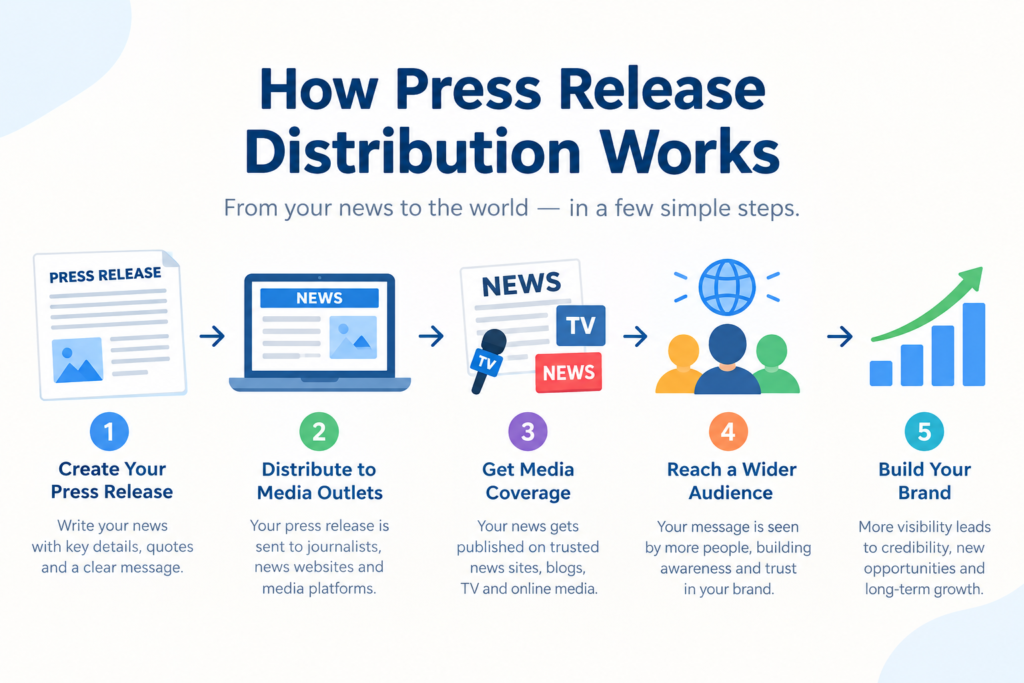
Press releases remain a useful communication tool for organizations that need to share timely, newsworthy information with journalists, media outlets, industry publications, and the public. While the format has changed considerably with digital media, the basic purpose remains the same: provide accurate information about a significant development in a format that can be reviewed and potentially reported on by relevant media.
Understanding PR Distribution is important for businesses, nonprofits, startups, public institutions, and other organizations that want to communicate news beyond their own websites or social media channels. Distribution is more than simply publishing a document online. It involves preparing the announcement, selecting an appropriate distribution network, reaching relevant media contacts or outlets, and measuring what happens after publication.
What Is PR Distribution?
PR distribution is the process of delivering a press release to a network of media outlets, journalists, news databases, industry publications, and other relevant channels.
A press release generally contains information about a specific event or development, such as:
- A new product or service
- A company milestone
- An executive appointment
- A business expansion
- A partnership or acquisition
- A research finding
- An event or community initiative
- A financial or corporate announcement
- A significant organizational change
The distribution process helps make this information available outside the organization’s existing audience.
However, distribution does not guarantee that journalists will write a story. Media coverage depends on factors such as newsworthiness, timing, relevance, editorial standards, and the interests of individual publications.
How the Press Release Distribution Process Works
Although distribution platforms differ in their features and networks, the process generally follows several stages.
1. Developing a Newsworthy Announcement
The first step is identifying whether there is a legitimate reason to issue a press release.
A press release should communicate something that an audience could reasonably consider news. Simply promoting an ordinary product or repeating general company information may not provide enough editorial value.
For example, announcing that a company has entered a significant partnership may be more newsworthy than announcing a routine update to its website.
Before distribution, organizations should ask:
- What actually happened?
- Why does it matter?
- Who is affected?
- What new information is being provided?
- Can the information be independently verified?
These questions help establish the foundation of a credible release.
2. Writing the Press Release
Once the news is identified, the information needs to be presented clearly.
A conventional press release typically includes a headline, location and date, introductory paragraph, supporting details, quotations, background information, and contact information.
The opening paragraph is particularly important because readers should quickly understand the essential facts.
A useful structure often follows the inverted-pyramid approach. The most important information appears first, followed by supporting details and background.
For example, instead of beginning with several paragraphs describing a company’s history, the release could immediately explain what was announced, when it happened, and why it matters.
3. Reviewing Facts and Sources
Accuracy is an essential part of responsible PR communication.
Before distribution, organizations should verify names, dates, statistics, quotations, financial figures, addresses, URLs, and other factual information.
Statements that could be misunderstood should be supported with appropriate evidence. If statistics or research findings are included, readers should be able to understand where the information originated.
This is particularly important for organizations communicating with U.S. audiences, where inaccurate claims can damage credibility and create regulatory or legal concerns depending on the subject matter.
4. Selecting a Distribution Method
After the release is finalized, an organization chooses how it will distribute the announcement.
Common approaches include:
Newswire distribution:
A distribution service sends the release through its established network of media outlets, databases, and other publishing channels.
Direct media outreach:
An organization contacts relevant journalists or editors individually. This approach can be highly targeted but requires research and relationship building.
Owned-media publication:
The organization publishes the announcement on its own newsroom, website, or corporate communications page.
Industry-specific distribution:
Organizations may focus on publications serving a particular sector, such as technology, healthcare, finance, manufacturing, or nonprofit organizations.
These methods can also be combined. For example, a company may publish a release on its newsroom while separately contacting journalists who cover the relevant industry.
5. Choosing Relevant Distribution Targets
Effective distribution is not necessarily about reaching the largest possible audience.
Relevance matters.
A technology announcement may be more useful when it reaches technology reporters and industry publications than when it appears on unrelated websites. Similarly, a regional business development may have greater relevance to local publications and business journalists.
Organizations should consider:
- Geographic relevance
- Industry relevance
- Audience demographics
- Publication credibility
- Editorial standards
- Potential audience interest
- Distribution timing
This helps prevent the announcement from becoming part of an undifferentiated stream of unrelated information.
What Happens After a Press Release Is Distributed?
Once a release enters a distribution network, several things can happen.
Some media outlets may publish the release with limited changes. Others may use it as a source of background information. A journalist may contact the organization for additional details or decide that the announcement is not relevant enough for coverage.
Search engines and news databases may also index publicly available versions of the announcement, depending on the publisher, website, technical setup, and search-engine policies.
It is important to distinguish distribution from earned media coverage.
Distribution makes information available to media and other audiences. Earned coverage occurs when an independent publication or journalist decides to report on the story.
The two are related, but they are not the same thing.
The Role of Journalists in PR Distribution
Journalists receive information from many sources every day. A distributed press release therefore competes for attention with other announcements, pitches, public records, research, interviews, and breaking news.
For this reason, a release should make its relevance easy to understand.
Strong releases generally provide:
- A clear news angle
- Specific facts
- Useful context
- Credible quotations
- Identifiable sources
- Accurate contact information
- Straightforward language
Organizations should also avoid treating journalists as guaranteed recipients of coverage. A distribution service can deliver information, but editorial decisions remain with individual publishers.
PR Distribution and SEO
Search visibility is often discussed in connection with press releases, but expectations should remain realistic.
A press release can create additional publicly accessible references to an organization’s name, announcement, executives, products, or other entities. Depending on where the release appears and how a particular search engine handles syndicated content, some versions may appear in search results.
However, publishing a large number of releases solely to obtain search-engine links is not a substitute for a broader SEO strategy.
Search visibility depends on many factors, including content quality, website authority, technical SEO, relevance, competition, and search-engine algorithms.
For organizations interested in PR Distribution, SEO should therefore be viewed as one possible secondary benefit rather than the only reason to issue a release.
Measuring the Results
Measurement helps organizations understand whether their communications achieved their intended objectives.
Useful metrics can include:
Distribution and publication data
Organizations can review how many outlets received or published the release, where the content appeared, and whether coverage occurred in relevant publications.
Referral traffic
If a release contains a legitimate link to an organization’s website, referral traffic can indicate whether readers visited the site after encountering the announcement.
Brand mentions
Monitoring online mentions can help identify discussions or publications that reference the announcement.
Media inquiries
Direct responses from journalists can be particularly valuable because they may lead to interviews, follow-up questions, or independent coverage.
Audience engagement
Depending on the announcement, organizations may monitor website visits, event registrations, downloads, or other actions related to the news.
The appropriate measurement framework depends on the original communication objective.
Common Mistakes in Press Release Distribution
Several mistakes can reduce the effectiveness and credibility of a release.
Writing promotional copy instead of news
A press release should communicate news rather than read like an advertisement. Excessive superlatives and unsupported claims can make the content less useful to journalists.
Distributing insignificant announcements
Not every internal development requires a press release. Organizations should consider whether the information genuinely offers something new or relevant.
Ignoring the target audience
Sending the same announcement to every possible publication may create unnecessary noise. Distribution should reflect the subject and intended audience.
Using unsupported statistics
Statistics can make a release more informative, but only when they are accurate and appropriately sourced.
Overusing keywords
Press releases should prioritize clarity and factual communication rather than forcing keywords into every paragraph.
Expecting guaranteed media coverage
Distribution creates an opportunity for visibility; it does not guarantee independent editorial coverage.
How Organizations Can Improve Their Distribution Strategy
A thoughtful strategy begins before the release is written.
First, establish the communication objective. Is the organization announcing a milestone, providing information about a new initiative, responding to an event, or sharing research?
Second, identify the audience most likely to care about the announcement.
Third, develop a concise news angle and support it with verifiable information.
Fourth, select distribution channels that match the subject and geography.
Finally, monitor the results and use what is learned to improve future communications.
Organizations researching distribution providers can also compare factors such as geographic reach, industry coverage, reporting features, editorial requirements, multimedia support, and pricing structure. For example, reviewing how services such as Vertex Newswire describe their distribution process can help organizations understand the different components commonly included in modern newswire distribution.
The Difference Between Distribution and Publicity
PR distribution should not be confused with a guarantee of publicity.
Publicity is the broader exposure an organization receives through media attention, public discussion, interviews, articles, broadcasts, and other forms of visibility. A press release is one communication mechanism that can contribute to that process.
The strongest results generally occur when a press release is part of a broader communications strategy rather than being treated as a standalone solution.
Organizations may combine press releases with direct journalist outreach, executive interviews, owned content, social media communication, newsletters, events, and other appropriate channels.
Final Considerations
Press release distribution is fundamentally about getting credible information in front of potentially relevant audiences.
The process starts with a genuine news angle, continues through careful writing and fact-checking, and then moves into targeted distribution and performance measurement. Understanding the distinction between distribution and independent media coverage is equally important.
For U.S. organizations, a practical approach is to focus on accuracy, relevance, transparency, and audience fit. A well-structured release can serve as a useful source of information for journalists and the public, while responsible distribution can expand the number of places where legitimate organizational news is available.
Ultimately, the value of PR Distribution depends less on the volume of outlets reached and more on whether the right information reaches relevant audiences in a credible and useful format.