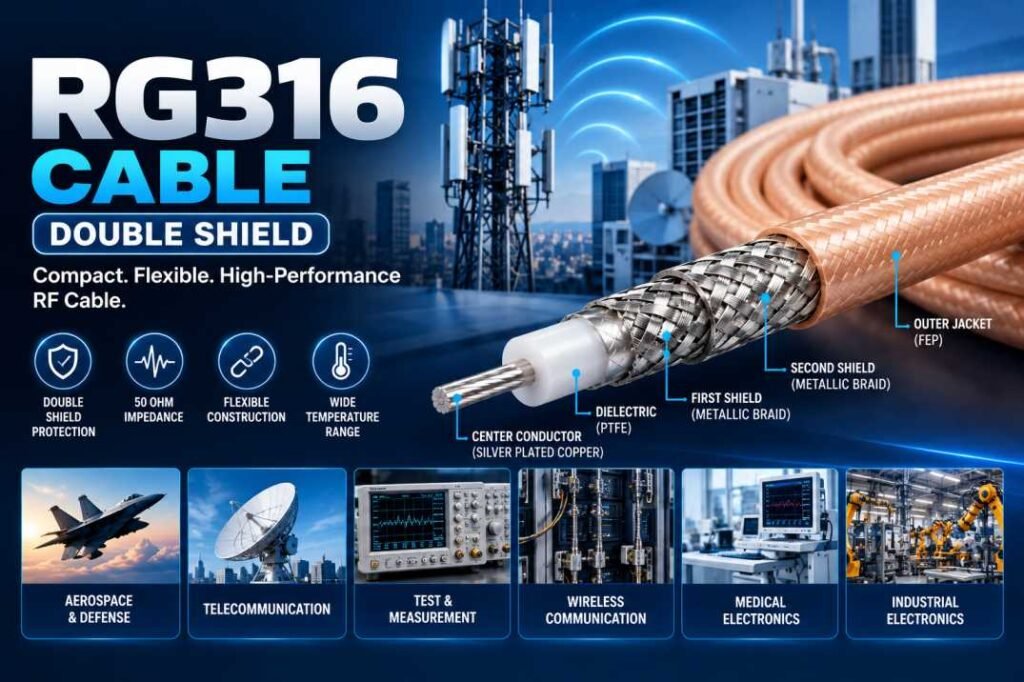
RG316 Cable is a compact, flexible 50 Ohm coaxial cable designed for RF signal transmission in electronic, communication, instrumentation, aerospace, and other high-frequency applications. Its small diameter and flexible construction make it particularly useful where installation space is limited and the cable must be routed around compact equipment.
The most important characteristics of RG316 Cable include its physical size, characteristic impedance, dielectric construction, shielding, temperature capability, and frequency performance. Understanding these specifications is essential when selecting RG316 for an RF cable assembly or electronic system.
What Is RG316 Cable?
RG316 Cable is a flexible coaxial RF cable generally designed with a 50 Ohm characteristic impedance. It uses a center conductor, dielectric insulation, metallic shielding, and protective outer jacket to provide a controlled path for RF signals.
Its compact construction makes RG316 Cable suitable for applications where a larger RF cable would be difficult to install. It is commonly used for internal connections, instrumentation, communication equipment, test systems, and compact RF assemblies.
RG316 Cable Size
One of the main advantages of RG316 Cable is its small physical size. The cable typically has an outside diameter of approximately 2.5 mm, making it significantly smaller than larger RF cables such as RG400.
Its compact size provides several installation benefits:
- Easy routing through restricted spaces
- Reduced cable weight
- Suitable for compact electronic equipment
- Easier integration into RF assemblies
- Useful for dense wiring environments
The exact cable diameter can vary depending on the manufacturer, jacket material, and construction, so the manufacturer’s datasheet should be checked for precise dimensions.
RG316 Cable Impedance
RG316 Cable is generally a 50 Ohm coaxial cable. Impedance is a critical parameter in RF systems because the cable must be compatible with the impedance of connected equipment.
50 Ohm RF systems are widely used in:
- Wireless communication
- RF testing
- Aerospace electronics
- Defense equipment
- Navigation systems
- Instrumentation
- Microwave systems
Maintaining a consistent impedance helps reduce signal reflections and supports reliable RF signal transmission.
Read also: 3BHK/4BHK Home Interior Design Services in Greater Noida
RG316 Cable Temperature Range
Temperature performance is another important specification when selecting RG316 Cable.
RG316 constructions commonly use PTFE dielectric material, which provides good thermal stability and makes the cable suitable for applications exposed to elevated temperatures.
Depending on the specific construction, RG316 Cable can commonly support a temperature range of approximately -55°C to +200°C.
However, the exact temperature rating depends on the cable manufacturer, jacket construction, conductor materials, and applicable specifications. Always verify the manufacturer’s datasheet when the cable will be used in aerospace, industrial, outdoor, or high-temperature environments.
RG316 Cable Construction
Center Conductor
RG316 Cable commonly uses a stranded silver-plated copper center conductor. The stranded construction provides flexibility, while silver plating supports good electrical conductivity and high-frequency performance.
Dielectric
PTFE is commonly used as the dielectric material. It provides electrical insulation between the center conductor and shield while supporting thermal stability and RF performance.
Shield
RG316 Cable commonly incorporates a braided metallic shield that provides protection against electromagnetic interference and helps reduce unwanted signal leakage.
Outer Jacket
The outer jacket protects the internal cable structure from mechanical damage and environmental exposure.
RG316 Cable Key Specifications
| Specification | Typical RG316 Characteristics |
| Cable Type | Flexible Coaxial RF Cable |
| Impedance | 50 Ohms |
| Nominal Diameter | Approximately 2.5 mm |
| Dielectric | PTFE |
| Center Conductor | Silver-Plated Copper |
| Construction | Flexible |
| Temperature Range | Commonly -55°C to +200°C |
| Shielding | Metallic Braid |
| Applications | RF, Aerospace, Defense, Instrumentation |
Exact specifications may vary depending on the manufacturer and cable construction.
Applications of RG316 Cable
Aerospace and Defense
RG316 Cable is suitable for compact RF connections in aerospace and defense electronics where lightweight construction, flexibility, and temperature performance are important.
RF Test Equipment
It can be used in laboratory instruments, test fixtures, signal generators, analyzers, and other RF measurement systems.
Telecommunications
RG316 can provide internal RF connections within communication equipment, wireless systems, and RF modules.
Navigation Systems
Its compact size makes RG316 useful for connections inside navigation and positioning equipment.
Industrial Electronics
RG316 Cable can be used in industrial instrumentation, sensors, control systems, and specialized RF equipment.
Advantages of RG316 Cable
The main advantages of RG316 Cable include:
- Compact diameter
- Lightweight construction
- 50 Ohm impedance
- High flexibility
- PTFE dielectric
- Good temperature capability
- Reliable RF performance
- Easy installation
- Wide connector compatibility
- Suitable for compact RF assemblies
RG316 Cable vs RG400 Cable
| Feature | RG316 Cable | RG400 Cable |
| Diameter | Approx. 2.5 mm | Approx. 4.95 mm |
| Impedance | 50 Ohms | 50 Ohms |
| Flexibility | High | High |
| Size | Smaller | Larger |
| Weight | Lower | Higher |
| Typical Use | Compact RF assemblies | Higher-performance RF assemblies |
| Temperature Capability | Application dependent | Application dependent |
RG316 is particularly useful when compact size and flexibility are priorities, while RG400 can be preferred when larger cable construction and higher performance requirements are needed.
How to Choose the Right RG316 Cable
When selecting RG316 Cable, consider:
- Required operating frequency
- 50 Ohm impedance
- Cable diameter
- Cable length
- Attenuation
- Temperature range
- Connector type
- Shielding requirements
- Power handling
- Installation space
For high-frequency applications, the cable should be selected based on its complete electrical specification rather than its RG designation alone.
Conclusion
RG316 Cable is a compact, flexible 50 Ohm coaxial cable designed for reliable RF signal transmission in space-constrained electronic systems. Its approximately 2.5 mm diameter, PTFE dielectric, flexible construction, and commonly specified temperature range of around -55°C to +200°C make it useful for aerospace, defense, telecommunications, instrumentation, and RF testing applications.
When selecting RG316 Cable, engineers should evaluate size, impedance, temperature rating, frequency range, attenuation, shielding, connector compatibility, and power requirements to ensure reliable long-term RF performance.
Frequently Asked Questions About RG316 Cable
1. What is RG316 Cable?
RG316 Cable is a compact, flexible 50 Ohm coaxial RF cable commonly used for high-frequency signal transmission in electronic and communication systems.
2. What is the size of RG316 Cable?
RG316 Cable typically has an outside diameter of approximately 2.5 mm, although exact dimensions can vary by manufacturer.
3. What is the impedance of RG316 Cable?
RG316 Cable is generally designed with a 50 Ohm characteristic impedance.
4. What is the temperature range of RG316 Cable?
Depending on its construction, RG316 Cable commonly supports approximately -55°C to +200°C. Always verify the exact manufacturer’s specification.
5. What dielectric is used in RG316 Cable?
RG316 Cable commonly uses PTFE dielectric material, providing good electrical insulation and temperature stability.
6. Where is RG316 Cable used?
RG316 Cable is used in aerospace, defense, telecommunications, RF test equipment, instrumentation, navigation systems, industrial electronics, and compact RF assemblies.
7. Is RG316 Cable flexible?
Yes. Its small diameter and stranded conductor construction make RG316 Cable highly suitable for flexible routing and compact installations.
8. What connectors are compatible with RG316 Cable?
RG316 Cable can be terminated with various RF connectors, including SMA, BNC, TNC, N-Type, SMB, MCX, MMCX, and other compatible interfaces.
9. Is RG316 Cable suitable for high-temperature applications?
Yes, many RG316 constructions use PTFE and offer high-temperature capability, but the exact operating range should always be confirmed from the manufacturer’s datasheet.
10. What is the difference between RG316 and RG400 Cable?
RG316 is smaller and lighter, with an approximate 2.5 mm diameter, while RG400 is larger at approximately 4.95 mm. Both are commonly used as 50 Ohm RF cables, but their electrical and mechanical specifications differ.