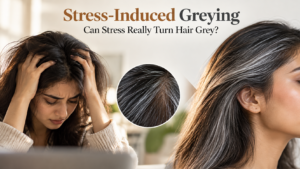
We have all blamed stress at some point or another for headaches, insomnia, acne, and sometimes even greying hair. However, if stress was the only thing responsible for hair greying, then shouldn’t everybody with a stressful job or exams have silver hair?
The truth is more interesting.
Doctors, especially dermatologists, today know that while stress can speed up the hair greying process, it doesn’t normally work alone. Factors such as age, genetics, malnutrition, hormone levels, illnesses, and general lifestyle impact the life span of hair color. This is why two people exposed to similar stress may experience totally opposite hair stories.
Let’s look at what your grey hair might really mean before you blame stress.
1. If You’re in Your 40s or 50s, It’s Probably Ageing
As we grow older, the pigment-producing cells, known as melanocytes, in our hair follicles get increasingly inactive. Furthermore, the number of melanocyte stem cells in our follicles gets reduced. This makes it difficult to produce melanin, which is the pigment that gives us hair color.
Fun fact: Our hair follicles generate small quantities of hydrogen peroxide. When we are young, the catalase enzyme helps break it down. But as we get older, catalase enzyme levels reduce, and hydrogen peroxide tends to bleach our hair. (1)
2. If You’re a Student or Young Professional, Stress May Be Only Part of the Story
Many individuals begin experiencing their greys during their board examinations, college, or the initial years of work. It is not difficult to point out stress as the reason; however, dermatologists take into consideration the whole scenario.
Stress is often accompanied by poor sleeping patterns, inconsistent eating habits, excessive caffeine intake, and an increase in oxidative stress, which may have an impact on the environment surrounding the hair follicles.
It has also been proven that stress triggers the body’s fight-or-flight mode, and noradrenaline is released into the body. (2) It causes exhaustion of melanocyte stem cells and hence decreases pigment production in the follicle.
3. Grey Hair in Your Teens? Don’t Ignore It
Having grey hair at a young age, like in your teens or early twenties, doesn’t always mean that you are stressed.
Premature greying may sometimes be associated with:
- Vitamin B12 deficiency
- Iron deficiency
- Copper deficiency
- Thyroid disorders
- A strong family history of early greying
It is always better to understand the possible cause of grey hair rather than just colouring it.
4. If Grey Hair Runs in Your Family, Genetics Is a Bigger Player Than Stress
Have you ever wondered why some families notice greying hair in their twenties while others have dark hair even in their fifties?
It is because your genetics influence how long your pigment-producing cells remain active.
Stress is like stepping on the gas pedal and not turning the key on. If your hair follicles are genetically susceptible to greying at an earlier age, stress may accelerate the process.
5. Can Illness or Lifestyle Trigger Grey Hair?
Sometimes, yes.
Conditions such as chronic inflammation, cigarette smoking, improper dieting, pollution, specific medical conditions, and illness may lead to an increase in oxidative stress, a condition characterized by an imbalance between the damaging effects of free radicals and the body’s natural antioxidants.
Oxidative stress is not only associated with skin ageing but also affects pigmentation production in hair follicles. (3)
So, Can Stress Really Turn Hair Grey?
Yes, but not independently.
Stress will not suddenly strip your hair of its natural color overnight. Rather, it may affect the biological mechanisms that allow your hair to produce pigment as it grows in the future. Whether or not the result is greying hair also depends on many other aspects, such as your age and genes.
This is why stress is seen as just one factor among many.
Supporting Hair Before Greying Progresses
When stem cells that produce pigment are permanently depleted, there is currently no established topical treatment that can reliably restore them completely. Yet, maintaining scalp and follicle health is an important part of a preventive hair care routine.
Modern anti-grey hair serums contain different active ingredients intended to support scalp and hair health:
- Copper peptides: These are studied for their potential role in supporting hair follicle health. Their ability to restore natural hair pigmentation in humans is not yet established.
- Biomimetic peptides: These act as signalling molecules and are used in some hair care formulations to support normal hair follicle function.
- Acetyl Tetrapeptide-3: This peptide is used in certain cosmetic formulations to support the extracellular matrix around hair follicles and promote scalp health.
- Antioxidants: Ingredients such as Vitamin E, Ferulic Acid, and Resveratrol help neutralise free radicals and support protection against oxidative stress.
- Niacinamide (Vitamin B3): This ingredient supports the skin barrier and helps maintain a healthy scalp environment.
- Caffeine: It is studied for its potential role in supporting hair follicle activity, although evidence for its effectiveness in preventing greying remains limited.
- Botanical extracts: Amla, Green Tea, Ginseng, Rosemary, and Centella asiatica are used for their antioxidant, soothing, and scalp-conditioning properties.
- Panthenol (Provitamin B5): It helps improve hair hydration, smoothness, and overall hair quality.
Although these ingredients cannot be assumed to regenerate melanocyte stem cells or reverse age-related greying, they may help maintain scalp health and improve hair condition. Evidence that cosmetic serums can prevent or reverse premature greying is currently limited.
Where Can an Anti-Grey Hair Serum Help?
Although ageing and genetics cannot be modified, the condition of your hair and scalp can be supported with an appropriate hair care routine. That’s where anti-greying hair serums may fit into a preventive hair care regimen.
Unlike hair dyeing products, which cover grey hair, these serums are formulated to support scalp and hair health. Antioxidants help protect against oxidative stress, while certain peptides and plant extracts are included to support the condition of the scalp and hair follicles.
However, claims that these ingredients restore melanin production or prevent the spread of grey hair require stronger clinical evidence. No cosmetic serum has been conclusively proven to reverse permanent age-related greying.
If you experience sudden or unusually early greying, consider consulting a dermatologist to identify any underlying causes, including possible nutritional deficiencies or thyroid problems.
Conclusion
Grey hair doesn’t always tell the same story.
Some of us see it as a consequence of growing old. Others may have genetic factors, dietary deficiencies, or stress contributing to the process. Rather than assuming that stress is the only factor involved, understanding the possible reasons behind greying can help you take better care of your hair.
Greyer hair can be a reminder to pay attention to your overall well-being. Focus on balanced nutrition, adequate sleep, stress management, and a consistent hair care routine. If you are considering an anti-grey hair serum, remember that supporting scalp health is not the same as proven prevention or reversal of grey hair.
References
- Gray Hair: From Preventive to Treatment – June 2025
https://pmc.ncbi.nlm.nih.gov/articles/PMC12182098/#s0003 - Hyperactivation of Sympathetic Nerves Drives Melanocyte Stem Cell Depletion – July 2020
https://pmc.ncbi.nlm.nih.gov/articles/PMC7184936/ - Age-induced hair greying – the multiple effects of oxidative stress – December 2013
https://pubmed.ncbi.nlm.nih.gov/24033376/