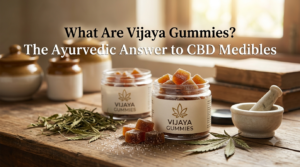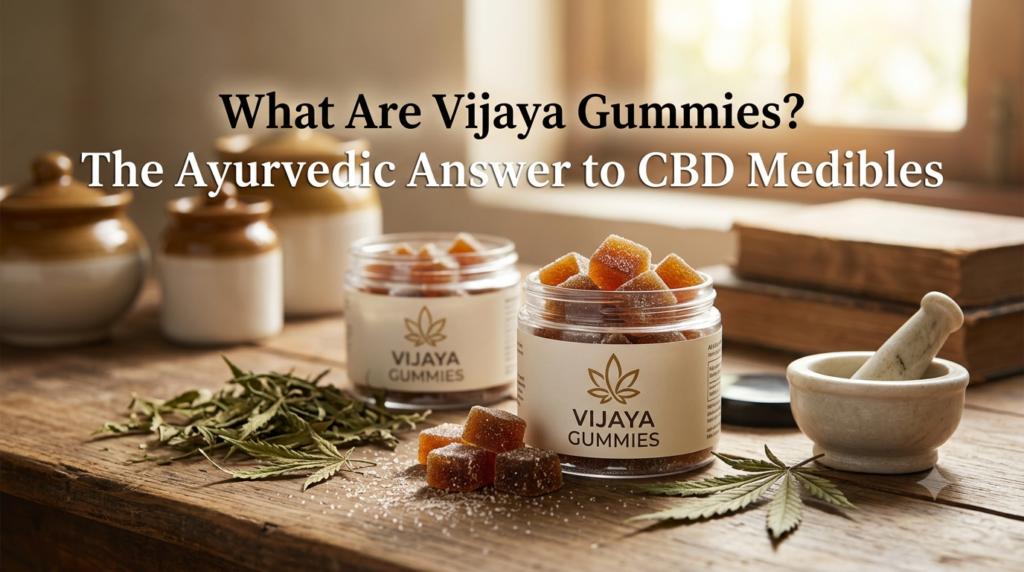
Vijaya gummies are edible products made with cannabis-leaf extracts and marketed through India’s Ayurvedic wellness and medical-product landscape. They are often presented as an Indian alternative to CBD gummies, but the terms are not interchangeable. CBD is one specific cannabinoid, whereas Vijaya is a traditional Ayurvedic name associated with cannabis-based preparations.
Depending on the formulation, Vijaya gummies may contain cannabidiol (CBD), tetrahydrocannabinol (THC), other cannabinoids or additional herbs such as ashwagandha and Brahmi. Their effects, legal status and safety therefore depend on the exact ingredients, dosage, manufacturer and regulatory category. A Vijaya gummy should not be treated as an ordinary sweet or purchased solely because it is described as “natural” or “Ayurvedic.”
What Does Vijaya Mean?
“Vijaya” is a traditional Ayurvedic term associated with cannabis. It is often translated as “the victorious one.” Historical Ayurvedic practice included cannabis in selected preparations, but traditional use generally involved careful preparation, small quantities and combinations with other ingredients.
This context is important because Ayurveda does not necessarily support casual or unlimited cannabis consumption. The use of a potent botanical ingredient traditionally depended on the preparation method, the individual’s condition and the practitioner’s judgement. Modern commercial products may use the word “Vijaya” to connect a cannabis formulation with this traditional heritage, but the label alone does not prove that a product follows classical Ayurvedic standards.
Today, Vijaya may appear in several forms:
- Gummies and edible candies.
- Oils and tinctures.
- Capsules and tablets.
- Balms and topical preparations.
- Herbal formulations containing cannabis leaf extract.
What Are Vijaya Gummies?
A Vijaya gummy may contain:
- CBD.
- THC.
- Minor cannabinoids such as CBG or CBN.
- Cannabis leaf extract.
- Ashwagandha or Brahmi.
- Spices or botanical ingredients.
- Sweeteners, colours and preservatives.
The word “Vijaya” does not identify a standard potency. One product may contain little or no THC, while another may have a more noticeable intoxicating effect. Some products may be CBD-dominant, whereas others may contain a broader “full-spectrum” extract.
Consumers should therefore look beyond front-of-pack marketing. A reliable label should state the amount of CBD and THC per gummy, serving instructions, batch number, expiry date, manufacturer details and applicable warnings. “Full-spectrum” is not a substitute for a potency figure. It describes a type of extract but does not tell the consumer how strong the product is.
Vijaya Gummies Versus CBD Gummies
| Feature | Vijaya gummies | CBD gummies |
|---|---|---|
| Meaning | Traditional Ayurvedic term associated with cannabis | Product specifically centred on cannabidiol |
| Possible ingredients | CBD, THC, other cannabinoids and herbs | Primarily CBD, with possible trace THC |
| Intoxicating potential | Depends on THC content | Usually low when THC is absent or present only in trace amounts |
| Product purpose | Ayurvedic, medical or wellness formulation | Wellness or cannabinoid product |
| Main concern | THC content, legality, licensing and supervision | Accurate CBD concentration, purity and trace THC |
| Dosage consistency | Depends heavily on the manufacturer | Depends heavily on testing and manufacturing |
| Legal classification | May be treated as an Ayurvedic medicine or another regulated product | Classification varies according to ingredients and claims |
How Do They Work?
The effects of a Vijaya gummy depend on its cannabinoid profile, dose, the consumer’s metabolism and whether other substances are used at the same time.
CBD is generally described as non-intoxicating. Consumers often use CBD products as part of routines intended to support relaxation, sleep or general wellness. However, non-intoxicating does not mean risk-free. CBD may interact with medicines, and the effects of unregulated products may differ from the label.
THC is intoxicating. It can affect memory, attention, coordination, decision-making and perception. The Centers for Disease Control and Prevention notes that THC-containing cannabis products can impair users and that edible products may have delayed or unpredictable effects (Centers for Disease Control and Prevention [CDC], 2025).
Edibles also behave differently from inhaled products. After swallowing a gummy, a person may not feel effects immediately. Public-health guidance states that edible cannabis can take approximately 30 minutes to two hours to produce noticeable effects, with full effects taking longer in some cases (CDC, 2024; Government of British Columbia, 2021). This delay may lead someone to consume another gummy before the first serving has taken effect.
Additional herbs can further complicate the experience. A product containing Vijaya, ashwagandha and Brahmi may produce effects that are difficult to attribute to one ingredient. Consumers should consider the complete formulation rather than focusing on a single traditional herb.
Why Are Gummies Popular?
Gummies have become popular because they are discreet, portable and familiar. They do not require smoking or special equipment, and their flavour can make them easier to consume than oils or raw plant material.
Other reasons for their popularity include:
- A pre-portioned format.
- Convenience at home or while travelling where legally permitted.
- A discreet appearance.
- Easy integration into a wellness routine.
- Availability in different flavours and formulations.
- The ability to combine cannabis extracts with other herbs.
Media coverage has reported growing interest in cannabis-leaf edibles and other products in India. This interest exists alongside continuing legal and social sensitivity around cannabis. Products promoted as Ayurvedic medicines may be subject to licensing, labelling and practitioner-related requirements rather than being unrestricted recreational goods.
The candy-like appearance can also create risks. THC-containing gummies may be mistaken for confectionery by children, visitors or pets. They should remain in their original, clearly labelled packaging and be stored securely.
Are Vijaya Gummies Legal in India?
The legal status of Vijaya gummies in India is complicated. It depends on the part of the cannabis plant used, the product’s composition, its intended use, the manufacturer’s licence and state-level requirements.
India’s Narcotic Drugs and Psychotropic Substances Act, 1985 distinguishes between different parts of the cannabis plant. Cannabis resin and flowering tops are treated differently from leaves and seeds under the Act. This distinction has contributed to a limited market for certain leaf-based preparations, including some traditional or Ayurvedic products (Narcotics Control Bureau, n.d.).
However, this does not mean that every product labelled “Vijaya,” “bhang,” “hemp” or “CBD” is automatically legal. The Ministry of Ayush has warned that it does not itself certify or approve individual Ayurvedic companies or medicines. Manufacturing licences for Ayurvedic, Siddha and Unani medicines are granted by the relevant State or Union Territory licensing authority. The Ministry also states that cannabis and its derivatives remain regulated by law (Ministry of Ayush, 2025).
Potential compliance requirements may involve:
- A licensed manufacturer.
- Approved sourcing of raw materials.
- State or Union Territory manufacturing permission.
- Correct product classification.
- Ingredient and dosage information.
- Lab testing.
- Prescription or practitioner consultation.
- Restrictions on advertising medical claims.
- State-specific rules on sale and possession.
What to Check Before Buying
A buyer should assess Vijaya gummies as a regulated botanical or medicinal product rather than ordinary food.
Verify the manufacturer
Look for the manufacturer’s legal name, physical address, licence details, batch number, expiry date and customer-service information. Anonymous sellers and social-media-only businesses make it difficult to verify accountability.
Check CBD and THC amounts
The label should identify the quantity of CBD and THC per gummy or serving. A statement such as “1,000 milligrams of cannabis extract” is incomplete unless the label explains how much extract is present in each gummy and what cannabinoids the extract contains.
Request a certificate of analysis
A certificate of analysis, or COA, should ideally be issued by an independent laboratory and match the product’s batch number. It may test for:
- CBD and THC concentration.
- Other cannabinoids.
- Heavy metals.
- Pesticides.
- Microbial contamination.
- Residual solvents.
- Potency accuracy.
A COA cannot replace legal verification, but it can help determine whether the product’s contents match its label.
Review the claims
Avoid products promising to cure cancer, depression, epilepsy, addiction or other serious diseases. Traditional use, customer testimonials and “doctor-formulated” advertising are not the same as strong clinical evidence.
Confirm prescription requirements
Some Vijaya products may be described as prescription-based Ayurvedic medicines. Others may be marketed as wellness products. Ask the manufacturer or a qualified practitioner what legal and medical requirements apply before ordering.
Examine the complete ingredient list
Check for allergens, added herbs, sweeteners and other active ingredients. People taking prescription medicines should discuss the product with a healthcare professional because cannabinoids and herbs may affect how medicines work.
Safety and Responsible Use
The safest approach is to follow the product label and qualified medical advice. Do not increase the serving simply because the effects are delayed.
Important precautions include:
- Use only the amount recommended by a qualified practitioner.
- Wait for the initial serving to take effect before considering more.
- Do not combine the gummy with alcohol or other intoxicating substances.
- Do not drive or operate machinery after consuming it.
- Do not share it with other people.
- Store it in a locked, clearly labelled location.
- Keep it away from children and pets.
- Avoid use during pregnancy or breastfeeding unless specifically advised by a healthcare professional.
- Seek medical help for severe anxiety, confusion, chest pain, fainting, hallucinations or persistent vomiting.
The delayed onset of edibles is a major safety concern. Health authorities warn that people may consume too much before feeling the first serving, increasing the risk of poisoning, injury or intense psychological effects (CDC, 2024; Government of Canada, 2020).[3]
People with cardiovascular conditions, a history of psychosis or severe anxiety, or those taking medicines should seek professional advice before using a cannabinoid product. “Natural” and “Ayurvedic” do not automatically mean suitable for every person.
Vijaya Gummies and Traditional Bhang
Vijaya gummies and bhang may both involve cannabis leaves, but they are not necessarily the same. Traditional bhang can be prepared as a drink, paste or edible mixture, and its potency may vary considerably.
A professionally manufactured gummy should offer greater consistency through:
- A defined serving size.
- Batch identification.
- Ingredient disclosure.
- Expiry information.
- Manufacturing controls.
- Potential laboratory testing.
Nevertheless, manufacturing alone does not guarantee safety. Consumers still need to verify THC content, product classification and the manufacturer’s credentials.
Conclusion
Vijaya gummies are modern cannabis edibles connected to India’s Ayurvedic tradition. They may contain CBD, THC, other cannabinoids and additional herbs, which means their effects cannot be predicted from the word “Vijaya” alone.
They differ from CBD gummies because CBD refers to a specific cannabinoid, while Vijaya refers to a traditional cannabis-related formulation. Some Vijaya gummies may be non-intoxicating or CBD-focused, while others may contain enough THC to impair coordination, judgement and perception.
India’s legal framework is narrow and product-specific. A responsible buyer should verify the manufacturer, licensing information, cannabinoid content, certificate of analysis, prescription requirements and state-level rules. The product should also be stored safely and used only according to professional guidance.
Vijaya gummies may represent an innovative meeting point between Ayurveda and modern edible formats, but traditional branding does not remove the need for evidence, accurate labelling and caution. The safest product is one with transparent ingredients, verifiable testing, responsible claims and clear compliance information.
References
- Centers for Disease Control and Prevention. (2024, May 20). Cannabis and poisoning. https://www.cdc.gov/cannabis/health-effects/poisoning.html
- Centers for Disease Control and Prevention. (2025, January 31). Cannabis frequently asked questions. https://www.cdc.gov/cannabis/faq/index.html
- Government of British Columbia. (2021). Cannabis health information. https://www2.gov.bc.ca/gov/content/safety/public-safety/cannabis/health-info
- Government of Canada. (2020, January 6). Council of Chief Medical Officers of Health statement on cannabis extracts, edibles, and topical products. https://www.canada.ca/en/public-health/news/2020/01/council-of-chief-medical-officers-of-health-statement-on-cannabis-extracts-edibles-and-topical-products.html
- Ministry of Ayush. (2025). Public notice regarding Ayurvedic, Siddha, Unani and Homoeopathic medicines and cannabis-related claims. National Institute of Ayurveda. https://nih.ayush.gov.in/assets/uploads/notice_pdf/content_matter_en_1745221919.pdf
- Narcotics Control Bureau. (n.d.). The Narcotic Drugs and Psychotropic Substances Act, 1985. Government of India. https://narcoticsindia.nic.in/legislation/ndpsact.pdf