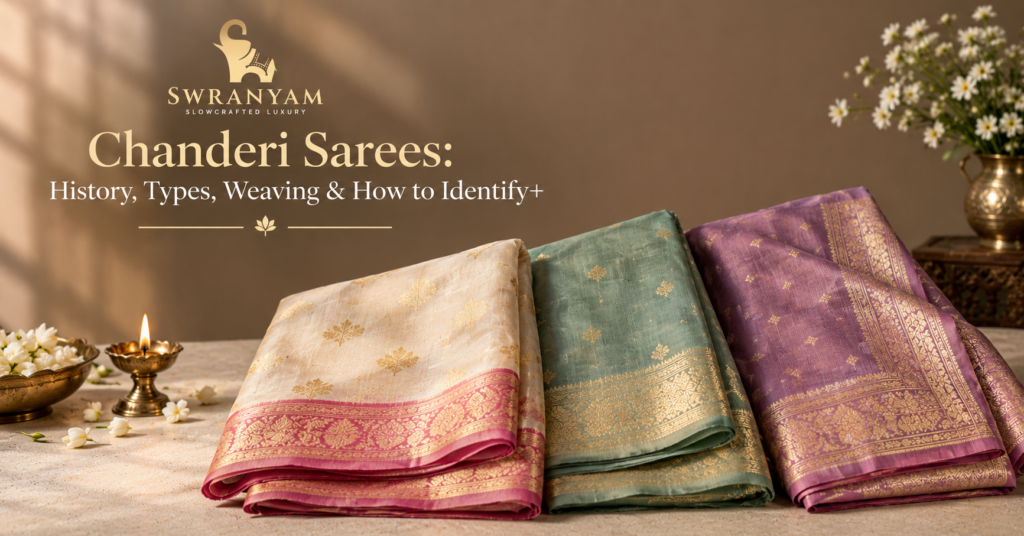
Hold a Chanderi saree up to the light and it seems to glow. The fabric is sheer, almost weightless, with a soft sheen that looks like it belongs to a different kind of textile altogether. This quality has made Chanderi one of India’s best-loved handloom weaves for generations. In this guide, you will learn what Chanderi sarees are, where they come from, how they are woven, the main types, and how to tell a genuine piece from an imitation.
What Are Chanderi Sarees?
Chanderi sarees are handwoven sarees that originate from the town of Chanderi in Madhya Pradesh. The town sits at the edge of two cultural regions, Malwa and Bundelkhand, and has been associated with fine weaving for centuries.
The fabric is known for three things: a lightweight, sheer texture, a gentle natural lustres and delicate woven motifs. Traditionally, Chanderi is made from silk and fine cotton yarns, often finished with zari, the metallic thread used in borders and motifs.
The Heritage Behind the Weave
The exact origin of Chanderi weaving is described differently in different sources, and the story blends history with local legend. What is widely agreed is that the craft flourished under royal and aristocratic patronage, especially during the Mughal period, when Chanderi cloth was valued for its fineness.
Like many handloom crafts, Chanderi weaving faced pressure from machine-made textiles in the 20th century. It has since seen renewed interest through government support, designers and a growing appreciation for handloom.
Chanderi fabric received a Geographical Indication (GI) tag in 2005. A GI tag links a product to a specific region and helps protect it from imitation, which makes it a useful reference point when you are checking authenticity.
Why Chanderi Fabric Is Sheer and Glossy
The sheer, glowing quality comes from the yarn. Chanderi weavers traditionally use non-degummed silk, which means the natural gum on the silk thread is not fully removed. The silk keeps a natural shine, and the fabric stays crisp and translucent. This is paired with very fine cotton yarn, which keeps the cloth light and breathable.
The result is a fabric that feels airy but holds its shape, which is why Chanderi drapes so gracefully.
Types of Chanderi Sarees
Chanderi is generally woven in three fabric types.
Pure Silk Chanderi
Made entirely of silk, this type has the richest lustre and the most formal feel. It is often chosen for weddings and festive occasions.
Silk-Cotton Chanderi
A blend of silk and cotton, this is the most common type. It balances the sheen of silk with the comfort of cotton, and it works for festive, office and everyday wear.
Cotton Chanderi
Woven entirely in cotton, this version is the lightest and most breathable. It suits warm weather and casual occasions.
If you want to see how these fabrics look in practice, you can browse a curated selection of Chanderi sarees and compare the textures and borders.
Traditional Motifs and Borders
Chanderi motifs are woven into the fabric during weaving, not printed or embroidered afterwards. They are usually small, elegant and inspired by nature and architecture.
- Asharfi (coin) motifs: Round, coin-like designs placed across the body.
- Peacocks: A classic symbol that often appears on borders and pallus.
- Lotus and floral designs: Soft, flowing patterns.
- Geometric buttis: Small repeating motifs arranged in neat rows.
- Stripes and checks: Simple patterns for a quieter look.
Borders are frequently woven with zari, and the finest ones are made with extra-weft technique, where additional threads are added to build the motif on the surface of the cloth.
How a Chanderi Saree Is Woven
Chanderi weaving is a patient, hands-on process.
- Yarn preparation. Silk and cotton yarns are selected, prepared and, where needed, dyed.
- Warping. The lengthwise threads are arranged on the loom with great care.
- Weaving the body. The weaver passes the weft through by hand, keeping the fabric even.
- Adding motifs. Small motifs are created by adding extra threads at specific points, often with fine needles.
- Finishing. The saree is checked, trimmed and prepared for sale.
Because every step is manual, a single saree can take days or even weeks, depending on how detailed the motifs and borders are.
How to Identify an Authentic Chanderi Saree
Imitations are common, so a few practical checks help.
- Hold it against the light. Genuine Chanderi shows a soft, even glow. A power-loom copy often looks flat or opaque.
- Feel the weight. Authentic Chanderi is very light but has a slight crispness. A saree that feels heavy and thick is suspect.
- Check the motifs. They should be woven into the fabric. Run your fingers over them and look at the reverse side, where you should see the thread work.
- Look for small natural variations. Handloom pieces often have tiny irregularities, while machine-made fabric is perfectly uniform.
- Read the fabric label carefully. Reputable sellers say clearly whether the saree is pure silk, silk-cotton or cotton.
- Look for GI or Silk Mark documentation. Genuine sellers can usually explain the source and provide documentation.
- Be careful with very low prices. Handloom weaving takes time and skill, so unusually cheap “pure silk” Chanderi is a warning sign.
Chanderi vs Maheshwari Sarees
People often confuse these two, since both come from Madhya Pradesh and both use silk and cotton. Chanderi is known for its sheer, glossy texture and delicate buttis. Maheshwari sarees come from Maheshwar and are known for their reversible borders and distinctive striped pallus. Looking at the weave, the texture and the border design will help you tell them apart.
When and How to Wear a Chanderi Saree
Chanderi’s light weight makes it versatile.
- Summer events and daytime gatherings: The breathable weave keeps you comfortable.
- Office wear: Cotton or silk-cotton in muted colours looks polished.
- Festivals and pujas: A zari-border Chanderi in a warm shade feels festive.
- Weddings as a guest: Pure silk Chanderi in a soft jewel tone or pastel works well.
For styling, keep accessories simple. A well-fitted blouse, light jewelry and neat pleats are enough. A smooth petticoat helps because the fabric is sheer.
How to Care for a Chanderi Saree
Chanderi is delicate, so gentle care matters.
- Dry clean pure silk Chanderi and any saree with zari work.
- Hand wash cotton Chanderi gently in cold water if the care label allows it.
- Avoid wringing or scrubbing, which can damage the fine threads.
- Dry in the shade, away from direct sunlight.
- Store in soft cotton or muslin, not plastic.
- Refold now and then along different lines to protect the zari and prevent permanent creases.
- Iron on a low or medium setting, preferably with a cloth between the iron and the saree.
Frequently Asked Questions
Where do Chanderi sarees come from?
They come from Chanderi, a town in Madhya Pradesh, India.
Is Chanderi a pure silk saree?
Not always. Chanderi is woven in pure silk, silk-cotton and cotton versions, so check the product description.
Why is Chanderi so light?
It is woven with very fine yarn in an open structure, and the use of non-degummed silk gives it a crisp, translucent quality.
Does Chanderi have a GI tag?
Yes. Chanderi fabric received a GI tag in 2005.
Is Chanderi suitable for summer?
Yes. The lightweight, breathable weave makes it comfortable in warm weather.
How do I wash a Chanderi saree?
Dry cleaning is the safest choice for silk and zari. Always follow the care instructions on the label.
Final Thoughts
A Chanderi saree is a small lesson in how much fine craftsmanship can sit in a light, sheer piece of cloth. Knowing the types, the motifs and the signs of authenticity will help you choose well and care for it properly. To explore more handloom textiles from India, visit Swranyam.