Living in New Zealand means that pretty much everywhere is a long way away, so if you’ve got family in Australia, the UK, India or the Islands, you’re going to end up on a plane with a baby at some point. Our first go was a three-hour hop across to Brisbane when our son was five months old. I packed as though we were emigrating and still managed to forget a few of the things that really mattered.
We’ve done a handful of flights since, one of them long-haul, and these are the bits I’d pass on.
Book around the baby
If you’ve got any flexibility, try to fit your flights around your baby’s sleep. For short flights we’ve had the best luck with a morning departure straight after a feed. Overnight flights can work well for long-haul, although there are no promises with babies. If you’re going a long way, ask about a bassinet seat when you book. They tend to be in the bulkhead rows and there are only a few, plus every airline sets its own weight and size limit for them, so get in early. Have a nosy at what the infant fare actually covers too. Baggage for babies is all over the place depending on the airline and ticket. Some throw in a stroller and car seat for free and others don’t.
Passports and paperwork
Your baby needs a passport of their own, however tiny they are, and children’s passport applications can take a while, so get it sorted well before you’re due to fly. Check whether your destination needs a visa or anything else for your baby. We also carry a copy of the birth certificate, which is a good idea especially if only one parent is travelling.
What to do about the stroller
You’ve more or less got three choices. You can leave the stroller at home and use a carrier, which is fine for a short trip but harder once you land. You can check in your full-size pram and not see it again until baggage claim. Or you can take a compact travel stroller, which many airlines will let you use right up to the gate, or even take on board if it’s small enough (check your airline’s size limits first).
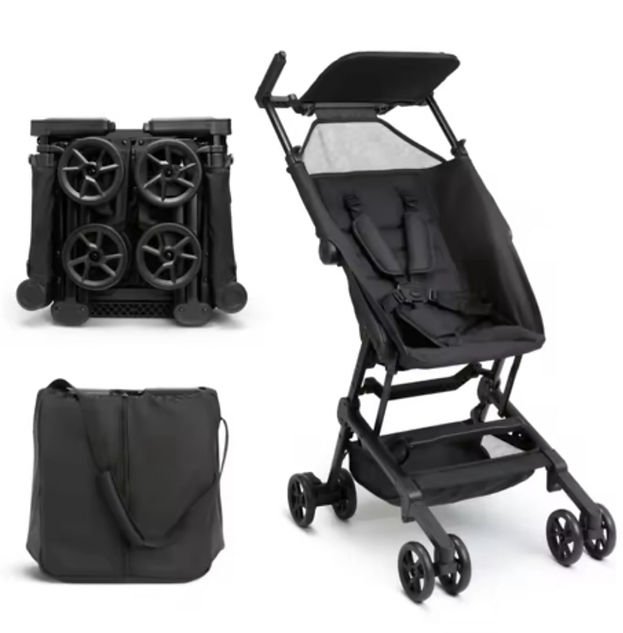
After that first trip we went for the third option and it was the best thing we did. The long walk to the gate, the customs queue and the wait at the other end are all so much easier when you can push rather than carry, and a baby who’ll nap in the stroller while you wait for the bags is worth its weight in gold. I’d look for a light frame you can carry in one arm, a fold you can manage while holding a baby, a folded size that suits your airline’s cabin rules, and a decent brake and harness for the airport crowds. The NV Kids pocket stroller is one example, with a 5.7 kg aluminium frame, a one-step fold that locks itself, and a linked brake. NV Kids say it fits most overhead lockers, though I’d still double-check the measurements with your airline. It’s listed at $275.
Packing the nappy bag
My one golden rule is to pack for delays and not for the flight time, so for a three-hour flight I pack for at least six. In practice that’s about double the nappies I reckon we’ll use, wipes, a change mat, a whole spare outfit for him and a spare top for me (ask me how I know), bottles and feeding stuff, a couple of muslins, a new toy or two, anything the doctor’s told us to bring in its labelled box, and a thin blanket since planes are always freezing. Baby food, milk and formula are allowed through security in sensible amounts, though they might pull them out for a separate check, so we keep them right at the top.
Those ears on the way up and down
Pressure changes can make little ears sore. We feed him or give him a dummy as we take off and land, since the swallowing seems to help. If they cry anyway, try not to stress. Most people on the plane have heard a crying baby before, and a fair few of them are parents.
At the airport
Give yourself loads of time because everything takes longer with a baby, use the family lane at security if there is one, and do a nappy change just before boarding even if it doesn’t strictly need it. If you can, let your baby have a wriggle and a crawl in the terminal before you get on.
When you land
If you’re driving from the airport, don’t forget the car seat rules. Here in New Zealand, kids have to be in an approved child restraint until they turn 7. Rental car companies can usually provide one if you book ahead, or you can bring your own as long as it meets an approved standard. Expect your baby’s routine to be a bit off for a day or two, especially if you’ve crossed time zones. Getting outside in daylight and keeping feeds regular helped us, and so did not planning much for the first day.
Get the gear early
Whatever you’re taking, get it well ahead of time so you can try it at home first. Take the travel stroller round the block and practise folding it in the car park. You’ll feel a bit silly, but you’ll be so much quicker on the day. If you’re still hunting for one, you can buy baby strollers online in NZ from NV Kids, who deliver free within Auckland.
Maybe the flight’s a dream, maybe it’s chaos. Either way you land eventually, usually with a decent story. Pack sensibly, take a stroller you can actually handle, leave heaps of time, and figure out the rest on the go.