Choosing the right hosting infrastructure is an important decision for businesses that depend on websites, applications, and online services. Whether you manage an e-commerce store, operate a SaaS platform, or host enterprise applications, server performance and reliability directly influence your digital operations.
Two popular hosting solutions are VPS Server and Cloud Server hosting. Both provide more flexibility and control than traditional shared hosting, but their infrastructure architectures, scalability options, and pricing models can differ significantly.
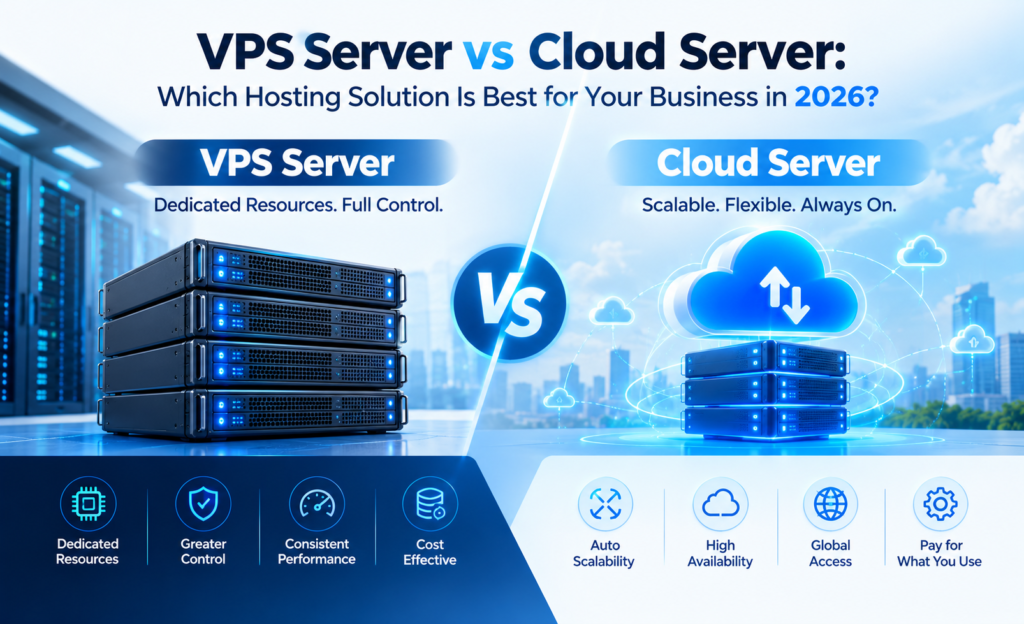
A VPS server provides a virtualized environment with allocated computing resources, while a cloud server typically operates on a cloud infrastructure platform designed for flexible resource provisioning.
Understanding these differences helps businesses select hosting solutions that match their technical requirements and growth plans.
In this guide, we explain VPS hosting, cloud servers, their benefits, use cases, pricing considerations, and how to choose the right solution.
What Is a VPS Server?
A VPS Server, or Virtual Private Server, is a virtual machine created by dividing a physical server into multiple isolated environments using virtualization technology.
Each VPS receives allocated resources such as virtual CPU cores, RAM, storage, and network connectivity.
Unlike shared hosting, where multiple accounts may compete for a common pool of resources, VPS hosting provides greater isolation and configuration control.
A VPS server is particularly suitable for organizations that require more flexibility than shared hosting without renting an entire physical dedicated server.
Key Features of VPS Servers
1. Allocated Computing Resources
VPS hosting provides a defined amount of CPU, RAM, and storage for each virtual server.
This makes resource planning more predictable for applications and business websites.
2. Root or Administrator Access
Depending on the hosting plan, users can access their operating system with administrative privileges and install compatible applications.
3. Cost-Effective Infrastructure
A VPS server generally costs less than renting a complete dedicated physical server, making it suitable for startups and growing businesses.
4. Operating System Flexibility
VPS solutions commonly support Linux distributions and Windows Server, subject to provider availability and licensing.
5. Configurable Security
VPS environments can support firewalls, SSH access controls, encryption, monitoring tools, and backup configurations.
What Is a Cloud Server?
A Cloud Server is a virtual computing instance provisioned through cloud infrastructure.
Cloud environments typically use centralized management, virtualization, software-defined networking, and storage systems to deliver computing resources.
Unlike conventional single-host VPS deployments, some cloud server platforms use clusters of physical machines and redundant infrastructure to improve resilience.
Cloud servers are commonly selected by businesses that require rapid provisioning, scalable computing resources, and flexible infrastructure management.
Key Features of Cloud Servers
1. Flexible Resource Scaling
Cloud servers can often be upgraded with additional CPU, memory, or storage according to application requirements.
Some platforms also support automated scaling across multiple instances.
2. Infrastructure Availability
Cloud platforms may provide redundant hardware, storage, and networking components.
Availability and automatic failover depend on the provider’s architecture and selected service configuration.
3. Rapid Deployment
Many cloud server platforms allow users to provision new virtual machines quickly through a control panel or API.
4. Flexible Billing
Cloud hosting providers may offer monthly subscriptions, hourly billing, or usage-based pricing.
5. Support for Modern Applications
Cloud servers can support APIs, databases, development environments, web applications, and distributed software systems.
VPS Server vs Cloud Server: Key Differences
The primary difference is often how the underlying infrastructure is managed and scaled.
Importantly, VPS and cloud servers are not completely separate technologies. A cloud server can also be a VPS because both may use virtualization.
| Feature | VPS Server | Cloud Server |
|---|---|---|
| Infrastructure | Often one physical host | Often cloud-managed or clustered |
| Computing Resources | Allocated virtual resources | Configurable virtual resources |
| Scalability | Plan-based upgrades | Often more flexible scaling |
| High Availability | Depends on configuration | May offer cluster-based resilience |
| Pricing | Usually fixed monthly plans | Monthly or usage-based |
| Root Access | Commonly available | Commonly available |
| Deployment | Virtual machine provisioning | Often automated provisioning |
| Best For | Websites, apps, development | Growing apps, enterprise workloads |
Neither architecture guarantees better performance or uptime on its own. Actual results depend on server hardware, resource allocation, storage configuration, network design, and provider operations.
Benefits of VPS Server Hosting
1. Affordable Hosting for Growing Businesses
VPS hosting offers a practical middle ground between shared hosting and dedicated infrastructure.
Businesses can receive more control over their server environment without the higher cost associated with renting a complete physical machine.
This makes VPS servers attractive for small businesses, agencies, developers, and startups.
2. Greater Administrative Control
A VPS server allows administrators to configure applications, install software, manage security rules, and customize operating system settings.
For businesses running specialized applications, this flexibility can be particularly valuable.
3. Predictable Resource Allocation
VPS plans generally specify the number of virtual CPU cores, available RAM, and storage capacity.
These allocations make it easier to choose infrastructure according to workload requirements.
4. Suitable for Multiple Websites
Web development agencies and businesses managing several websites can use VPS environments to host multiple projects.
Control panels such as Plesk or cPanel may simplify website and account management.
5. Flexible Development Environments
Developers can use VPS hosting for application testing, staging environments, API services, and development workflows.
Benefits of Cloud Server Hosting
1. Infrastructure Scalability
Cloud servers can help businesses increase computing resources as application requirements grow.
For example, an online store experiencing higher traffic during a sale may require additional resources.
The ability to scale depends on the cloud platform and application architecture.
2. High Availability Options
Some cloud platforms support redundant infrastructure and automated failover.
These capabilities can reduce downtime caused by certain hardware failures, although they do not eliminate every possible outage.
3. Fast Resource Provisioning
Cloud management platforms often allow users to create virtual machines and provision infrastructure without purchasing physical equipment.
This helps development teams deploy environments quickly.
4. Suitable for Business Applications
Cloud servers can support enterprise software, database systems, APIs, web applications, and private business platforms.
5. Flexible Infrastructure Management
Businesses can use dashboards, APIs, and automation tools to manage supported cloud resources.
This can simplify routine infrastructure management and deployment processes.
Popular Use Cases for VPS Servers
Website Hosting
A VPS server provides a suitable environment for business websites that require more flexibility and allocated resources than shared hosting.
E-Commerce Hosting
Online stores can benefit from VPS resources when their applications require additional memory, CPU processing, or custom software configurations.
Application Hosting
Developers can deploy web applications, backend services, and APIs on VPS infrastructure.
Database Hosting
VPS environments can support databases such as MySQL, PostgreSQL, and MariaDB when configured with appropriate storage and memory resources.
Development and Testing
VPS servers offer independent environments for testing software updates, application configurations, and development projects.
Popular Use Cases for Cloud Servers
SaaS Platforms
Software-as-a-Service applications may benefit from cloud hosting platforms that support flexible deployment and resource expansion.
Enterprise Applications
Cloud servers can provide computing infrastructure for ERP, CRM, and internal business applications.
High-Traffic Websites
Cloud environments can support websites with varying traffic patterns when combined with suitable scaling and load-balancing systems.
Business Continuity
Cloud infrastructure with properly configured redundancy, monitoring, and backup systems can contribute to business continuity planning.
API and Microservices Hosting
Development teams can deploy backend APIs, application services, and distributed workloads on cloud infrastructure.
VPS Server vs Cloud Server: Which Is More Secure?
Both VPS and cloud servers can provide secure hosting environments when properly configured.
Security depends on more than the hosting architecture.
Important factors include:
- Operating system updates and patches
- Firewall and network access configuration
- Strong authentication and access controls
- Data encryption
- Regular backups
- Security monitoring
- DDoS protection
- Application-level security
A VPS server benefits from virtual machine isolation, while cloud platforms may provide additional security management features.
However, businesses must still configure their systems appropriately.
VPS Server vs Cloud Server: Which Offers Better Performance?
Performance depends primarily on the allocated hardware resources and infrastructure quality.
A VPS server with fast NVMe storage, sufficient memory, and capable processors may perform better than a cloud server with limited resources.
Similarly, a cloud server using high-performance hardware and optimized storage can provide excellent results for demanding applications.
Before choosing a service, evaluate:
CPU Performance: The number of virtual cores and processor generation.
RAM: The memory required by your application, database, and operating system.
Storage: SSD and NVMe options, disk throughput, and I/O performance.
Network: Bandwidth, latency, connectivity, and data transfer limits.
Uptime SLA: The provider’s service availability commitment.
Technical Support: Availability of assistance for infrastructure problems.
The correct server configuration matters more than the label VPS or Cloud.
VPS Server and Cloud Server Hosting in India with Webyne
Businesses looking for reliable hosting infrastructure in India can explore VPS and cloud computing solutions from Webyne.
Webyne provides virtual private servers and cloud hosting plans for websites, enterprise software, development environments, and demanding applications.
Its hosting solutions include options such as:
- Linux and Windows VPS hosting
- Allocated virtual CPU and RAM resources
- SSD and NVMe storage configurations
- Full root or administrator access
- Dedicated IP addresses on eligible plans
- Scalable server configurations
- 24/7 technical support
- Indian data center infrastructure
- 99.95% uptime SLA on advertised hosting plans
Webyne VPS Server Plans
Webyne offers several VPS configurations for different workload requirements.
For example, its published Speed VPS range includes a configuration with:
- 4 vCPU
- 8 GB RAM
- 200 GB SSD storage
- 200 Mbps network connectivity
This type of VPS can be suitable for growing websites, business applications, and development workloads.
Webyne Cloud Server Plans
Webyne also offers Cloud VPS solutions designed for businesses requiring scalable virtual infrastructure.
One published cloud configuration includes:
- 8 vCPU
- 32 GB RAM
- 500 GB SSD storage
- 1 Gbps network connectivity
- Noida data center location
Actual configurations, pricing, and availability should be checked on the Webyne website before purchasing.
How to Choose Between VPS Server and Cloud Server
Your decision should depend on the applications you plan to host and your expected infrastructure requirements.
Choose a VPS Server when:
- You need affordable hosting with more control than shared hosting.
- Your website or application has relatively predictable resource requirements.
- You want a fixed monthly hosting budget.
- You need root access for custom software.
- You manage business websites or development projects.
Choose a Cloud Server when:
- Your application requires flexible resource provisioning.
- You expect significant or unpredictable changes in traffic.
- You need infrastructure automation.
- Your business requires a platform offering high-availability options.
- You plan to deploy multiple applications or services.
For many small and medium-sized businesses, a VPS server is a practical starting point.
Organizations requiring greater infrastructure flexibility can evaluate cloud server options as their workloads expand.
Frequently Asked Questions
1. What is a VPS Server?
A VPS Server is a virtual private server that provides allocated computing resources, operating system control, and an isolated hosting environment on physical server infrastructure.
2. What is a Cloud Server?
A Cloud Server is a virtual computing instance deployed through cloud infrastructure, often offering flexible provisioning, resource scaling, and centralized management.
3. Is a VPS Server cheaper than a Cloud Server?
VPS hosting often provides straightforward monthly pricing, while cloud server pricing varies according to the provider, resources, and billing model. The cheaper option depends on the configuration and workload.
4. Which is better for an e-commerce website?
Both VPS and cloud servers can host e-commerce websites. A VPS may suit predictable traffic levels, while a scalable cloud architecture can help businesses manage variable demand.
5. Can I upgrade my VPS Server?
Many VPS hosting providers offer CPU, RAM, and storage upgrades. The available upgrade process depends on the hosting plan and virtualization platform.
6. Does Cloud Server hosting provide better uptime?
Cloud platforms can offer high-availability features, but uptime depends on how the infrastructure is designed and configured. A cloud server is not automatically immune to outages.
7. Can I install Windows or Linux on a VPS Server?
Yes. Many VPS providers support Linux and Windows operating systems, depending on plan availability and licensing.
8. Where can I buy a VPS Server or Cloud Server in India?
Webyne offers VPS Server and Cloud VPS hosting solutions in India with different resource configurations, storage options, and support services.
Conclusion
Both VPS Server and Cloud Server hosting offer businesses greater flexibility and control than traditional shared hosting.
A VPS server is often suitable for cost-conscious businesses, developers, and websites with predictable requirements. Cloud server platforms can provide additional options for scaling, automation, and infrastructure resilience.
The best hosting solution depends on your application’s computing needs, expected traffic, budget, security requirements, and future expansion plans.
Explore VPS Server and Cloud Server hosting solutions with Webyne to build a reliable infrastructure foundation for your business.