Pizza packaging plays an important role in maintaining food quality, protecting fresh ingredients, and ensuring customer satisfaction. Choosing the right pizza box dimensions can make a significant difference in how pizzas are stored, transported, and delivered. Whether you operate a small pizza shop, a large restaurant, or a food delivery business, selecting suitable box sizes helps prevent damage, maintain temperature, and improve packaging efficiency. A properly sized pizza box provides enough space for the pizza without allowing it to move around during transportation. It also makes stacking easier, saves storage space, and creates a professional presentation. Understanding different pizza box sizes and their practical uses can help businesses improve their packaging systems while delivering fresh and delicious pizzas to customers.
Understanding Pizza Box Dimensions
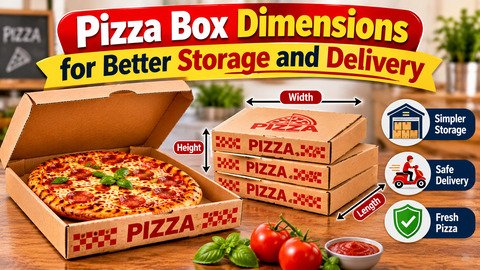
Pizza box dimensions refer to the length, width, and height of a pizza packaging box. These measurements determine how comfortably a pizza fits inside the packaging and how effectively the box protects it during storage and delivery.
Most traditional pizza boxes are square because pizzas are generally round. The square design provides enough room for the pizza while allowing convenient folding, stacking, and handling.
The three main measurements include:
- Length: The measurement from one side of the box to the opposite side.
- Width: The distance across the other side of the box.
- Height: The vertical space available inside the box.
For example, a 12-inch pizza generally requires a box measuring approximately 12 to 13 inches across internally, depending on the design and clearance required. The additional space helps prevent the pizza crust and toppings from touching the box walls.
Choosing the correct measurements is essential because packaging that is too small can damage the pizza, while oversized packaging may allow the food to slide during delivery.
Common Pizza Box Sizes for Different Pizzas
Pizza businesses usually offer several pizza sizes to meet different customer preferences. Each pizza size requires suitable packaging to ensure proper protection and convenient transportation.
Here are some common pizza box sizes:
| Pizza Size | Approximate Box Dimensions |
| Small Pizza (8 inches) | 9 × 9 inches |
| Medium Pizza (10 inches) | 11 × 11 inches |
| Large Pizza (12 inches) | 13 × 13 inches |
| Extra Large Pizza (14 inches) | 15 × 15 inches |
| Family Pizza (16 inches) | 17 × 17 inches |
| Party Pizza (18 inches) | 19 × 19 inches |
These measurements are general examples. Actual box dimensions vary depending on the manufacturer’s design, wall thickness, and internal measurements.
Restaurants should always check the usable internal dimensions before ordering packaging in bulk.
Why Proper Pizza Box Measurements Matter
Selecting the correct box measurements is more than a packaging decision. It directly affects food quality, customer experience, transportation, and business efficiency.
Here are some important reasons why proper sizing matters.
Protecting Pizza During Transportation
Pizza delivery involves movement, turning, and occasional bumps. If the packaging is too large, the pizza may slide from one side to another, causing toppings to become uneven or fall off.
A correctly sized box keeps the pizza in position and provides better protection during transportation.
Maintaining Food Quality
Proper packaging helps protect pizza from dust, dirt, and other external contaminants. It also supports heat retention and helps maintain the pizza’s quality during delivery.
A well-designed box includes suitable ventilation to release excess steam. This helps reduce moisture accumulation that could make the crust soft.
Improving Customer Satisfaction
Customers expect their pizza to arrive in good condition. Damaged crusts, scattered toppings, and crushed packaging can create a negative impression.
Choosing suitable box dimensions helps businesses deliver attractive pizzas and build customer trust.
Making Storage Easier
Standardized packaging sizes allow restaurants to organize boxes efficiently. Matching box sizes can be stacked neatly, making better use of available storage space.
How Pizza Box Dimensions Improve Food Storage
Storage is an important part of restaurant operations. Pizza boxes must be stored in a clean, dry, and organized environment to maintain their quality before use.
Choosing appropriate dimensions can help businesses improve storage efficiency in several ways.
Better Stacking: Uniform box sizes are easier to stack. Restaurants can organize small, medium, and large boxes separately to make packaging operations faster.
Efficient Space Management: Properly selected packaging sizes help reduce unnecessary gaps between stored boxes. This allows businesses to use shelves and storage areas more effectively.
Easy Inventory Management: Different pizza sizes require different packaging. Clearly organizing boxes according to size helps employees select the correct packaging quickly.
Reduced Packaging Damage: Boxes stored in organized stacks are less likely to bend, crush, or become damaged before use.
Businesses should also avoid storing cardboard packaging in damp areas because moisture can weaken its structure and reduce its protective qualities.
Choosing the Right Box Height
While length and width receive most of the attention, box height is equally important.
The height of a pizza box should provide sufficient space for the crust, cheese, toppings, and any additional ingredients without allowing excessive movement.
A box that is too short may press against the toppings, damaging the appearance of the pizza. On the other hand, an unnecessarily tall box may allow the pizza to move vertically and create less efficient packaging.
Different pizzas may require different box heights.
For example:
- Thin-crust pizzas generally need less vertical space.
- Regular-crust pizzas require standard clearance.
- Thick-crust pizzas need additional height.
- Deep-dish pizzas may require specially designed packaging.
Restaurants should consider the type of pizza they sell before selecting packaging dimensions.
The Role of Pizza Box Design in Better Delivery
Pizza box design influences how effectively food can be protected during transportation. Although dimensions are important, other packaging features also contribute to delivery performance.
Strong Cardboard Construction
A durable cardboard structure helps protect pizza against pressure and accidental impacts. Corrugated or appropriately designed paperboard packaging can provide additional support, depending on the product and application.
Secure Folding Mechanism
A properly folded box keeps the pizza covered and makes it easier for delivery workers to carry multiple orders.
Secure folding also helps prevent the lid from opening accidentally during transportation.
Ventilation Openings
Hot pizza produces steam. Without sufficient ventilation, moisture can accumulate inside the packaging.
Small ventilation openings allow some steam to escape, helping reduce condensation and maintain a better crust texture.
Stable Bottom Surface
A strong bottom panel provides support for the pizza and helps prevent the packaging from bending when lifted.
A stable base is particularly important for large pizzas and orders containing heavier toppings.
Selecting Pizza Packaging for Different Business Needs
Not every pizza business has the same packaging requirements. A small takeaway restaurant may need different packaging solutions from a large delivery chain.
Understanding business requirements can help restaurant owners select suitable dimensions and packaging styles.
Small Pizza Restaurants
Small restaurants often serve limited pizza varieties. They can benefit from keeping a few standard packaging sizes that accommodate their most popular products.
This approach reduces inventory complexity and makes storage easier.
Large Pizza Chains
Large pizza chains usually handle higher order volumes and multiple pizza varieties. They require standardized packaging systems to maintain consistency across different locations.
Using consistent dimensions can simplify purchasing, inventory management, and employee training.
Online Pizza Delivery Businesses
Online delivery businesses should prioritize packaging that protects pizzas during transportation. Boxes must be strong enough to handle movement while maintaining their shape.
The correct dimensions help reduce unnecessary movement and improve the overall delivery experience.
Catering and Party Services
Catering businesses often handle larger orders and family-sized pizzas. They may require larger boxes or specially designed packaging to accommodate oversized products.
Packaging should be easy to carry, stack, and transport in delivery vehicles.
How the Right Dimensions Reduce Packaging Costs
Packaging expenses can become significant for restaurants that process hundreds of orders every day.
Selecting appropriate box dimensions can help control these expenses.
First, correctly sized packaging reduces unnecessary material usage. Businesses do not need excessively large boxes for smaller pizzas.
Second, standardized packaging makes bulk purchasing easier. Restaurants can order frequently used sizes in larger quantities and potentially benefit from better supplier pricing.
Third, efficient storage reduces the space required for packaging inventory.
Fourth, appropriate sizing can help minimize product damage during delivery. Fewer damaged orders can mean fewer replacements and customer complaints.
Businesses should compare the total cost of packaging rather than focusing only on the price of individual boxes. Material quality, storage requirements, transportation, and durability all contribute to the overall value.
Sustainable Pizza Packaging and Environmental Benefits
Environmental responsibility is becoming increasingly important in the food packaging industry. Many restaurants are exploring sustainable packaging options to reduce waste and improve their environmental practices.
Pizza boxes made from recyclable paper-based materials can be a practical option when they meet local recycling requirements.
Choosing suitable box dimensions also supports sustainability because it helps reduce unnecessary packaging material.
Here are some environmentally responsible packaging practices:
- Select appropriately sized boxes to avoid excessive material use.
- Choose packaging made from responsibly sourced paperboard.
- Work with suppliers that provide recyclable packaging options.
- Avoid unnecessary plastic accessories where practical.
- Educate customers about local recycling guidelines.
- Store packaging properly to prevent damage and waste.
It is important to remember that recycling rules vary by location. Pizza boxes contaminated with grease or food residue may not be accepted in every recycling program.
Businesses should check local recycling guidance before making environmental claims about their packaging.
How Bizz Craves Supports Better Packaging Knowledge
Understanding packaging measurements and selecting suitable materials are important steps for businesses looking to improve their food delivery operations. Bizz Craves highlights the importance of practical business knowledge, smart packaging decisions, and efficient solutions that support modern businesses.
Pizza restaurants can benefit from learning about packaging trends, box designs, storage methods, and delivery requirements. These factors help business owners make informed decisions when selecting packaging suppliers and managing their daily operations.
A suitable packaging strategy should focus on durability, convenience, affordability, and product protection. Businesses should also consider customer expectations because attractive and reliable packaging can improve the overall food experience.
By paying attention to packaging measurements and design, restaurants can create more organized operations while maintaining consistent product presentation.
Common Mistakes to Avoid When Choosing Pizza Box Dimensions
Selecting pizza packaging may seem simple, but several mistakes can affect food quality and business efficiency.
Choosing Boxes That Are Too Small
A small box can press against the pizza crust and toppings. This may damage the food and make it difficult to remove the pizza without breaking its shape.
Ordering Oversized Packaging
Large boxes may provide unnecessary empty space. This can allow the pizza to slide during transportation and increase packaging costs.
Ignoring Box Height
Some restaurants focus only on length and width. However, the height must also accommodate the pizza’s crust and toppings.
Overlooking Material Quality
Even a correctly sized box may fail if its material is weak. Packaging should provide sufficient strength for the pizza’s weight and delivery conditions.
Forgetting Storage Requirements
Businesses should consider how many boxes they can store and how easily employees can access different sizes.
Avoiding these mistakes can help restaurants develop a more reliable packaging system.
Tips for Measuring a Pizza Box Correctly
Before purchasing pizza boxes, restaurant owners should understand how to measure packaging accurately.
Follow these simple steps:
- Measure the internal length of the box from one inside wall to the opposite inside wall.
- Measure the internal width using the same method.
- Check the internal height from the bottom panel to the underside of the closed lid.
- Compare these measurements with the actual pizza size.
- Allow sufficient clearance around the pizza.
- Test the box with a real pizza before ordering large quantities.
It is also important to understand the difference between internal and external measurements. External measurements include the thickness of the cardboard, while internal measurements determine the usable space available for the pizza.
For restaurants ordering packaging in bulk, requesting a sample from the supplier is a practical way to confirm that the box meets their requirements.
The Future of Pizza Packaging and Delivery
The food packaging industry continues to evolve as restaurants look for better ways to protect food, manage expenses, and meet customer expectations.
Modern pizza packaging focuses on convenience, sustainability, durability, and improved transportation performance.
Innovative designs may include improved ventilation systems, stronger cardboard structures, easy-to-fold designs, and materials developed to support recycling.
Technology is also influencing packaging operations. Some businesses use inventory management systems to monitor packaging supplies and prevent shortages.
As online ordering and food delivery continue to influence restaurant operations, packaging will remain an important part of the customer experience.
Businesses that invest in suitable packaging can improve operational efficiency and maintain consistent service quality.
Conclusion
Choosing the right pizza box dimensions is essential for better storage, safe transportation, and customer satisfaction. Proper measurements help protect pizzas from unnecessary movement, maintain their appearance, and make packaging easier to organize. Restaurants should consider length, width, height, material quality, ventilation, and storage requirements when selecting suitable boxes.
Whether a business serves small individual pizzas or large family-sized orders, appropriate packaging can improve daily operations and reduce unnecessary expenses. By choosing durable materials, standardizing popular sizes, and avoiding common measurement mistakes, pizza businesses can develop an effective packaging strategy. Ultimately, the right pizza box is not simply a container; it is an important part of delivering fresh, attractive, and satisfying food to every customer.
Frequently Asked Questions (FAQs)
What are the standard pizza box dimensions?
Common pizza box sizes range from approximately 9 × 9 inches for small pizzas to 19 × 19 inches for extra-large and party-sized pizzas.
Why are pizza boxes usually square?
Square pizza boxes are easy to manufacture, fold, stack, store, and transport while providing enough space for round pizzas.
How do pizza box dimensions affect delivery?
Proper dimensions help prevent pizzas from sliding, protect toppings, and maintain the food’s presentation during transportation.
What material is commonly used for pizza boxes?
Most pizza boxes are made from paperboard or corrugated cardboard because these materials provide structure, convenience, and practical food packaging properties.
How can restaurants choose the correct pizza box size?
Restaurants should measure their pizzas, consider crust thickness and toppings, check internal box measurements, and test packaging before purchasing in bulk.