Every parent wants their child to grow into a confident, capable, and successful adult. While academic subjects such as math, science, and language are important, today’s world requires much more than good grades. Children need skills that help them think, communicate, solve problems, and work with others.
Education has changed significantly over the years. Employers, universities, and communities now value skills that help people adapt to new situations and work effectively in a fast-changing environment. This is why educators around the world focus on developing the 4 c’s in students from an early age.
These essential skills help children become independent learners, better decision-makers, and strong contributors to society. In this guide, we will explore these important abilities, why they matter, and how parents and teachers can help children develop them.
Why Modern Education Is About More Than Academics
In the past, education often focused mainly on memorizing facts and passing exams. While knowledge remains important, students today face a different world. Technology, globalization, and innovation have created new challenges and opportunities.
Children must learn how to think creatively, solve complex problems, and work with people from different backgrounds. They need skills that prepare them not only for school but also for life.
Modern education aims to develop the whole child by encouraging intellectual, emotional, and social growth. This balanced approach helps students succeed in classrooms, careers, and everyday situations.
Understanding the Four Essential Skills
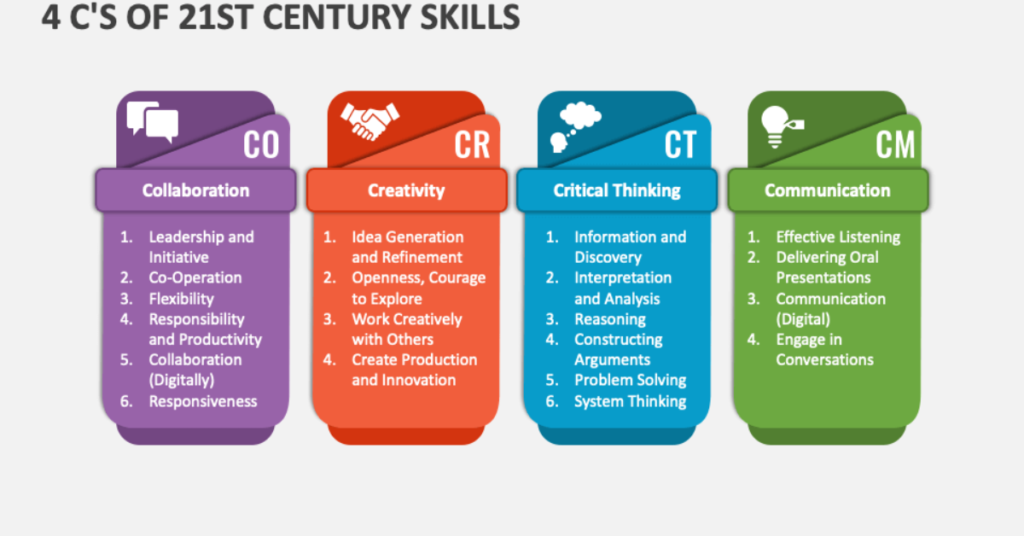
The 4 c’s represent four key abilities that help students thrive in school and beyond:
- Critical Thinking
- Communication
- Collaboration
- Creativity
Each skill plays an important role in personal and academic development.
Critical Thinking: Learning How to Think
Critical thinking is the ability to analyze information, ask questions, and make informed decisions. Instead of simply accepting information, children learn to evaluate facts and consider different perspectives.
Why Critical Thinking Matters
Children encounter information every day through books, conversations, television, and the internet. Critical thinking helps them determine what is accurate and useful.
Students with strong critical thinking skills can:
- Solve problems effectively
- Make better decisions
- Understand different viewpoints
- Evaluate information carefully
- Learn independently
How Parents Can Encourage Critical Thinking
Parents can support this skill by:
- Asking open-ended questions
- Encouraging curiosity
- Discussing real-life situations
- Allowing children to make age-appropriate decisions
- Exploring different solutions to problems
Simple activities such as puzzles, science experiments, and storytelling can strengthen analytical thinking.
Communication: Expressing Ideas Clearly
Communication is one of the most valuable skills a child can develop. It involves speaking, listening, reading, and writing effectively.
Benefits of Strong Communication Skills
Children who communicate well are often more confident and successful in social and academic settings. Effective communication helps students:
- Share ideas clearly
- Build positive relationships
- Participate in group discussions
- Understand instructions
- Resolve conflicts peacefully
Ways to Improve Communication
Parents and educators can help children by:
- Encouraging daily conversations
- Reading together regularly
- Practicing public speaking
- Listening actively
- Teaching respectful discussion skills
When children feel comfortable expressing themselves, they become more confident learners.
Collaboration: Working Together Successfully
Collaboration means working with others to achieve a common goal. In today’s interconnected world, teamwork is essential in almost every profession.
Why Collaboration Is Important
Children who learn to collaborate develop valuable social and emotional skills. They learn how to:
- Respect different opinions
- Share responsibilities
- Support team members
- Resolve disagreements
- Achieve goals together
These experiences help prepare students for future workplaces where teamwork is often required.
Building Collaborative Skills
Teachers and parents can encourage collaboration through:
- Group projects
- Team sports
- Community activities
- Family responsibilities
- Cooperative games
Children learn that success often comes from working together rather than working alone.
Creativity: Turning Ideas Into Reality
Creativity is the ability to generate new ideas, imagine possibilities, and develop innovative solutions. It is not limited to art or music. Creativity can be applied to every subject and situation.
Why Creativity Matters
Creative thinkers are often better problem-solvers because they can approach challenges from different angles.
Benefits of creativity include:
- Increased confidence
- Better problem-solving abilities
- Greater flexibility
- Improved innovation
- Stronger self-expression
Encouraging Creative Thinking
Parents can nurture creativity by:
- Providing opportunities for imaginative play
- Encouraging artistic activities
- Allowing experimentation
- Supporting curiosity
- Celebrating unique ideas
Children should feel free to explore and learn without fear of making mistakes.
How These Skills Work Together
Although each skill is important on its own, they become even more powerful when combined.
For example, a student working on a science project may:
- Use critical thinking to analyze information
- Communicate findings clearly
- Collaborate with classmates
- Apply creativity to develop solutions
Together, these abilities help children become adaptable and successful learners.
The Role of Schools in Developing Essential Skills
Schools play a major role in helping students build these abilities. Effective educational environments provide opportunities for discussion, teamwork, problem-solving, and creative exploration.
At institutions such as NH Montessori, educators focus on creating learning experiences that support both academic achievement and personal growth. This balanced approach helps students develop confidence and independence while mastering important life skills.
Classrooms that encourage active participation often produce students who are more engaged and motivated to learn.
The Role of Parents
Parents are a child’s first teachers and have a significant influence on skill development.
Create a Supportive Environment
Children learn best when they feel safe, respected, and encouraged.
Encourage Questions
Allow children to ask questions and explore topics that interest them.
Promote Reading
Reading expands knowledge, vocabulary, imagination, and communication abilities.
Support Independence
Giving children age-appropriate responsibilities helps build confidence and decision-making skills.
Celebrate Effort
Recognizing effort rather than focusing only on results encourages continuous learning and growth.
Preparing Children for the Future
The world is changing rapidly. Many future careers may not even exist today. Because of this uncertainty, children need flexible skills that can help them adapt to new opportunities and challenges.
Employers increasingly seek individuals who can think critically, communicate effectively, work with others, and develop innovative solutions. These abilities remain valuable regardless of industry or profession.
By focusing on the 4 c’s, parents and educators can help children build a strong foundation for lifelong success.
Long-Term Benefits
Students who develop these essential skills often experience:
- Higher academic achievement
- Greater confidence
- Better social relationships
- Improved leadership abilities
- Stronger problem-solving skills
- Increased adaptability
- Better career readiness
These benefits continue throughout adulthood and contribute to personal and professional success.
Conclusion
Education is about much more than memorizing facts or earning high grades. Children need practical skills that prepare them for real-life situations and future opportunities. The 4 c’s provide a framework for developing these important abilities.
When parents and educators work together to strengthen critical thinking, communication, collaboration, and creativity, children gain the tools they need to thrive in a rapidly changing world. Investing in these skills today can help create confident, capable, and successful adults tomorrow.