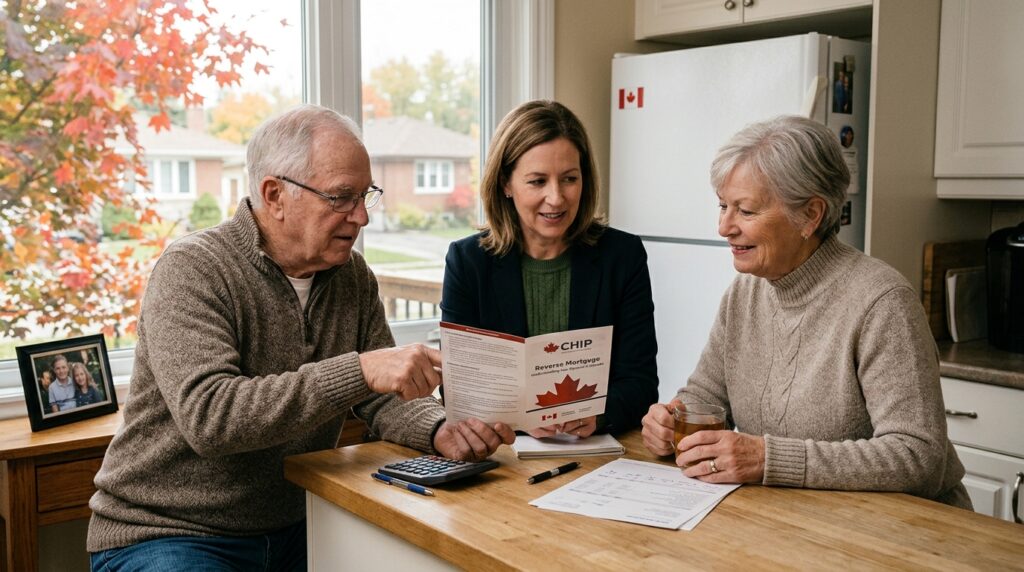
“renewal cliff.” With nearly one million mortgages coming up for renewal this year, many homeowners are facing payment increases of 15% to 20% compared to their previous fixed-rate terms. For those on a fixed income, these rising costs have transformed home equity from a dormant asset into a vital lifeline. A reverse mortgage in Canada has emerged as a primary tool for seniors aged 55 and older to navigate this environment without being forced to sell the family home.
However, accessing home equity is not a decision to be made lightly. While the promise of tax-free cash with no monthly payments is appealing, the long-term impact of compounding interest and setup costs must be weighed against the lifestyle benefits. This guide provides a comprehensive breakdown of the current 2026 costs, the inherent risks to your estate, and the strategic benefits of leveraging your home’s value in today’s economy.
Decoding the Costs: Interest Rates and Fees in 2026
The most immediate concern for any borrower is the cost of borrowing. In June 2026, the interest rate environment for a reverse mortgage in Canada has stabilized following the Bank of Canada’s easing cycle. Rates currently range from approximately 6.44% to 7.50% for standard fixed terms. While these rates are typically 2% to 3% higher than traditional conventional mortgages, they reflect the unique nature of a loan where no payments are required for decades.
Beyond the interest rate, setup costs are a critical component of the initial financial burden. These costs are often “capitalized,” meaning they are added to the loan balance rather than paid out of pocket. This is convenient for cash-strapped retirees but results in interest being charged on the fees themselves over time. Borrowers should expect to navigate several administrative layers, including home appraisals and mandatory independent legal advice, to ensure they fully understand the commitment.
| Expense Category | Estimated Cost (2026) | Payment Method |
| :— | :— | :— |
| Home Appraisal | $300 – $600 | Out-of-pocket (Initial) |
| Setup/Admin Fee | $1,795 – $2,995 | Deducted from loan proceeds |
| Independent Legal Advice | $500 – $900 | Paid to lawyer directly |
| Closing/Diligence Fees | Included in Admin Fee | N/A |
| Prepayment Penalties | Variable (often 3-year sliding scale) | Deducted at discharge |
The Compounding Interest Factor: Long-Term Financial Impact
The defining characteristic of a reverse mortgage in Canada is that interest is compounded semi-annually and added to the principal balance. Because you are not making monthly payments to cover the interest, the loan balance grows over time. This is known as “negative amortization.” In the 2026 market, where home price appreciation has moderated to a more sustainable 2% to 3% annually, the speed at which debt grows relative to home value is a vital metric for every borrower to track.
For example, a $200,000 initial loan at a 6.95% interest rate will roughly double in approximately 10.5 years. If the home’s value does not grow at a similar pace, the remaining equity for heirs will diminish. Most modern Canadian lenders, such as HomeEquity Bank and Equitable Bank, provide a “No Negative Equity Guarantee.” This ensures that as long as the homeowner meets their obligations—such as paying property taxes and maintaining the home—the amount owed at the end will never exceed the fair market value of the home at the time of sale.
- Initial Equity: The percentage of home value you keep at the start (usually 45% to 85%).
- Equity Erosion: The process of your share of the home’s value decreasing as interest accumulates.
- Break-even Point: The moment where debt growth matches or exceeds home value appreciation.
- Residual Equity: The funds left over for the estate after the loan is repaid.
Strategic Benefits: Tax-Free Cash Flow in a High-Inflation Economy
For many Canadians, the primary benefit of a reverse mortgage is the immediate relief of cash flow pressure. Funds received through a reverse mortgage are classified as loan proceeds, not income. This distinction is critical in 2026, as it means the money is 100% tax-free and does not trigger clawbacks on government benefits like Old Age Security (OAS) or the Guaranteed Income Supplement (GIS). This makes it an ideal tool for “pension bridging” or covering the rising costs of in-home care.
Furthermore, a reverse mortgage allows seniors to “age in place.” In a year where the average cost of private assisted living in major Canadian hubs has hit record highs, the ability to stay in a familiar environment while accessing the funds needed for renovations or healthcare is a significant psychological and financial benefit. Many borrowers use the funds to eliminate existing debt, such as high-interest credit cards or remaining traditional mortgage balances, effectively freeing up hundreds or thousands of dollars in monthly disposable income.
Why Tax-Free Access Matters for Retirees:
- OAS/GIS Protection: Income-tested benefits remain untouched because loan proceeds aren’t “income.”
- Tax Bracket Management: Allows you to keep your RRIF or RRSP withdrawals at a minimum to avoid higher tax brackets.
- Debt Consolidation: Replaces monthly debt obligations with a single, non-recourse loan.
- Investment Preservation: Avoids the need to sell stocks or mutual funds during a market downturn.
Risk Mitigation: Protecting Your Estate and Your Heirs
A common fear regarding a reverse mortgage in Canada is that the bank will “take the house” or leave the children with a debt they cannot pay. Under current Canadian regulations and lender policies in 2026, these fears are largely unfounded, provided the borrower understands the terms. The homeowner retains full title and ownership of the property. The lender only steps in when the last remaining borrower passes away or moves into long-term care, at which point the estate typically has 180 days to settle the loan.
The most significant “risk” is the reduction of the inheritance. Heirs do not inherit the debt personally, but they do inherit a property with a significant lien against it. Open communication with family members is essential to prevent surprises. In many cases, heirs choose to take out a traditional mortgage to pay off the reverse mortgage and keep the family home, or they simply sell the property and keep the remaining equity.
Key Protections for Canadian Borrowers:
- No Negative Equity Guarantee: You will never owe more than the home is worth.
- Full Ownership: You remain on the title and can sell the home at any time.
- Independent Legal Advice (ILA): It is a mandatory requirement to speak with a lawyer before signing.
- 90 to 180-Day Grace Period: Heirs are given time to settle the estate without immediate foreclosure.
Reverse Mortgage vs. HELOC: Choosing the Right Equity Release
Many homeowners consider a Home Equity Line of Credit (HELOC) as an alternative to a reverse mortgage. In the 2026 economic climate, qualifying for a HELOC has become more difficult for retirees due to stricter income-to-debt ratio requirements. A HELOC requires at least interest-only monthly payments, which can strain a fixed budget. Conversely, while a reverse mortgage has a higher interest rate, its lack of monthly payment requirements provides a level of “disposable income security” that a HELOC cannot match.
For a homeowner who still has a high monthly income and only needs short-term cash, a HELOC might be the cheaper option. However, for the “house-rich, cash-poor” senior, the reverse mortgage is often the only sustainable long-term solution. Below is a comparison of how these two products function in the current market.
| Feature | Reverse Mortgage | HELOC |
| :— | :— | :— |
| Monthly Payments | None required | Interest-only or P+I required |
| Qualification | Based on age and home value | Based on income and credit score |
| Impact on Cash Flow | Increases monthly cash flow | Decreases monthly cash flow (due to payments) |
| Maximum Loan-to-Value | Up to 55% | Up to 65% (80% combined with mortgage) |
| Interest Rates | Higher (Fixed/Variable) | Lower (usually Prime + 0.5%) |
| Risk of Recall | Very low (as long as taxes/insurance are paid) | Lender can freeze or reduce limit at any time |
The Qualification Roadmap: Is Your Home and Age Ready?
To qualify for a reverse mortgage in Canada in 2026, there are three primary pillars: age, property type, and equity. All owners on the home’s title must be at least 55 years old. The amount you can borrow is heavily influenced by the age of the youngest borrower; a 55-year-old may only qualify for 15% to 20% of their home’s value, while an 80-year-old could access the full 55%.
The property must also meet specific criteria. Lenders in 2026 are increasingly selective about the location and condition of the home. Properties in major urban centers like the Greater Toronto Area (GTA), Vancouver, or Montreal generally command higher loan-to-value ratios than homes in rural areas. Additionally, the home must be your primary residence, meaning you must live there for at least six months of the year.
- Age Minimum: 55+ for all registered homeowners.
- Primary Residence: Must not be a rental-only property or secondary vacation home (exceptions apply for some lenders).
- Home Type: Single-family, semi-detached, and most condos are eligible.
- Existing Debt: Any current mortgage or HELOC must be paid off using the proceeds of the reverse mortgage.
- Location Matters: Accessibility and LTV ratios vary by province and proximity to urban cores.
Navigating the complexities of home equity requires a clear understanding of both the immediate relief and the long-term trade-offs. By weighing the costs and risks against the significant lifestyle benefits, Canadian seniors can make an informed choice that secures their financial future during these volatile times