If you have ever stood on the 17th tee, eight strokes over for the day, and felt like your round was already ruined, Stableford scoring might just change how you see the game. Instead of punishing every bad hole with a number that follows you around like a bad smell, Stableford rewards good holes and lets the disasters fade quietly into the background.
I still remember the first time I played a Stableford event. I triple bogeyed the 4th hole, something that would have wrecked my card in stroke play, and my playing partner just shrugged and said, “Doesn’t matter, you still get your quota next hole.” That mindset shift is the whole point of this format, and once you understand how the points work, you will probably start wishing more of your rounds were scored this way.
So let’s break down exactly how Stableford scoring works, how to calculate it yourself, and why so many club competitions and casual weekend games have adopted it.
What Is Stableford Scoring?
Stableford is a points based scoring system where golfers earn points on each hole based on their score relative to a fixed target, usually par. Unlike stroke play, where every shot counts against your total, Stableford caps the damage from bad holes and rewards strong ones instead.
Who Invented Stableford Scoring?
Dr. Frank Stableford, an English physician and golfer, created this format in the 1930s. He wanted a system that kept players from getting demoralized after one or two rough holes, encouraging them to keep pushing through the round instead of giving up.
Why Golfers Prefer It Over Stroke Play?
Stableford removes the sting of blow up holes. A quadruple bogey costs you the same as a double bogey, zero points, so there is no reason to keep grinding out a lost cause. This keeps pace of play faster and rounds far less stressful.
The Basic Stableford Points System
Before you can calculate anything, you need to know the point values assigned to each score. These values are fairly standard across most clubs and tours, though some private events tweak them slightly for their own competitions.
Standard Point Values
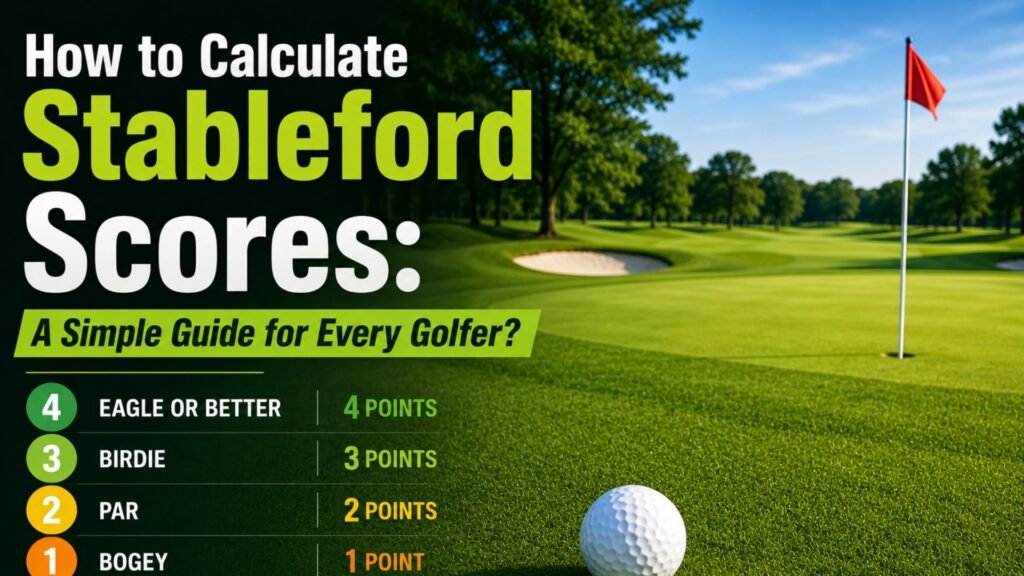
Here is the typical breakdown used in most Stableford competitions:
- Double bogey or worse: 0 points
- Bogey: 1 point
- Par: 2 points
- Birdie: 3 points
- Eagle: 4 points
- Albatross: 5 points
Why the Scale Works This Way?
The scale rewards aggressive, skilled play while softly penalizing mistakes. Notice how there is no way to score negative points. Even your worst hole of the day contributes nothing rather than actively dragging your total down, which keeps momentum and morale intact.
How to Calculate Your Stableford Score Step by Step?
Calculating your score is genuinely simple once you have played a hole. You are just comparing your actual score to par, then assigning points based on that difference. Let’s walk through it properly.
Step 1: Know the Par for Each Hole
Check your scorecard before you start. Every hole has a par value, usually 3, 4, or 5, and this is your baseline target for scoring points on that specific hole.
Step 2: Play the Hole and Record Your Strokes
Play the hole as normal and count your total strokes, including penalty strokes for lost balls, water hazards, or out of bounds shots. This total is what you will compare against par.
Step 3: Compare Your Score to Par
Subtract par from your actual strokes. If you shot a 5 on a par 4, that is one over par, a bogey. If you shot a 3 on that same hole, that is one under, a birdie.
Step 4: Assign the Correct Points
Match your result to the point scale above. A bogey earns 1 point, a par earns 2, a birdie earns 3, and so on. Write this number down next to the hole on your card.
Step 5: Add Up All 18 Holes
Once you have played all 18 holes, add up the points you earned on each one. This total is your final Stableford score for the round.
A Real Example to Make This Click
Numbers on a page only make sense once you see them applied. Let’s say you played a full 18 holes and here is roughly how your card looked, mixing good holes with a few rough patches along the way.
Sample Scorecard Breakdown
Imagine 6 pars, 3 bogeys, 2 birdies, and 7 double bogeys or worse across your round. That gives you 12 points from pars, 3 from bogeys, 6 from birdies, and 0 from the rest, totaling 21 points.
What a Good Score Actually Looks Like?
A score of 36 points typically represents playing to your handicap in a standard Stableford format. Anything above 36 usually means you are playing better than your handicap suggests, and scores in the low 40s are considered an excellent round.
Stableford Scoring With Handicaps
Most club competitions use net Stableford, which factors in your handicap to level the playing field between players of different skill levels. This is where a lot of golfers get confused, so let’s clear it up.
How Handicap Strokes Are Applied?
Your handicap determines how many extra strokes you receive across the round, usually applied to the hardest holes first based on the stroke index on your scorecard. These extra strokes adjust your net score on that specific hole.
Calculating Net Stableford Points
Subtract your handicap strokes for that hole from your gross score before comparing it to par. For example, if you shot a 6 on a par 4 but received a stroke on that hole, your net score becomes 5, earning you 1 point instead of 0.
Common Mistakes Golfers Make When Calculating Stableford Scores
Even experienced players trip up on Stableford math occasionally, especially when handicap strokes are involved or when they are new to the format. Here are the errors I see most often on the course.
Forgetting to Apply Handicap Strokes Correctly
Players often forget which holes their handicap strokes apply to, especially on courses where the stroke index is not clearly marked. Always check your scorecard’s stroke index column before the round starts.
Confusing Points With Strokes
New players sometimes think a higher number of strokes means a higher score, which is backward in Stableford. Remember, fewer strokes relative to par means more points, not fewer.
Why Stableford Is Great for Club Days and Casual Rounds?
Beyond the math, Stableford genuinely changes how a round feels. I have played in club days where a member shanked three balls into the trees on one hole, laughed it off, and made par on the very next one, unbothered because that disaster hole cost him nothing extra.
This format keeps groups moving, keeps spirits up, and keeps everyone in contention until the final hole, since one bad stretch rarely eliminates you from a competition the way it would in stroke play.
Final Thoughts
Stableford scoring turns golf into a game about your best moments rather than your worst ones. Once you understand the point system, comparing your score to par, applying handicap strokes correctly, and adding up your total, the calculation becomes second nature after just a round or two.
Next time you are signed up for a Stableford golf event, or even just playing a casual round with friends, try scoring it this way. You might find yourself enjoying the game a little more, and stressing over it a little less.
Frequently Asked Questions
1. What is a good Stableford score for a beginner?
For beginners, anything between 28 and 34 points is respectable, especially if you are still working on consistency. A seasoned player typically scores closer to 36, which represents playing to their handicap.
2. Do you lose points in Stableford if you score badly on a hole?
No, the lowest score you can receive on any hole is 0 points. A blow up hole never subtracts from your total, it simply contributes nothing, protecting your overall score from one bad moment.
3. How many points is a hole in one worth in Stableford?
A hole in one on a par 3 counts as an albatross relative to a longer hole, but on a standard par 3, it is typically scored as an eagle or better depending on the point scale used, often earning 4 or 5 points.
4. Is Stableford scoring used in professional golf?
Yes, the PGA Tour occasionally uses modified Stableford scoring in select events, most notably The Barracuda Championship, which uses an adjusted point system rather than traditional stroke play.
5. Can you play Stableford without a handicap?
Yes, this is called gross Stableford, where points are calculated purely off your actual score against par with no handicap adjustment. It is common in casual rounds or scratch competitions.
6. What happens if I pick up my ball before finishing a hole?
If you cannot finish a hole, or choose to pick up once you can no longer score points, you simply record 0 for that hole and move on. There is no penalty beyond the lost scoring opportunity.