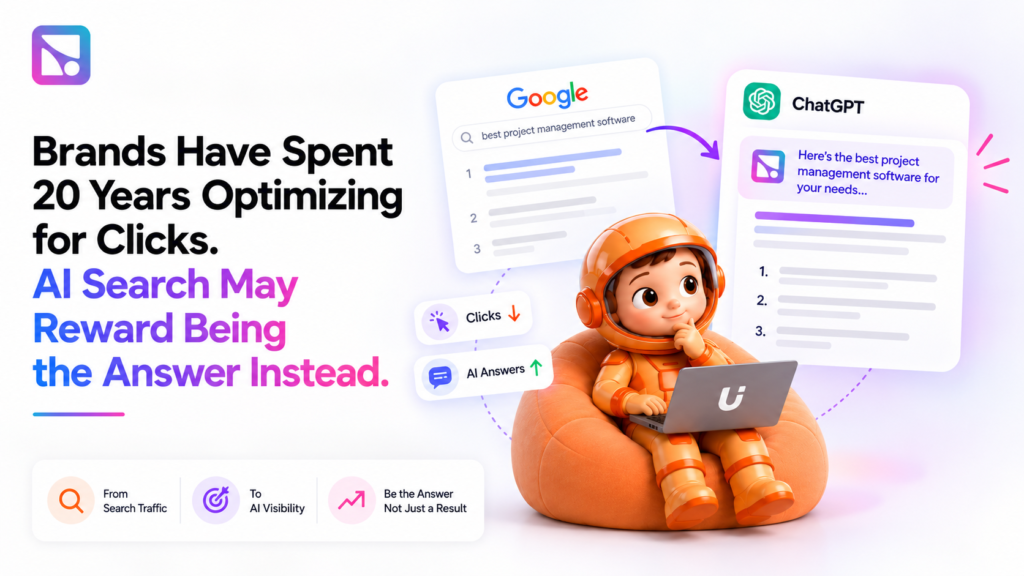
As buyers receive direct recommendations and synthesized answers, marketing success may increasingly depend on being represented inside the answer itself.
For twenty years, the goal of marketing was simple to state, even when it was hard to achieve. Get the click. Rank higher, write a better meta description, earn the backlink, win the impression, and the click would follow. Everything downstream of that click, the conversion, the sale, the customer, depended on first winning the click itself.
That goal is starting to look incomplete.
A growing share of buyers now get their answer before they ever reach a results page. They ask an AI assistant a question, receive a synthesized response naming two or three brands, and make a decision from inside that conversation. No page loads. No click happens. The brand that spent years earning position one on Google may not even appear in the answer the buyer actually reads.
The click was never really the goal. It was the proxy. AI search is starting to reward the thing the click was always standing in for: being part of the answer a buyer trusts.
The click was always a stand-in for something else
Marketers optimized for clicks because clicks were measurable, and measurable things get budget. But no customer ever wanted to click a link. They wanted an answer to a question: which product fits their situation, which vendor is reliable, which option is worth the money.
A click was the mechanism by which a buyer went and found that answer themselves, one tab at a time. Rankings, ad placements, and meta descriptions were all built to win the moment before that search, the moment where a brand earned the chance to be read.
AI search collapses that mechanism. The buyer describes their situation once, in their own words, and the system reads the market on their behalf. It does the comparing that used to happen across a dozen open tabs. The output is not a list of links to evaluate. It is a shortlist, sometimes a single recommendation, already evaluated.
When that happens, the brand’s job stops being “win the click” and starts being “be part of what gets recommended when nobody clicks at all.”
Twenty years of SEO built for a page. AI answers don’t need one.
Traditional SEO optimized a page to satisfy a search engine’s ranking signals: keywords, backlinks, site structure, page speed, all in service of getting that specific page in front of a specific searcher.
AI systems do not return a page. They return an answer, built from a synthesis of many sources, and a brand can be cited, mentioned, or recommended inside that answer without a single visitor ever landing on the brand’s website in that interaction.
This is not a small technical shift. It changes what “ranking” even means. A page can rank first on Google and still be absent from an AI-generated answer to a closely related question, because the two systems are optimizing for different things. Google is deciding which page best matches a query. An AI platform is deciding what to say in response to a need, drawing on a much wider set of signals about a brand’s credibility and relevance than any single page can carry on its own.
That is why a category of tools built specifically around AI search analytics is emerging. Traditional rank trackers were built to answer “where do we appear on the results page.” That question does not map cleanly onto a world where the result is a paragraph, not a list. Businesses need a different kind of measurement, one built around whether a brand shows up inside an answer at all, not where a page sits in a list of ten.
What it means to be “the answer” instead of a result
Being recommended inside an AI answer depends on a different set of inputs than ranking first in search, even though the two overlap more than most marketing teams assume.
An AI system builds its answer from a wide, distributed set of signals: how a company describes itself, how other sites and publications describe it, what problems it’s consistently associated with, and how often credible, independent sources mention it in the context of a buyer’s question. A single well-optimized product page contributes to that picture. It is no longer the whole picture.
Semrush studied 50,000 brands across 1,094 topic areas and found that appearing for one prompt did not mean a brand consistently owned that topic. Related buyer questions frequently surfaced different brands entirely, and only 15.2% of the topics studied had a clear topic owner. That finding says something important: visibility inside AI answers is not a fixed position a brand earns once. It is closer to a reputation that has to be earned and reinforced across many different ways a buyer might phrase the same underlying need.
That is a harder thing to track by hand. It is also exactly the gap AI search analytics tools exist to close, by testing a wide set of realistic buyer questions rather than a single target keyword, and showing which ones a brand shows up for and which ones it doesn’t.
Why an LLM visibility tracker answers a different question than a rank tracker
A traditional rank tracker answers one question well: where does this page sit for this keyword, today, on this search engine.
An LLM visibility tracker answers a different question: when a buyer describes their problem to an AI system, in the many different ways they might phrase it, does this brand get mentioned, and how does that compare to competitors.
The difference matters because AI-generated answers are not stable in the way a ranked page is. Ahrefs has noted that responses from systems like ChatGPT are probabilistic, meaning a brand can appear in one version of an answer and disappear from a nearly identical follow-up. A single check tells a marketing team very little. What matters is the pattern across repeated queries, different phrasings, and multiple AI platforms, since a business’s presence in ChatGPT, Gemini, Claude, Copilot, and Perplexity can vary meaningfully from one to the next.
This is the layer WorksBuddy built Ranko to track. Rather than assigning a page a rank, Ranko monitors the actual questions buyers ask across AI engines, records which brands get named in the answers, tracks share of voice against named competitors, and identifies which sources those answers are drawing from. It treats AI visibility as a pattern to monitor over time, the way a rank tracker monitors a keyword’s position, rather than a single lucky mention to celebrate and forget.
The traffic case for paying attention now
This is not a purely defensive argument. There’s a growing case that buyers who arrive through AI-assisted research convert better once they do reach a website.
Adobe found that between April and June 2026, traffic from AI sources to U.S. retail websites grew 125% year over year. Separately, Adobe reported that AI-referred visitors to U.S. retail sites converted 42% better than visitors from non-AI sources, spent 48% longer on the site, and viewed 13% more pages. The pattern held during the 2026 Prime Day period as well, with AI-driven traffic converting 40% better than non-AI channels.
Those figures are retail-specific and shouldn’t be assumed to transfer directly to every B2B category. But the underlying logic is worth taking seriously regardless of industry. A buyer who reaches your site after an AI system has already narrowed the field for them arrives further along in their decision than a buyer clicking a paid ad cold. If AI systems aren’t naming a brand in the first place, that brand never gets the chance to receive that better-qualified visitor at all.
Being a good answer for AI means being a good source on the web
None of this makes the old work obsolete. It changes what the old work is for.
A page that ranks well in Google still matters, both because search remains a major channel and because that same page is part of the evidence AI systems draw on when forming their answer. A press mention is no longer valuable only because a human reads the article. It becomes another signal an AI system can weigh when deciding whether a brand belongs in its answer to a related question. A clear, well-written comparison page, a detailed FAQ, an expert quote in a trade publication: all of it becomes part of the wider information environment machines use to decide what a brand is and when to recommend it.
The businesses adapting well to this shift are not abandoning SEO. They are extending the same discipline that built strong search visibility into a new target: consistent, credible, specific representation across the sources AI systems already trust.
Conclusion
Twenty years of marketing infrastructure was built to win a click. That infrastructure is not wasted, but it was never really the finish line. It was the mechanism for getting a brand in front of a buyer who would then have to do their own evaluating.
AI search does more of that evaluating upfront, and it does it whether or not a brand has prepared for it. The businesses that show up in that evaluation are not necessarily the ones that rank highest today. They are the ones that show up consistently, across many phrasings of the same buyer need, with sources credible enough for an AI system to trust and cite.
Measuring that requires a different kind of tool than a keyword tracker, one built to test how a brand is actually represented across the AI systems buyers are already using to decide. See how Ranko tracks AI search visibility and shows exactly where a brand shows up in the answer, and where it doesn’t.