mobile windshield replacement
Your new windshield goes in, the adhesive sets, everything looks perfect. Then the technician says the job isn’t done yet, there’s a calibration step left. If your reaction is “wait, calibration of what,” you’re in good company. Most drivers have no idea their windshield is doing anything beyond keeping bugs out of their teeth.
But if your car has lane departure warnings, automatic emergency braking, or adaptive cruise control, there’s a camera mounted to that glass. Move the glass, and that camera’s view of the world shifts slightly. Calibration is how you tell it where it’s actually looking.
Quick answer: ADAS calibration is the process of realigning your vehicle’s camera and sensor systems after the windshield they’re mounted to has been removed and replaced. Skipping it means your safety features may misjudge distance, lane position, or when to brake. Most reputable mobile windshield replacement providers include it as a required step, not an upsell.
What Calibration Actually Does
Think of it like a pair of glasses knocked slightly off-center on your face. You can still see, but everything sits a degree or two from where your brain expects it. Your camera has the same problem after windshield replacement SC technicians perform, except the camera can’t compensate the way your brain does. Calibration resets its reference point so it reads lane lines, vehicles, and obstacles from the correct angle.
Why Your Windshield Affects Safety Systems at All

The forward-facing camera on most modern vehicles is mounted directly to the windshield glass, usually behind the rearview mirror housing. That camera was aimed and calibrated at the factory against a windshield sitting in an exact position.
A replacement windshield can sit a fraction of a millimeter differently in the frame. That sounds like nothing. At fifty yards down the road, a fraction of a millimeter at the camera translates into a meaningful error in where the system thinks a lane line sits. This is why calibration follows nearly every mobile windshield replacement on a camera-equipped vehicle, and why any windshield replacement SC shop that skips it is cutting a genuine safety corner.
The Two Types of Calibration
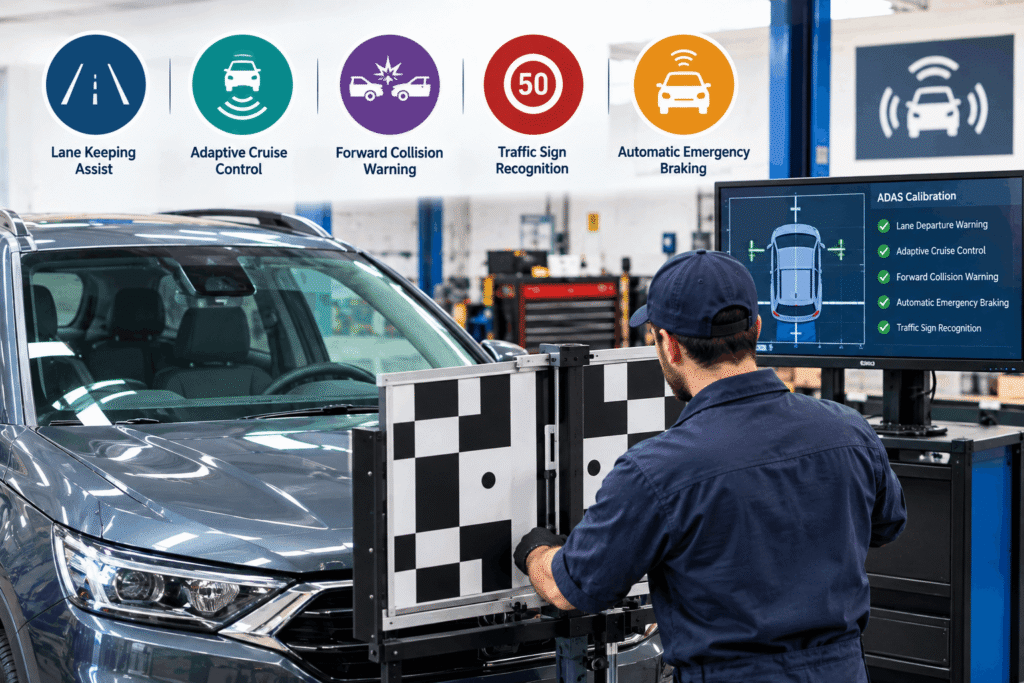
1. Static Calibration
Static calibration happens with the vehicle stationary. The technician positions specific printed targets at manufacturer-specified distances and heights in front of the car, then runs a scan tool that teaches the camera what it should be seeing. This requires a flat, level surface with controlled lighting and enough clear space, which is why static jobs sometimes need a shop bay rather than a sloped driveway.
2. Dynamic Calibration
Dynamic calibration happens on the road. After connecting a scan tool, the technician drives the vehicle at a steady speed on well-marked roads while the system recalibrates against real lane lines. This one works fine at a mobile windshield replacement appointment, since the test drive can start from your driveway just as easily as a shop parking lot.
3. Dual Calibration
Some vehicles require both, static targets first, then a confirming road drive. Manufacturers decide this, not the shop. If your vehicle calls for dual calibration, expect the appointment to run longer than a standard mobile windshield replacement without ADAS, and expect a windshield replacement SC provider to flag that timing difference before you book.
Which Systems Depend on Correct Calibration
People often don’t realize how many features route through that one camera:
- Lane departure warning and lane keep assist
- Automatic emergency braking and forward collision alerts
- Adaptive cruise control that maintains following distance
- Traffic sign recognition
- Automatic high beam switching
- Pedestrian and cyclist detection on some models
Every one of those reads the road through the camera mounted to the glass you just replaced.
What Happens If You Skip It

An uncalibrated system doesn’t usually shut off and announce itself. That’s the dangerous part. It keeps running, just with a slightly wrong understanding of where things are. Automatic braking might trigger late. Lane keep assist might nudge you toward the edge of a lane rather than the center.
There’s also a liability angle worth knowing. If a crash occurs and an investigation finds the ADAS system was never recalibrated after windshield replacement SC records show was performed, that becomes a complicated conversation with an insurer.
Warning Signs of Bad Calibration
Watch for these after any windshield job:
- Lane keep assist tugging the wheel toward one side consistently
- Adaptive cruise braking earlier or later than it used to
- Dashboard warning lights for driver assistance systems
- Automatic high beams behaving erratically
Any of these after a mobile windshield replacement means going back and having the calibration verified.
What to Ask Before Booking
A few questions separate a thorough mobile windshield replacement provider from one treating calibration as optional:
- Does my specific vehicle need static, dynamic, or dual calibration? A provider who can answer from your VIN has done the homework.
- Is calibration included in the quote or billed separately? Both are normal, but you want to know before the invoice arrives.
- Do you perform it in-house or subcontract it? Subcontracting isn’t a dealbreaker, but it affects timing.
- Will I get documentation confirming calibration was completed? Keep this record with your service paperwork.
Conclusion
ADAS calibration isn’t a padded line item, it’s the step that makes your safety features trustworthy again after the glass they depend on has been swapped out. Static calibration needs a controlled space, dynamic calibration happens on a road drive, and some vehicles need both. Any quality windshield replacement SC provider will tell you which one your vehicle requires before work begins, include documentation afterward, and never treat it as optional. If a shop doesn’t mention calibration at all on a camera-equipped car, that silence is your answer about whether to book with them.
FAQs
- Does every vehicle need ADAS calibration after windshield replacement SC shops perform?
No, only vehicles with a windshield-mounted forward-facing camera. Older cars without driver assistance systems don’t require it at all.
- How long does calibration add to a mobile windshield replacement appointment?
Dynamic calibration usually adds 20 to 45 minutes for the road drive. Static or dual calibration takes longer and may require relocating to a level indoor space.
- Can calibration be done in my driveway?
Dynamic calibration, yes. Static calibration needs a flat, level surface with proper lighting and clearance, so it sometimes has to happen at a shop.
- Does insurance cover calibration costs?
Usually yes, when the windshield claim itself is covered. In South Carolina, comprehensive coverage that handles windshield replacement SC claims typically covers the required calibration too.
- What if my warning lights come on days after the job?
Go back to the provider. Delayed warning lights often mean the calibration didn’t hold or wasn’t completed correctly, and a reputable shop will verify it under their workmanship warranty.