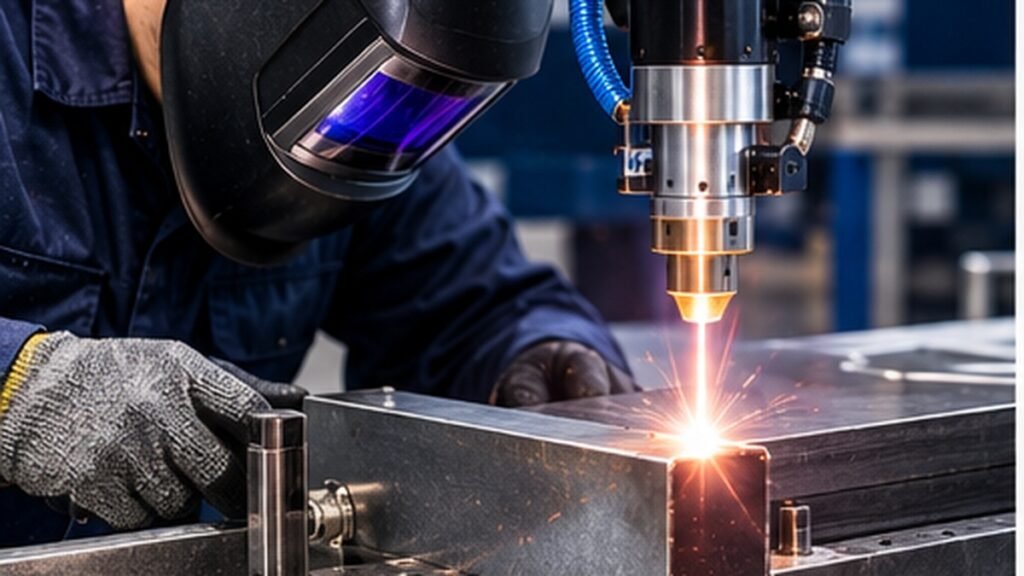
welding with a laser
Laser welding has a reputation for precision and thin-section work. Tiny parts, delicate assemblies, narrow heat-affected zones, that is what most people picture when they think about it. So when engineers start asking how thick a laser welder can actually go, the answers sometimes catch people off guard.
The truth is that modern laser welding systems handle material thicknesses that would surprise anyone who formed their opinion about the process ten years ago. And yet, thickness capability in laser welding is not a single number you can pull from a chart and apply to every situation. It shifts based on the laser system, the material, the joint design, the quality requirements, and whether you need one clean pass or are willing to do multiple.
This guide gives you real numbers, clear explanations of what controls them, and honest guidance on where the process works brilliantly versus where it needs help from other technologies.
The Direct Answer Engineers and Buyers Need First

1. Typical Thickness Ranges Across Common Materials
For most industrial fiber laser systems running between 2kW and 10kW of output power, practical single-pass welding depths fall in the following ranges. Stainless steel welds cleanly up to about 6mm in a single pass on a mid-power system, with higher-power systems pushing that toward 10mm or more. Titanium, which responds well to laser energy, achieves similar depths. Aluminum is harder and requires more power for equivalent penetration, typically landing at about 60 to 70 percent of the steel depth on the same machine.
At the high end of commercial laser welding power, 20kW and above, single-pass penetration depths in steel can exceed 25mm under optimized conditions. Multi-pass welding extends the practical range further for structural applications where multiple weld beads are engineered into the joint design.
2. Why Maximum Thickness Is Never One Fixed Number
Asking how thick a laser welder can weld is a lot like asking how fast a car can go. The answer depends entirely on which car, on which road, under which conditions, and what you consider acceptable performance at the end of the run. A laser system’s maximum weldable thickness shifts dramatically based on power output, beam quality, material type, shielding gas, joint geometry, and whether the application demands a clean, fully certified weld or just fusion.
Laser welding solutions designed for aerospace-grade structural joints operate under very different constraints than those designed for consumer product assembly. Both are laser welding. The thickness numbers they target and the quality standards they must hit are completely different conversations.
3. The Difference Between What Is Possible and What Is Practical
This distinction matters enormously for anyone making process selection decisions. A powerful enough laser can fuse thick metal. Whether it does so at acceptable speed, with the required weld quality, at a reasonable cost, and with the documentation a specific industry demands is a separate question.
Practically speaking, most production laser welding for precision industries targets material thicknesses between 0.1mm and 10mm. This is where laser welding delivers its clearest advantages over conventional processes: minimal distortion, narrow heat-affected zone, precise energy control, and high repeat ability. Thicker work is possible, but the process trade-offs become more significant as thickness climbs.
What Actually Controls Laser Welding Depth

1. Laser Power and Its Direct Relationship to Penetration
Power is the most direct lever for increasing weld penetration. More power delivers more energy to the weld pool per unit time, which drives deeper fusion before the material surrounding the joint pulls that heat away. The relationship between power and penetration is not perfectly linear, but as a working guide, doubling the power of a laser welding system roughly increases single-pass penetration by 40 to 70 percent depending on material and parameters.
A 1kW fiber laser welds stainless steel to about 2mm in a single pass under typical conditions. A 3kW system reaches 4 to 5mm. A 10kW system can hit 10mm or beyond with optimized parameters. Each step up in power opens access to thicker material but also increases equipment cost, operating complexity, and the demands on fixturing and shielding systems.
2. Beam Focus, Spot Size, and Energy Density
Raw power matters less than what you do with it at the focal point. A focused laser beam concentrated onto a very small spot delivers orders of magnitude more energy density than the same power spread across a larger area. That energy density, measured in watts per square centimeter, is what drives the rapid heating and melting needed for deep weld penetration.
Focusing optics, stand-off distance, and beam quality all determine what spot size is achievable at the workpiece surface. A system with excellent beam quality can focus to a tighter spot and achieve higher energy density, enabling deeper penetration at the same power level compared to a system with lower beam quality. This is why beam quality is as important a specification as power output when evaluating a laser welding system for thick-section work.
3. Welding Mode: Conduction vs. Keyhole and Why It Matters
Laser welding operates in two fundamentally different physical regimes, and understanding them is key to understanding thickness capability.
In conduction mode, the laser heats the surface of the material and energy conducts inward gradually. The weld pool is relatively wide and shallow, shaped like a half-sphere. Conduction mode is used for thin materials, surface welds, and applications where cosmetic appearance of the weld face is critical. Penetration depth in conduction mode is limited, typically to a fraction of a millimeter up to a couple of millimeters depending on material and power.
How Keyhole Mode Unlocks Much Greater Penetration Depth
Keyhole mode is where deep welding becomes possible. When laser power density exceeds a threshold specific to the material, the surface does not just melt; it vaporizes rapidly enough to create a vapor-filled channel, the keyhole, that extends deep into the material. The laser beam travels down this channel, depositing energy along its walls, which melt and then flow back together as the beam moves forward, solidifying into a weld bead with a characteristically high depth-to-width ratio.
Keyhole mode welds look completely different from conduction mode welds in cross-section: narrow, deep, and almost parallel-sided rather than wide and shallow. This is the mode that makes it possible to weld 5mm, 10mm, or more in a single pass. Welding with a laser in keyhole mode is fundamentally what separates laser welding from surface fusion processes and is the basis for its use in thick-section joining applications.
Weld Depth by Material Type: Real Numbers to Work With

1. Stainless Steel Welding Depth Capabilities
Stainless steel is one of the most common laser welding materials and a good baseline for understanding depth capabilities. It absorbs laser energy well, has moderate thermal conductivity, and produces clean, consistent welds with proper shielding. On a 3kW fiber laser system running in keyhole mode, single-pass penetration in stainless steel typically reaches 4 to 6mm. A 6kW system extends that to 8 to 10mm. Above 10kW, penetration beyond 12mm becomes achievable, though at that depth the process demands careful parameter optimization and robust fixturing to maintain weld quality.
For production applications, most laser welding on stainless steel targets thicknesses between 0.5mm and 8mm where the process delivers clear advantages over TIG and MIG in terms of speed, distortion control, and heat-affected zone width.
2. Titanium and How It Responds to Deep Laser Welding
Titanium is a laser welding-friendly material in many respects. It absorbs laser energy well at fiber wavelengths, has lower thermal conductivity than stainless steel which helps concentrate heat at the weld zone, and produces strong, clean welds when properly shielded. Penetration depths on titanium are comparable to or slightly better than stainless steel at equivalent power levels.
The critical requirement with titanium is atmosphere control. Titanium reacts aggressively with oxygen and nitrogen at welding temperatures, and even small amounts of contamination produce brittle, discolored welds that fail inspection. Trailing shields, inert gas purging on both sides of the joint, and sometimes full chamber welding under argon or vacuum are required for aerospace and medical-grade titanium weld quality.
3. Aluminum Welding Thickness and Its Unique Challenges
Why Aluminum Requires Higher Power for Equivalent Penetration
Aluminum presents real challenges for deep laser welding. Its high reflectivity, particularly at fiber laser wavelengths, means a significant portion of the incident beam energy is reflected rather than absorbed. Its high thermal conductivity pulls heat away from the weld zone rapidly. Both factors reduce effective energy delivery to the weld pool and limit penetration depth relative to steel on the same power system.
In practical terms, achieving the same weld depth in aluminum as in stainless steel requires approximately 1.5 to 2 times the laser power. A 3kW system that welds 5mm stainless in a single pass may only reach 3mm in aluminum. A 6kW system closes that gap but does not eliminate it entirely.
Aluminum also tends toward porosity in laser welds due to hydrogen absorption and the rapid solidification rates inherent to the process. Process development for thick aluminum laser welding is more involved than for steel or titanium, and the parameter window for consistently clean, pore-free welds is narrower.
4. Nickel Alloys, Inconel, and High-Temperature Superalloys
Nickel-based superalloys like Inconel 625 and Inconel 718 are widely used in aerospace and energy applications where high-temperature strength is critical. They weld with laser, but their high alloy content makes them susceptible to hot cracking and heat-affected zone liquation cracking if heat input is not carefully managed.
Penetration depths on nickel superalloys with industrial laser systems are similar to stainless steel in achievable depth, but the process window for crack-free welds is narrower. Preheat, interpass temperature control, and post-weld heat treatment are often required for structural applications on these materials, adding process steps that must be factored into planning.
How Joint Design Affects Maximum Weldable Thickness
1. Butt Joints vs. Lap Joints and Depth Requirements
Joint design has a direct effect on how thick a laser welder must penetrate to achieve a sound weld. A butt joint on 5mm plate requires full 5mm penetration to create a complete fusion weld. A lap joint on two 3mm plates requires penetration through the top sheet and into the bottom sheet for a structurally sound joint, but does not necessarily require full penetration through both sheets.
Choosing the joint design wisely can make thick-section welding more tractable. Engineering a lap joint where a butt joint was initially specified can bring a job within the capability of a lower-power system, reduce heat input, and improve weld quality consistency, all without changing the function of the finished assembly.
2. Single-Pass vs. Multi-Pass Welding for Thick Sections
Multi-pass laser welding opens up sections that would be beyond single-pass capability. Successive weld beads deposited in a prepared groove joint build up fusion progressively, allowing total joint thickness well beyond what a single keyhole pass can achieve. This approach is used routinely in structural fabrication on sections that exceed single-pass penetration limits.
Multi-pass laser welding requires more process development, careful interpass temperature management, and consistent groove preparation between passes. The total heat input is higher than a single-pass approach, which increases distortion risk. But for thick sections where laser welding’s metallurgical advantages over arc processes are still desired, multi-pass is a practical path.
3. Fit-Up Tolerances and Their Impact on Full-Penetration Welds
Laser welding’s narrow beam is both its greatest advantage and one of its sensitivity points. The joint must be positioned precisely relative to the beam, and the gap between mating faces must be controlled tightly. For full-penetration welds on thick sections, gap width must typically be held to a fraction of a millimeter. A gap that would be trivial in MIG welding can cause incomplete fusion or weld drop-through in laser welding.
This means that machined or precisely formed joint faces are usually required for thick-section laser welding, which adds cost to part preparation but is offset by the reduction in post-weld cleanup, straightening, and secondary machining that laser’s low-distortion process enables.
Industries That Regularly Weld at the Thickness Limits
1. Aerospace Structural Welding Requirements
Aerospace structural welding routinely pushes laser capability toward its practical limits on advanced alloys. Fuselage panels, engine casings, structural brackets, and pressure vessel components all present thick-section welding challenges where the combination of material difficulty, tolerance requirements, and documentation demands makes process selection critical.
Laser welding earns its place here because even at the thickness limits, its advantages over TIG in distortion control and heat-affected zone width translate into tighter dimensional compliance on finished assemblies, which reduces downstream fit-up issues and rework.
2. Medical Device and Implant Welding Constraints
Medical device welding rarely involves the thickest sections that laser systems can handle. The challenge in medical is not maximum thickness but rather welding very thin sections with absolute consistency and zero contamination. Battery housings, implant enclosures, and surgical instrument joints typically involve wall thicknesses from 0.2mm to 3mm where laser welding’s precision and cleanness are what matter, not raw penetration depth.
3. Defense and Energy Sector Thick-Section Welding
Defense and energy sector components, pressure vessels, heat exchangers, turbine components, and munitions casings, represent some of the thicker-section laser welding applications in regular production. These sectors benefit from laser welding’s combination of deep penetration capability, low distortion, and documented process control that regulatory and program requirements demand.
When Laser Welding Reaches Its Limits
1. Where Electron Beam Welding Takes Over
Electron beam welding operates in a vacuum and uses a focused beam of electrons rather than photons to deliver energy to the weld zone. Its penetration capability is greater than laser, with single-pass welds in steel exceeding 100mm under appropriate conditions. For very thick, high-value sections in exotic materials where heat input must be minimized and distortion cannot be tolerated, EBW occupies a capability space that laser welding cannot reach.
The cost and complexity of EBW, requiring vacuum chambers and specialized facilities, keep it in a niche role. But for the applications it suits, it is the right tool regardless of cost.
2. Hybrid Laser-Arc Welding for Bridging the Gap
Hybrid laser-arc welding combines a laser beam with a conventional arc welding process, typically MIG, at the same weld pool. The laser provides deep penetration and keyhole stability while the arc adds filler metal and additional heat input, improving gap bridging and reducing the sensitivity to fit-up variation that pure laser welding exhibits.
Hybrid welding achieves penetration depths greater than laser alone at equivalent laser power, handles wider gaps, and deposits more metal per pass. It is used in shipbuilding, heavy fabrication, and pipeline construction where thick sections, long weld lengths, and tolerance variability make pure laser welding impractical.
3. Process Selection Criteria for Very Thick Sections
When laser welding alone is not the right answer for a thick section, the decision between electron beam, hybrid laser-arc, or conventional arc processes comes down to tolerance requirements, material type, production volume, available infrastructure, and the quality documentation the application demands. No single process dominates all thick-section welding scenarios. The right answer is always the one that meets the full set of requirements at the best total cost over the life of the program.
Conclusion
Laser welding thickness capability is broader than most people expect, and it keeps expanding as laser power and beam quality technology advances. Practical single-pass welding reaches 5 to 10mm on common materials with mid-range industrial systems, and well above that with high-power platforms or multi-pass approaches. Understanding what controls that depth, how material type shifts the numbers, and where the process hands off to complementary technologies gives engineers and buyers the foundation to make accurate process selection decisions and get first-rate results on even the most demanding welding programs.
Frequently Asked Questions
- What is the maximum thickness a laser welder can weld in steel?
High-power industrial fiber laser systems above 20kW achieve single-pass penetration exceeding 25mm in mild steel under optimized conditions. Multi-pass welding extends practical thickness further for structural applications. - Can laser welding replace TIG welding on thick stainless steel?
For sections up to about 8 to 10mm, laser welding often replaces TIG with better speed, lower distortion, and narrower heat-affected zone. Above that range, multi-pass laser or hybrid processes are typically required. - Why does aluminum need more power than steel for the same weld depth?
Aluminum’s high reflectivity and thermal conductivity both reduce effective energy delivery to the weld zone, requiring 1.5 to 2 times more laser power to achieve equivalent penetration compared to stainless steel. - Is multi-pass laser welding as strong as single-pass?
When properly executed with correct interpass temperature management and qualified procedures, multi-pass laser welds achieve mechanical properties equivalent to the base material, meeting the same standards as single-pass work. - What shielding gas works best for deep laser welding?
Argon is the most common choice for deep laser welding across most materials. Helium provides better plasma suppression at high power densities and improves penetration on some materials but costs more. Nitrogen works on certain stainless steels but is unsuitable for titanium.