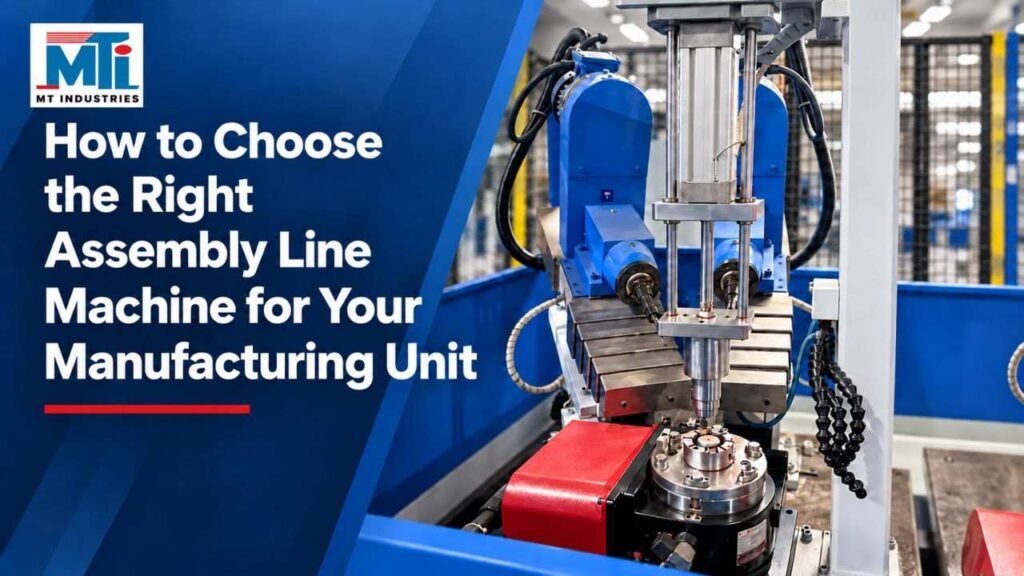
Choosing an Assembly Line Machine starts with a question: what must your production line deliver every shift? A machine that looks fast in a demonstration may still struggle with your components, product variations, quality checks or available floor space. The right choice depends on how the entire process works, from feeding the first part to checking the finished product.
Before requesting quotations, document your current process and the result you need. This guide explains how to compare an Industrial Assembly Machine or a complete Automated Assembly System using practical production criteria.
1. Map the assembly process before choosing a machine
List every operation required to make a finished unit. Include part feeding, positioning, joining, fastening, inspection, marking and unloading where applicable. Record which steps operators perform, how long they take and where errors or delays occur.
Pay particular attention to the slowest step. If one station takes longer than the rest, adding faster equipment elsewhere may leave total output unchanged. Also note whether parts arrive in a consistent orientation and whether their dimensions vary. These details affect the design of feeders, fixtures and inspection stations.
Ask your production and maintenance teams to review the process map. Operators can identify handling difficulties that may be missed in a quotation, while maintenance staff can flag access and service concerns early.
2. Calculate the output you actually need
Set a realistic production target in good units per shift, then work backward to the required cycle time. For example, if you need 800 good units in an eight-hour shift, the line must deliver an average of 100 good units per hour. That equals one good unit every 36 seconds on average. Breaks, changeovers, stoppages and rejected units mean the machine’s operating cycle will usually need to be faster than that average.
Give suppliers the same assumptions when comparing proposals: shift length, expected operating time, product mix and acceptable reject rate. Ask them to state whether a quoted output is a theoretical maximum or an output demonstrated with parts similar to yours.
This is a useful point to involve MT Industries or any shortlisted supplier: share the target along with a representative sample of the product, rather than asking only for the fastest available Assembly Line Machine.
3. Choose the level of automation that fits the work
A manual assembly line can suit lower volumes, frequent product changes or tasks that need operator judgment. A semi-automatic assembly line uses machines for selected operations while operators load parts, transfer items or perform checks. A fully automated line handles more of the sequence with limited routine intervention.
The best option depends on volume and process stability. If designs change often, a highly specialised system may require costly modifications. If the product is stable and output is high, automation may make consistent production easier to achieve.
Ask which tasks the proposed Automated Assembly System will perform automatically and which will still require an operator. “Automatic” is too broad to serve as a complete specification.
4. Check compatibility with your product and future changes
An Industrial Assembly Machine should be assessed against the actual parts it will handle. Provide drawings, material details, weight, dimensions, tolerances and samples where possible. Identify delicate surfaces, difficult part orientations and components that may vary between batches.
If you manufacture several models, ask how the machine changes from one to another. Will operators replace fixtures? Select a stored program? Adjust guides by hand? How long does a typical changeover take, and how will the correct settings be confirmed before production resumes?
Consider likely product changes over the machine’s working life, but be specific. Paying for theoretical flexibility has little value if you cannot name the variations the line may need to handle.
5. Inspect quality control throughout the line
Final inspection alone may allow defects to move through several stations before they are found. Ask where the proposed line checks part presence, position, fastening or other product requirements. The checks should match your actual failure risks.
Discuss what happens when a check fails. Does the machine stop, reject the unit or alert an operator? Can the team identify which station caused the problem? These answers matter as much as the presence of a camera or sensor.
MT Industries should be given your acceptance criteria during the initial discussion so any proposed inspection method can be assessed against measurable requirements. A demonstration using your parts is more informative than a demonstration using a standard sample.
6. Measure the space and utilities available
Confirm the full machine footprint, including safe access for operators, material replenishment, cleaning and maintenance. A line that fits on a floor plan may still be difficult to operate if doors cannot open or staff cannot reach service points.
Document the utilities available at your site, such as electrical supply and compressed air, and ask the supplier to specify requirements. Check how parts will enter the line and where finished units and rejected items will go. If equipment must connect to an existing conveyor or machine, agree on that interface before finalising the layout.
A practical layout should support both production flow and safe access. Review it with the people who will use and maintain the equipment every day.
7. Compare total cost, not just the quoted price
The purchase price is only one part of the decision. Compare installation, tooling, operator training, energy use, routine maintenance, replacement parts and possible downtime. Ask what is included in the quotation and what will be billed separately.
A lower-priced Assembly Line Machine may cost more to run if changeovers take too long or commonly replaced parts are difficult to obtain. Conversely, an expensive fully automated system may be unnecessary for a product made in small, changing batches.
Request an itemised proposal from MT Industries and other suppliers. Use the same product brief for each one, then compare the promised output, included checks, changeover method, support terms and total cost on equal grounds.
8. Verify performance and support before placing an order
Ask how the system will be tested before dispatch and after installation. Agree on a factory acceptance test using suitable components where practical. The test plan should define the required cycle time, quality criteria, operating duration and how failures will be recorded. After installation, a site acceptance test can confirm performance under your factory conditions.
Also clarify documentation, operator training, maintenance instructions, spare parts and the process for getting technical support. These details are particularly important when a stoppage can affect the rest of the production line.
When discussing an Automated Assembly System with MT Industries, request written acceptance criteria. Clear criteria help both teams determine whether the installed system meets the original production requirement.
A practical decision checklist
Before selecting a supplier, make sure you can answer these questions:
- What is the required number of good units per shift?
- Which operation currently limits output?
- Which product variations must the line handle?
- What quality checks are required, and what happens when a unit fails?
- How much floor space and which utilities are available?
- What is included in testing, installation, training and support?
The right Assembly Line Machine is the one that meets your production target reliably with your actual parts, within your available space and operating budget. Give suppliers a clear process brief, test their claims against agreed criteria and involve the teams that will run the line. That groundwork makes the buying decision much more dependable.
Frequently Asked Questions
1. How do I choose an assembly line machine for my product?
Start with your product drawings, component samples, production target, required quality checks and available floor space. Map each assembly step, then ask suppliers to explain how their proposed machine handles your actual parts. Compare performance against written acceptance criteria rather than a general speed claim.
2. What is the difference between a semi-automatic and a fully automated assembly line?
A semi-automatic assembly line requires operators to perform some routine steps, such as loading or transferring parts. A fully automated assembly line performs more of those steps through connected equipment. The better choice depends on production volume, product variation, labour requirements and the cost of changeovers.
3. How much does an assembly line machine cost?
There is no reliable single price for every Assembly Line Machine. Cost depends on the number of stations, level of automation, tooling, inspection requirements and installation scope. Ask for an itemised quotation and compare the total cost of operating and maintaining the line, not only its purchase price.
4. Can one assembly machine handle different product models?
It may be able to, but this depends on how different the models are. Ask whether each model needs a separate fixture, tooling change or program. Request a demonstration of the changeover and confirm the time and checks required before restarting production.
5. What should I ask MT Industries before buying an assembly line machine?
Give MT Industries your product details and output target. Ask for a proposed process layout, the expected output in good units, required utilities, changeover steps, inspection method, acceptance test plan and included support. Get these points in writing so the proposal can be checked against your manufacturing needs.
For More Information Click Here:- https://mtindustries.in/service-assembly