b tech colleges in Lucknow
Two Branches, One Campus, and a Decision That Confuses Most Twelfth Graders
A neighbour’s son came over last year holding his JEE counselling form, completely stuck between two options that sounded almost identical to him — Information Technology and Computer Science with AI and ML specialisation. Both had “computer” written all over the course description. Both promised good placements. He had about six hours to submit his choice and no real sense of what separated them beyond the name.
This confusion is more common than colleges tend to admit. The names of these branches suggest overlap, and there is genuine overlap in the first year or two, but the paths diverge meaningfully by the time students reach their final year — different core subjects, different lab work, and different kinds of jobs waiting at the end.
Why This Confusion Exists in the First Place
Information Technology and Computer Science with AI/ML both live under the broader computing umbrella, both attract students who enjoyed coding in school, and both get marketed with almost identical placement statistics in college brochures. That’s exactly why students end up guessing rather than choosing.
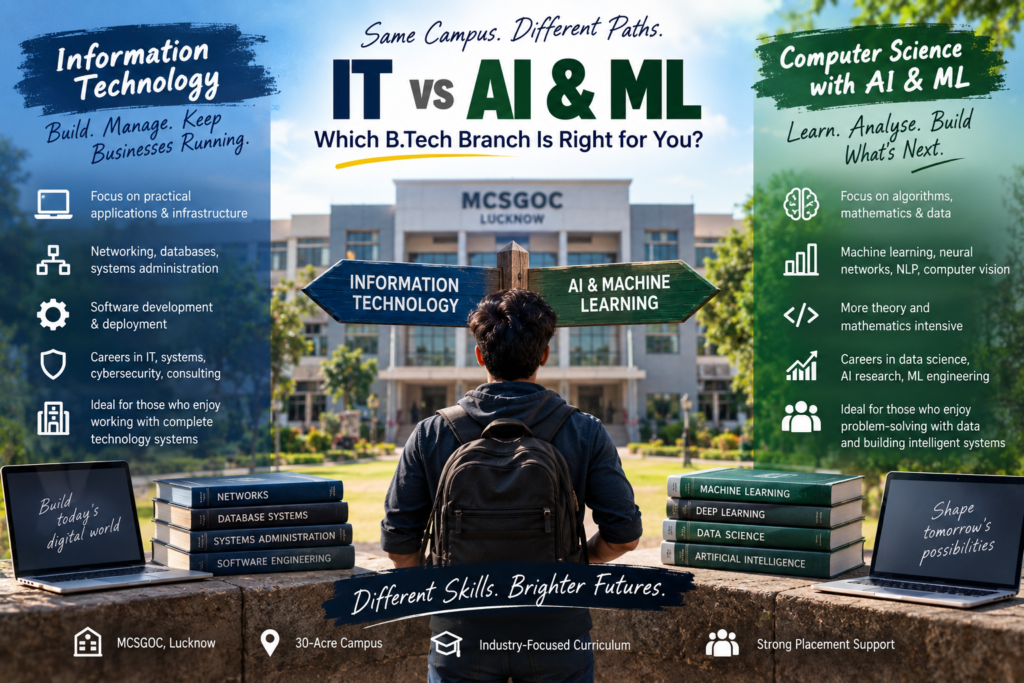
The actual difference comes down to focus. IT as a discipline is built around managing and applying computing systems — networks, databases, software deployment, systems administration, the practical machinery that keeps organisations running on technology. AI/ML sits further into the theoretical and mathematical end of computing — algorithms that learn from data, statistical modelling, and the specific engineering that goes into building systems that improve their own performance over time.
What Information Technology Actually Covers
IT programs build a foundation similar to any core computing branch — programming, data structures, and the fundamentals of how software actually works — but the specialisation leans toward application and infrastructure rather than pure theory. Students spend meaningful time on networking, database management, systems administration, and the software development lifecycle that governs how real-world applications get built, tested, and deployed.
Among b tech colleges in Lucknow offering this branch, the IT program tends to attract students who enjoy the practical, systems-oriented side of computing — people who want to understand how an entire technology stack fits together rather than focusing narrowly on one theoretical specialisation. Career paths from here run through systems administration, network engineering, software development, IT consulting, and cybersecurity roles across almost every industry that runs on digital infrastructure, which today is essentially every industry.
The MCSGOC information technology in btech program specifically positions itself around this application-first approach, training students to design and implement the practical technology solutions that businesses actually need rather than treating computing purely as an academic exercise.
What AI and Machine Learning Actually Covers
This branch goes considerably deeper into the mathematical and statistical foundations that make machine learning work — probability, linear algebra, statistics, and the algorithmic thinking required to build systems that learn patterns from data rather than following fixed, pre-written rules.
Coursework typically covers machine learning algorithms, neural networks, natural language processing, computer vision, and increasingly deep learning as the field’s practical applications have expanded. This is considerably more theory-heavy in the early years than IT, and it demands genuine comfort with mathematics — students who struggled with statistics or linear algebra in school often find this branch harder going than they expected, regardless of how much they enjoyed coding.
B tech artificial intelligence and machine learning graduates tend to move into more specialised roles than IT graduates — machine learning engineer, data scientist, AI research roles, and increasingly positions embedded directly within product teams at companies building AI-driven features into their core offerings. The job titles sound more specific because the skill set genuinely is more specific.
The Overlap That Makes This Confusing
Here’s where the actual overlap lives, and it’s worth naming clearly rather than pretending these branches exist in complete isolation. Both require solid programming fundamentals in the first two years. Both increasingly touch on data — IT students work with databases and data management systems, while AI/ML students work with data as raw material for training models. Both lead to reasonably strong placement outcomes if the underlying college has real industry connections and updated curriculum.
The genuine difference shows up in depth and direction rather than complete separation. An IT graduate could reasonably pivot into a data-adjacent role with some additional upskilling. An AI/ML graduate could work on infrastructure-adjacent problems if the situation called for it. Neither path locks a student permanently into one narrow track, but the four years of specialised coursework do shape which door opens more naturally at graduation.
How to Actually Decide Between the Two
The honest advice here isn’t a checklist — it’s a question worth sitting with for longer than the six hours my neighbour’s son had. Does the idea of designing networks, managing databases, and building the practical technology infrastructure businesses run on sound genuinely interesting? That points toward IT. Does the idea of teaching a system to recognise patterns, working through the mathematics behind why an algorithm behaves the way it does, and building models that improve with more data sound more compelling? That points toward AI/ML.
Mathematical comfort matters more than most students account for when making this decision. A student who finds statistics and linear algebra genuinely tedious will likely struggle more in an AI/ML program than in IT, regardless of how strong their general coding ability is. This isn’t a value judgment on either branch — it’s simply an honest match between a student’s actual strengths and what each program demands.
What to Check Before Committing to Either Branch
Curriculum currency matters significantly for both branches, but especially for AI/ML given how fast the field moves. A program still teaching outdated frameworks or skipping recent developments in deep learning and generative AI is already behind where the industry has moved. For IT, checking whether the curriculum includes current practices in cloud infrastructure and cybersecurity — rather than only legacy networking concepts — serves the same purpose.
Lab access deserves real scrutiny for both. IT students need genuine hands-on time with networking equipment and systems administration tools, not just theoretical instruction. AI/ML students need computational resources actually capable of training models at a reasonable scale, not decade-old lab machines that make every assignment take three times longer than it should.
MCSGOC runs both programs from its Lucknow campus, spread across a 30-acre site, with placement support structured around the specific career paths each branch actually leads toward rather than a single generic placement pitch applied uniformly across every engineering program.
Making Peace With the Decision
Whichever branch a student ultimately picks, the honest reality is that four years of genuine effort in either program leads to a reasonable, employable outcome in a field that continues to have strong demand. The decision matters, but it isn’t the irreversible, life-defining choice it can feel like while filling out a counselling form under time pressure.
What matters more than the branch name on the degree is whether a student actually engages with what that branch teaches — building real projects in IT, or genuinely working through the mathematics in AI/ML — rather than passively sitting through four years of coursework and hoping the placement cell sorts out the rest. That distinction, more than which specific branch gets chosen, tends to determine how the first few years after graduation actually go.