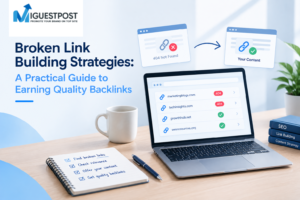
Although having websites which are willing to link back to your content is an important step towards building a quality backlink network, there is more to broken link building strategies than that. The application of effective broken link building strategies will help you to discover the broken links on relevant websites and suggest appropriate replacement materials, which will be beneficial both to users and website owners.
Broken Link Building: Definition
The process of finding links that point to non-existent pages on other websites, for example, which return a 404 page, is called broken link building SEO outreach technique. Then, you look for relevant replacement content and contact the owner of the website suggesting a new resource.
For example, if a marketing blog post contains a link to an old guide about backlinks research, you can suggest replacing it with a high-quality, relevant resource on your own website, covering the same issue.
But locating a broken link is not enough. The new content should be relevant and useful for the initial article.
Pros of Broken Link Building for SEO
In case it is done properly, broken link building offers several possible benefits.
- Backlinks relevance: You could concentrate on relevant publications and sites related to your industry.
- Building relationships: Through the personalized outreach, the editors and the site owners could find out about your company.
- Finding topics: The research could help discover topics, on which you can provide useful resources.
- Improved experience: Your audience could get the needed information by replacing the outdated links with the working ones.
The main goal is to offer the real value rather than gain maximum links.
Strategies for Constructing Dead Backlinks That Will Work
- Locate Relevant Websites
Locating sites that produce relevant content on your topic must be your top priority. You may want to consider checking out industry blogs, references, educational websites, and periodicals.
Look into the backlinks of your competitors and determine some useful pages by means of SEO services like Ahrefs and Semrush. Besides that, you may want to check out some articles and resource pages in Google on the topics of your choice.
It is recommended to choose those websites where the content and audience are similar to yours.
2. Seek Out Broken Links
Once you’ve made a list of relevant websites, find the non-working webpages among the outgoing links from those pages. You will be able to find potentially broken URLs using link checkers and backlink analyzers through your browser.
Before contacting the publisher with your complaint, manually verify your problem. The URL might be unreachable despite the availability of the page due to temporary server problems, a denied request, or a redirect.
Remember to identify the subject matter of the original resource, the page containing it, and the broken URL.
3. Build or Identify an Appropriate Substitute
Providing a solution which is truly useful is vital for success in an outreach campaign. Check the initial source, understand what information was provided there, and find a webpage on your site that performs the same task.
If you do not have an appropriate resource, try composing a comprehensive guide that answers the same question. If you need a backlink, do not suggest unnecessary resources.
The substitute needs to be specific, relevant, understandable, and helpful for the readers of the publisher.
- Create Targeted Outreach Efforts
Create a brief but professional e-mail to the editor or owner of the site. Explain how you found the broken link, provide the URL of the page affected by the problem, and suggest your own resource as an alternative.
Do not be rude. Do not approach those people who refused your idea before or send a spam-like bulk e-mail.
This is the task of the publisher to evaluate your proposal.
- Track Your Results
Track the results by documenting the website, dead link, replacement, outreach date, response, and ultimate placement on a spreadsheet.
Look at what type of contact and websites generate notable responses. Don’t just focus on the number of emails you send out.
Backlinks vs. Referring Domains: What Should Be Measured?
The difference between backlinks vs. referring domains is critical in measuring the outcomes of your link building process. While backlinks refer to the links directing to your website, the referring domains are the unique sites linking to it.
In case one site makes five links to your blog post, there will be five backlinks but one referring domain. Therefore, a list of thousands of backlinks may mean just a few unique websites.
None of the two gives an entire view of the scenario. The ideal way is one that considers the editorial context, number of unique referring domains, quality of linking pages, and whether the links help in getting to relevant content.
Common Mistakes That Should Be Avoided
The high authority value of a website should not be taken into account alone. The review of editorial value and topical relevance cannot be substituted for third-party analyses, as they are estimations.
Do not suggest your article for every broken link that you find. Do not engage in manipulative linking tactics; focus on relevant links and choose natural anchor texts. This is how Google classifies the paid links as per their spam policy guidelines.
Conclusion
When these aspects are taken into account, broken link building can become a powerful tool for a strategically crafted link building approach. It would be wrong to treat each broken link as an opportunity for a backlink. Focus on helping the publishers enhance their sources; your website will be able to make its SEO and backlink strategy even more effective.