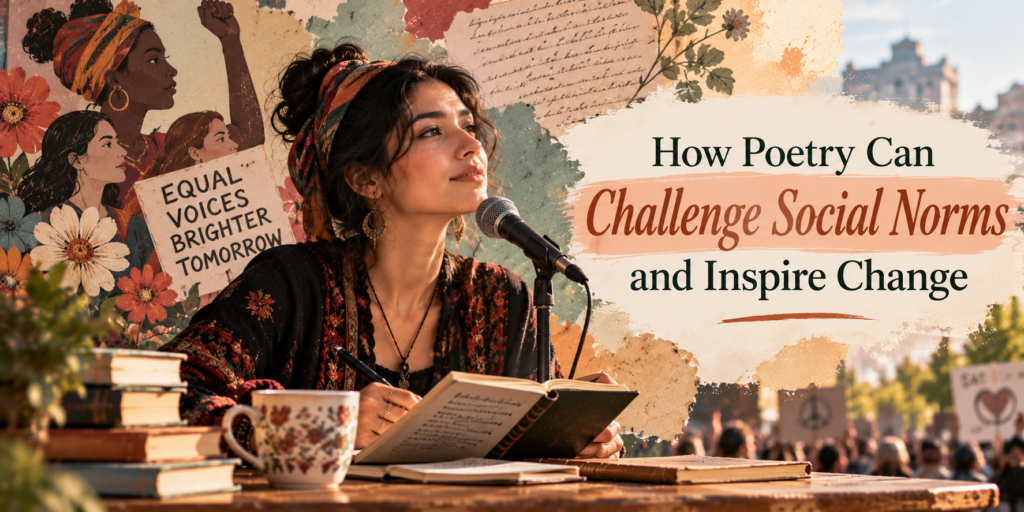
Poetry has always offered people a way to express ideas that are difficult to communicate through ordinary conversation. A few carefully chosen words can question long-standing beliefs, reveal hidden injustices, and encourage readers to reconsider the world around them. From personal experiences to wider social struggles, poems can bring attention to issues that are often ignored or misunderstood. They give individuals the freedom to share their perspectives, challenge expectations, and imagine a fairer future. By combining emotion, imagination, and critical thought, poetry can become a powerful form of expression that inspires meaningful conversations and encourages positive change in society.
Understanding the Power of Poetry
Poetry communicates ideas in a distinctive way. Instead of relying entirely on facts or direct arguments, poets often use imagery, symbolism, rhythm, and personal stories to help readers connect with a subject emotionally. This connection can make complicated social issues easier to understand and remember.
A poem about inequality, for example, might describe an ordinary moment in someone’s life to reveal the effects of discrimination. Another poem might explore the pressure people experience when they are expected to follow traditional rules. These personal details help readers see how broad social expectations influence everyday decisions.
Poetry also leaves room for interpretation. Readers may discover different meanings depending on their backgrounds and experiences. This openness encourages reflection rather than simply telling people what to believe. When a poem introduces an unfamiliar perspective, it can inspire readers to question assumptions they have accepted without thinking.
Questioning Traditional Beliefs Through Words
Social norms are the unwritten rules and expectations that influence how people behave. They can shape ideas about gender, family, success, relationships, identity, and belonging. Although some traditions provide a sense of community, others may restrict individual freedom or reinforce unfair treatment.
Poets can examine these expectations by writing about people whose experiences do not fit conventional standards. A poem might explore a woman choosing independence over social approval, an individual rejecting stereotypes, or a community member questioning an inherited belief. Such writing makes room for perspectives that may otherwise receive little attention.
Challenging social norms does not always require angry or confrontational language. Sometimes a quiet observation can reveal a contradiction more effectively than a direct accusation. A poet may describe the difference between what society promises and what people actually experience, encouraging readers to consider whether established practices are genuinely fair.
Through these approaches, poetry can create opportunities for thoughtful discussion. It allows readers to reconsider familiar ideas and recognize that traditions can evolve as society becomes more aware of different experiences.
Giving a Voice to Underrepresented Experiences
One of poetry’s most important contributions is its ability to make overlooked experiences visible. People who feel excluded from public conversations may use poetry to express their memories, frustrations, hopes, and ambitions. Their words can challenge narrow representations of identity and demonstrate that every individual has a story worth hearing.
Writers may explore experiences related to migration, cultural differences, disability, economic hardship, discrimination, or the struggle to belong. By presenting these subjects through personal narratives, poets can move beyond generalizations and help readers recognize the humanity behind social issues.
Representation matters because stories influence how people understand one another. When readers encounter experiences different from their own, they may begin to question stereotypes and develop a more thoughtful perspective. A poem cannot eliminate prejudice on its own, but it can create a starting point for greater understanding.
Poetry also allows individuals to reclaim the language used to describe them. Instead of accepting labels imposed by others, poets can define their identities through their own words. This freedom can be especially meaningful for people whose perspectives have historically been overlooked or dismissed.
Exploring Gender, Identity, and Personal Freedom
Ideas about gender and identity have influenced social expectations for generations. People may be encouraged to behave in particular ways, pursue certain careers, or organize their lives according to traditional expectations. Poetry gives writers an opportunity to examine these pressures and express the complicated emotions that accompany them.
A poem can explore the difference between a person’s private desires and the role society expects them to perform. It can question why some choices are celebrated while others are criticized, or examine how cultural traditions affect personal independence. These subjects invite readers to think about freedom, equality, and the importance of allowing individuals to make meaningful decisions about their lives.
Writing about identity can also help people understand themselves. Putting difficult experiences into words provides an opportunity to recognize emotions, identify personal values, and consider new possibilities. Readers who recognize their own struggles in a poem may feel less isolated and more confident in expressing their perspectives.
By examining gender and identity with honesty, poets contribute to conversations about respect and equal opportunity. Their work can encourage people to question restrictive expectations while recognizing the value of individual differences.
Using Metaphors and Imagery to Inspire Change
Poets frequently use metaphors and imagery to communicate social messages in memorable ways. A locked door might represent exclusion, a changing season might symbolize transformation, and a growing tree might suggest resilience. These images allow readers to understand abstract ideas through familiar experiences.
Symbolism can make difficult subjects more approachable. Rather than explaining every detail of an injustice, a poet may build a scene that allows readers to feel its emotional consequences. This approach gives the audience space to reflect and draw connections to situations they have witnessed in their own communities.
Strong imagery can also help readers imagine alternatives to existing conditions. A poem describing a community where everyone is heard and respected presents more than a criticism of inequality. It offers a vision of what a more inclusive society might look like.
When writers combine vivid language with meaningful ideas, their poems can remain in the reader’s mind long after the first reading. This lasting impression may encourage conversations, influence personal attitudes, or inspire people to take a closer look at the world around them.
Learning From Poets Who Speak About Social Issues
Reading poetry from different periods and cultural backgrounds helps writers understand how language can respond to social change. Many poets have used their work to address injustice, celebrate cultural identity, question authority, and preserve the experiences of their communities.
Exploring these voices can help readers recognize that poetry is not limited to romantic themes or descriptions of nature. It can also be a record of personal resistance, collective memory, and changing public attitudes. Writers who study socially conscious poetry may discover new ways to approach difficult topics without losing their individual style.
It is useful to consider how a poet develops a central message, chooses particular images, and balances personal emotion with broader social concerns. These observations can guide new writers as they develop their own approaches to meaningful subjects.
A California poetry speaker can also contribute to these conversations by sharing poems, discussing creative experiences, and encouraging audiences to explore how language reflects social realities. Public readings and literary discussions provide opportunities for people to hear different perspectives and consider the relationship between poetry and everyday life. When audiences engage with a poem collectively, its themes can become a starting point for broader dialogue.
Creating Space for Dialogue Through Poetry
Poetry becomes especially valuable when it brings people together to discuss ideas they might not otherwise explore. Readings, literary gatherings, school activities, and community events can create welcoming environments where writers and audiences exchange perspectives.
Listening to someone read a poem aloud can reveal emotions and meanings that may not be immediately apparent on the page. Tone, pauses, and rhythm influence how listeners experience the words. A discussion afterward allows participants to explain what stood out to them and how the poem relates to their own experiences.
These conversations work best when participants feel comfortable disagreeing respectfully. Poetry does not need to provide one final answer to every social question. Instead, it can encourage people to ask better questions, listen carefully, and consider viewpoints beyond their usual circles.
Community poetry events can also connect people across generations and backgrounds. When individuals share their stories, they may discover common concerns despite differences in age, culture, or personal circumstances. Such connections can strengthen understanding and create a foundation for cooperative action.
Developing Socially Conscious Writing Skills
Writers who want their poetry to inspire change should begin with subjects they genuinely care about. Personal observations, community experiences, historical events, and everyday interactions can all provide starting points. The goal is not to address every social problem in a single poem but to explore one meaningful idea with clarity and depth.
Research can help writers approach unfamiliar subjects responsibly. Reading different perspectives and checking relevant facts can prevent oversimplification. At the same time, personal reflection allows poets to identify the emotions and questions that make a subject important to them.
Revision is equally essential. An early draft may contain a strong feeling but lack a clear focus. Reading it aloud, removing unnecessary phrases, and experimenting with images can make the message more effective. Feedback from other writers can reveal how readers interpret the poem and whether its central idea comes through as intended.
A poetry writing workshop offers a useful environment for developing these skills. Participants can experiment with language, exchange constructive feedback, and discuss ways to approach challenging subjects thoughtfully. A supportive workshop can also help writers build confidence, explore different forms, and refine their voices without feeling pressured to follow a single creative formula.
Writers should remember that meaningful poetry does not need to sound complicated. Honest language, careful observation, and a clear emotional purpose can often communicate more effectively than elaborate wording.
Turning Reflection Into Meaningful Action
Poetry can influence how people think, but lasting social change usually requires participation beyond reading and writing. A poem may introduce an issue, encourage empathy, or motivate someone to learn more. Readers can then use that awareness to support community initiatives, participate in discussions, volunteer, or advocate for fairer practices.
Writers can contribute by sharing their work in public spaces, collaborating with community organizations, and creating opportunities for others to tell their stories. They can also use digital platforms to reach readers who might not have access to traditional literary events.
It is important to recognize that change rarely happens immediately. Some poems affect a small group of readers, while others become part of wider cultural conversations over time. Their influence may be difficult to measure, yet even a single poem can help someone feel understood or reconsider a deeply held belief.
The purpose of socially conscious poetry is not necessarily to persuade every reader. It is to make space for reflection, challenge silence, and remind people that the world they inhabit can be questioned and improved.
Conclusion
Poetry can challenge social norms by questioning restrictive expectations, highlighting underrepresented experiences, and encouraging readers to see familiar issues from new perspectives. Through personal stories, powerful imagery, and thoughtful language, poets can open conversations about identity, equality, freedom, and belonging. Although a poem cannot solve every social problem, it can influence attitudes and inspire people to think more deeply about their responsibilities to one another. When writers share their voices and audiences respond with curiosity, poetry becomes more than an artistic expression. It becomes a meaningful way to encourage understanding, imagine possibilities, and contribute to positive social change.