Key Takeaways
- Dubai’s hotel sector is large and fast-moving: connected systems beat stand-alone tools.
- Fix the core first: PMS, booking engine, POS and payments, then add guest-facing apps.
- Compare three-to-five-year costs, not one month’s subscription against a build quote.
- Hybrid works well: keep a proven PMS and build custom apps or integrations for the gaps.
- Plan for the tourism dirham, guest data protection and secure payments from day one.
- Use a 90-day roadmap to measure results before committing to a bigger rollout.
- Smart upgrades improve efficiency, enhance guest experience and keep you competitive in a rapidly evolving market.
Dubai’s hotels run on a tight clock. A guest lands at DXB in the early hours and expects a room that is ready, a restaurant bill that posts to the right folio, and a checkout that takes two minutes. Behind that experience sit room inventory, F&B outlets, online bookings, tourism dirham reporting and a front-desk team juggling all of it. When those pieces live in separate tools, someone ends up re-typing data, and guests notice.
This guide is written for owners, operations directors and CIOs who need to decide how to modernise. It covers the systems a Dubai hotel actually needs, the 2026 trends worth funding, build-versus-buy logic, realistic budgets, compliance, and a 90-day plan. If you are weighing hospitality Software development against configuring an existing platform, you will find the decision criteria here, along with indicative figures that are labelled as planning ranges, not supplier quotes.
Why Dubai’s Hospitality Software Market Is Different in 2026
Rising guest volumes and premium service expectations
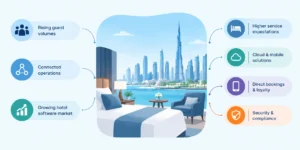
Dubai welcomed 19.59 million international overnight visitors in 2025, a 5% rise on 2024, according to the Dubai Department of Economy and Tourism (DET). Hotels recorded 44.85 million occupied room nights at an average occupancy of 80.7%, with guests staying 3.7 nights on average.
2026 began with a disrupted stretch for Gulf travel, but recovery has been steady. DET reported 6.97 million international visitors and 21.61 million occupied room nights for January to August 2026, with August occupancy reaching 66%, the strongest monthly figure in six months. Inventory stands at roughly 149,000 rooms across 794 hotel establishments, and the average daily rate for the period was reported at AED 470.
Those numbers explain why small inefficiencies get expensive here. When rooms are valued at that level, a double-booked room, a missed minibar charge or a slow check-in has a real cost. Technology helps teams keep service consistent without hiring at the same pace as demand: faster check-in, accurate live availability, and service requests routed straight to the right person.
Fragmented systems and the need for connected operations
Few Dubai properties built their technology in one go. A typical hotel has a PMS from one vendor, a POS in each outlet from another, a booking engine bolted on later, a CRM used by sales only, and a payment gateway tied to none of them. Housekeeping may still run on WhatsApp groups.
The cost shows up in small ways. A guest updates a preference at booking and the front desk never sees it. A spa charge reaches the folio a day late. Availability on an OTA lags behind the PMS by an hour. Many operators bring in specialist hospitality IT services Dubai teams to map these gaps before buying anything, because the right fix is often connecting what exists rather than replacing it. An integrated platform, or a well-planned set of integrations, gives every team one version of the guest record and one version of the bill.
What the hotel management software market means for Dubai operators
The hotel management software market is moving in a few clear directions: cloud platforms in place of on-premise servers, mobile-first guest experiences, direct-booking tools, and integration-led modernisation where hotels add capabilities through APIs instead of ripping out everything at once.
Your needs will depend heavily on your property type. A boutique hotel wants light, fast tools and a strong direct-booking engine. A hotel apartment operator cares about long stays, serviced-unit housekeeping and monthly billing. A resort has many outlets and heavy ancillary revenue. A multi-property group needs consolidated reporting and shared guest profiles. This guide deliberately avoids quoting market-size forecasts, because they vary widely by source. What can be said with confidence is the direction of travel: connected, cloud-based and guest-centric.
Essential Hospitality Software Systems Dubai Hotels Need
A useful technology stack is not a shopping list. For each system, ask what it does, what it must connect to, and which operational problem it removes. This is also where system integration services Dubai providers earn their fee, because the value sits in the connections between modules, not the modules alone.
Property management system and booking engine
The PMS is the hotel’s system of record. It handles reservations, front-desk operations, housekeeping status, room inventory, billing and multi-property reporting. Everything else reads from it or writes to it.
The booking engine and channel manager sit on top. Together they keep direct bookings, OTA availability, room rates and corporate reservations in sync. The failure point is almost always inventory accuracy: if the channel manager updates every few minutes instead of in near real time, overbookings follow. When evaluating a PMS, ask how many native integrations it has, how its APIs are documented, and what happens to data when a connection drops.
POS, F&B management and ancillary revenue systems
Restaurants, bars, room service, spas, retail counters and event venues each run on a POS. In a connected setup, charge-to-room posts instantly to the guest folio, outlet-level reports roll up centrally, and payments flow through one processor.
This matters because ancillary spending is often where hotels leave money on the table. If a guest can book a spa slot, order dinner and add a late checkout from one interface, and every charge lands on one bill, those extras become easier to sell and easier to reconcile.
CRM, guest applications and loyalty platforms
A unified guest profile holds stay history, room preferences, dietary notes and communication consent. From it, a hotel can run personalised offers, loyalty programmes and post-stay follow-up.
Guest-facing features include mobile check-in, service requests, digital menus, room-service ordering, digital keys and messaging. This is where hospitality Software development earns its place, provided the app is built to connect with the PMS, POS and CRM instead of sitting beside them as one more disconnected tool. A beautiful app that cannot see room status or post a charge creates more work for staff, not less.
Revenue management, housekeeping and financial systems
Revenue tools use demand forecasting to inform pricing. Housekeeping and maintenance modules update room status, assign tasks and flag repairs. Finance systems handle multi-currency payments, reconciliation, invoicing and tourism dirham accounting.
When these share data, managers see bottlenecks quickly: rooms waiting on cleaning while arrivals queue, outlets with falling margins, or a rate strategy that is not converting.
A connected guest journey in one example. A guest books a deluxe room on the direct booking engine. The reservation lands in the PMS with the guest profile already attached. At check-in, the room status shows as clean because housekeeping marked it complete on a mobile device. That evening the guest dines at the hotel restaurant and charges the meal to the room; the POS posts it to the folio. Later, the guest orders room service through the app, and the kitchen ticket and folio charge are created together. At checkout the bill, including the tourism dirham as a separate line, is already complete. Nobody re-keyed anything.
Quick Question: “Should we launch a guest app before connecting the PMS and POS?”— Usually no. A guest app is only as useful as the data behind it. Connect the PMS, booking engine, POS and payments first, then build guest features on that foundation.
Seven Hospitality Technology Trends Shaping Dubai in 2026
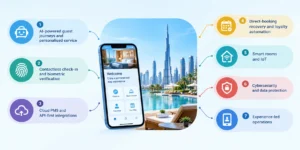
These are the shifts that influence investment decisions, not a generic list of emerging technology.
Trend 1: AI-powered guest journeys and personalised service
AI is now practical in hotels: pre-arrival messaging, conversational concierge support, personalised offers, sentiment analysis on reviews and automated routing of service requests. The caveat is data quality. AI built on incomplete guest records gives generic answers. It also needs clear escalation so that a guest with a complaint reaches a human quickly.
Trend 2: Contactless check-in and biometric verification
Mobile pre-arrival verification reduces front-desk queues, especially at peak arrival times. If biometrics are involved, consent, restricted access, secure processing and sensible retention limits are essential, not optional. Treat identity data as the most sensitive data in your system.
Trend 3: Cloud PMS and API-first integrations
Cloud platforms offer centralised reporting, faster deployment and routine updates. API-first design lets a hotel add capabilities without replacing every system. If you need to connect a legacy PMS to a new booking engine or loyalty tool, a specialist API integration service in Dubai can build and maintain those connections so your core system stays stable. Ask any vendor for API documentation before signing, not after.
Trend 4: Direct-booking recovery and loyalty automation
Hotels pay commissions on third-party distribution, so there is a strong case for winning more direct bookings. Abandoned-booking recovery, clear rate presentation, automated guest communication and repeat-stay campaigns all help. Measure the cost of acquiring each booking by channel, so that you can see whether direct tools actually pay for themselves.
Trends 5 to 7: Smart rooms, cybersecurity and experience-led operations
Three more shifts often arrive together. First, smart-room controls and IoT sensors support predictive maintenance and energy management. Second, cybersecurity is now a design requirement: encryption, access management and audit logs protect guest and payment data. Third, staff mobile applications bring task management, requests and reporting to the people actually doing the work. Each should be tied to a measurable outcome, such as fewer maintenance call-outs, faster room turnaround or reduced response times, so that spend can be justified to an investment committee.
Custom Hospitality Software vs. Off-the-Shelf Platforms
The real question is not custom versus packaged in the abstract. It is whether to configure an existing platform, integrate several products, or commission custom development for the parts that matter most.
When an existing hotel platform is the better choice
Standard PMS and SaaS products suit hotels with conventional workflows and limited customisation needs. You get quicker implementation, vendor support and a product roadmap you do not have to fund. The trade-offs are recurring subscription fees and the limits of what the vendor lets you change.
Platforms worth evaluating include Oracle OPERA, Mews, Cloudbeds and Shiji. These are examples, not a ranking. Fit depends on property type, size and integration needs. If you are considering a bespoke cloud product of your own, working with an experienced SaaS development company Dubai can help you judge whether building a subscription-based hospitality product makes commercial sense.
When custom hospitality software development makes sense
Custom development is worth considering for multi-property operations with unusual reporting, specialised F&B workflows, branded residences, unusual integrations, or guest experiences that need to be a point of difference. You gain control over workflows and architecture. You also take on maintenance, security updates and technical ownership, so budget for those from the start.
A practical build-vs-buy decision framework
Score your situation against these factors:
- Scale: number of rooms, properties and F&B outlets.
- Complexity: how many systems must integrate, and how unusual the workflows are.
- Compliance: reporting and data-handling duties that the software must support.
- Capacity: whether you have internal IT staff to own a custom system.
Then compare total cost of ownership over three to five years. A custom build quote set against a single month’s subscription is a misleading comparison. Include change requests, vendor dependency and support. Many Dubai hotels land on a hybrid approach: retain the existing PMS and use custom applications or integrations to close specific gaps. For many, hospitality software development fits best as a targeted layer on top of the core platform.
Hospitality Software Development Cost in Dubai
Costs vary enormously with scope, so treat the figures below as indicative planning ranges drawn from market research, not verified supplier quotations.
Estimated hospitality software development costs in 2026
| Software scope | Indicative budget |
|---|---|
| Guest-facing hotel app | AED 30,000–120,000+ |
| Single-property PMS or management system (starting point) | AED 40,000+ |
| Mid-size custom hospitality platform | AED 120,000–280,000 |
| Enterprise hospitality platform | AED 280,000–750,000+ |
| Large custom PMS or hotel-chain platform | AED 750,000–2 million+ |
| Custom PMS for a 50-room hotel | AED 400,000–800,000 |
These ranges describe different project scopes and are not interchangeable. The single-property starting figure is an entry point, not a fixed price for a complete custom PMS; the 50-room estimate shows how quickly a full build grows once billing, housekeeping, integrations and reporting are included.
What affects hotel booking app development cost?
Hotel booking app development cost depends mainly on:
- Platforms: iOS, Android and web each add effort.
- Booking logic: booking engine complexity, room inventory, payment gateway, cancellation rules and OTA synchronisation.
- Guest features: accounts, loyalty, multilingual interfaces, CRM integration and notifications.
- Assurance and running costs: security testing, deployment, maintenance and third-party service fees.
Costs rise when an app must support several properties, complex rules and real-time integrations, which is why a “simple” booking app can end up near the top of its range.
What affects hotel management software cost?
Hotel management software cost is driven by the number of rooms, properties, users, outlets and modules. Beyond that, the biggest swing factors are PMS-POS integration, data migration, custom reporting and replacing a legacy system. Add compliance requirements, access controls, testing, training and ongoing support. It also matters whether you are paying for a custom build, a SaaS subscription, or a SaaS implementation project, because each has a different cost shape.
SaaS implementation vs. custom development
As a planning estimate, first-year SaaS implementation at a mid-size hotel can run from AED 100,000 to AED 500,000 or more. That usually covers configuration, data migration, hardware, training, channel setup and reporting integration. Subscriptions, hosting, payment processing, support and integration maintenance then continue as recurring costs.
For a fair comparison, price both paths over three to five years, including change requests and the cost of depending on one vendor. If your needs go beyond what packaged tools offer, a custom software development company in Dubai can scope the gap and show where bespoke work pays off.
Before you request estimates: prepare a requirements and integration inventory. List every system you use, what data moves between them, which steps are manual, and what must be compliant. Vendors who see this document can quote accurately, and you will avoid change orders later.
Quick Question: “Is AED 40,000 enough to build a hotel PMS?”— No. That figure is a starting point for a single-property system with limited scope. A complete custom PMS with billing, housekeeping and integrations for a 50-room hotel is estimated at AED 400,000–800,000.
Dubai Hospitality Compliance and Guest Data Protection
Software should be designed around your obligations from the start. It cannot guarantee compliance on its own, so confirm every point below with current official sources and your legal advisers.
UAE PDPL and biometric data safeguards
Federal Decree-Law No. 45 of 2021, the UAE Personal Data Protection Law, governs the processing of personal data, subject to its scope and exceptions. Notably, financial free zones such as DIFC and ADGM run their own regimes, and certain government and security-related data is excluded. The law treats biometric data as sensitive personal data, which calls for particular care when used for identity verification.
In practice, build in access restrictions, encryption, audit trails, data minimisation, defined retention periods and consent where required. Check the current status of implementing regulations and any guidance from the UAE Data Office before finalising your design.
DET/DTCM reporting and tourism dirham
Hotels in Dubai have operational reporting duties to the tourism authorities, and your systems should capture the data needed to meet them without manual rework.
The tourism dirham is a per-room, per-night fee that varies by classification, generally from AED 7 to AED 20 per occupied room night. Under Dubai’s Administrative Resolution No. 2 of 2020, it is charged for a maximum of 30 consecutive nights, and it has long been expected to appear as a separate line on the guest bill. Your software must calculate, record, reconcile and report it accurately, including when a guest changes rooms or a property’s classification changes mid-stay. Always validate current rates and rules with DET before implementation.
Secure payments and transparent digital bookings
Integrate payment gateways securely and align with PCI DSS where applicable. Show prices clearly and state booking terms plainly, including cancellation conditions and charges. Test these regulatory workflows during implementation, because retrofitting them after launch costs far more than building them in.
A 90-Day Digital Transformation Roadmap for Dubai Hotels
Use this as a planning framework. Larger custom platforms and complex integrations can take considerably longer.
Days 1–30: Audit systems and define requirements
Map your PMS, POS, booking, CRM, payment and reporting workflows. Identify duplicate data, manual processes, integration gaps and compliance risks. Set baseline KPIs, such as check-in time, direct-booking share and housekeeping turnaround, and rank problems by impact.
Days 31–60: Integrate core systems and launch priorities
Connect the priority systems and confirm that data syncs correctly. Pilot one visible improvement, such as guest messaging, mobile service requests or a booking-flow fix. Test access controls, payment flows, reporting and staff workflows before widening the rollout.
Days 61–90: Optimise, measure and expand
Train staff and collect guest feedback. Review direct-booking share, check-in times, housekeeping turnaround, response times and upsell revenue against your baseline. Choose the next integrations based on measured outcomes, not technology trends. This evidence-led approach is how hotels stay ready as the hotel management software market keeps evolving.
How SISGAIN Supports Hospitality Software Development
Building connected hospitality solutions around business requirements
SISGAIN Technologies is an IT software development company founded in 2009. Its approach starts with requirements: the hotel’s existing technology stack, business objectives, integration needs and budget decide the scope, not a fixed package.
For hospitality businesses, that can mean planning custom applications, software integrations, guest-facing experiences and connected digital workflows. In hospitality software development specifically, the priority is linking guest-facing features to the operational systems that support them, so the app and the front desk see the same data.
If you are ready to scope a project, share your requirements and integration priorities with the team and ask for a tailored development estimate.

Frequently Asked Questions
How much does hospitality software development cost in Dubai?
It depends on scope. Indicatively, a guest-facing app starts around AED 30,000, a mid-size custom platform runs AED 120,000–280,000, and large multi-property systems can reach AED 750,000 to AED 2 million or more. Integrations and operational complexity drive the final figure.
What is the hotel booking app development cost in Dubai?
Expect AED 30,000–120,000+ for a guest-facing app. Booking workflows, payment integrations, channel synchronisation, loyalty features and the number of platforms (iOS, Android, web) all move the estimate.
Is custom hotel management software better than SaaS?
Not automatically. SaaS often suits standard workflows and gets you live faster. Custom software suits specialised processes and complex integrations. Compare total ownership costs over three to five years before deciding.
What systems should a Dubai hotel integrate first?
Start with the PMS, booking engine, POS and payment systems, then guest profiles and required reporting, prioritised by your biggest operational gaps.
How long does it take to develop hospitality software?
It varies with requirements, integrations, data migration, testing and rollout complexity. No single delivery period fits every project, so ask for a phased timeline tied to your scope.