Press releases remain an important communication tool for businesses that want to share announcements with journalists, industry professionals, customers, and the wider public. Whether a company is introducing a new product, announcing a partnership, or sharing an important business milestone, a press release packages can help communicate the news in a structured and professional format.
However, press release distribution services often offer different packages, including basic and premium options. For businesses unfamiliar with media distribution, understanding the differences between these packages can be challenging.
The price difference is not always easy to understand because providers may use different terms, distribution networks, and service descriptions. Knowing what each package includes can help businesses make informed decisions based on their communication goals, audience, and budget.
Understanding Basic Press Release Packages
A basic press release package is generally designed for businesses that need a straightforward way to distribute an announcement. These packages usually focus on essential writing, formatting, and distribution services without including extensive media outreach or additional visibility options.
Although package features vary between providers, basic distribution commonly includes several standard components.
1. Standard Press Release Distribution
One of the primary components of a basic package is distribution through a designated newswire network or online publication network.
Depending on the provider, this may include:
- Distribution to selected online news websites
- Publication through partner news platforms
- Access to a standard distribution network
- Basic geographic distribution options
- Online availability of the published announcement
Businesses should understand that distribution does not necessarily mean guaranteed editorial coverage. A release appearing on a distribution partner website is different from a journalist independently reporting on the announcement.
This distinction is particularly important when evaluating the expected results of a press release campaign.
2. Basic Formatting and Editing
Some basic packages include formatting assistance to make the announcement suitable for distribution.
Typical formatting requirements may include:
- A headline and subheadline
- A dateline
- Company information
- Main announcement content
- Contact information
- Supporting links
Certain providers also offer proofreading or limited editing. However, full press release writing may be available only as an additional service.
Companies that already have a professionally written announcement may find these packages sufficient for their requirements.
3. Standard Geographic Reach
Basic distribution may provide access to a specific geographic network, such as regional or national distribution.
For example, a small business announcing a local expansion may not need international distribution. A standard regional package could be appropriate if the intended audience is concentrated in a particular market.
The geographic reach depends on the provider’s network and distribution agreement rather than the package name alone.
4. Online Publication and Reporting
Basic packages may include a publication report or links to websites where the announcement has appeared.
These reports help businesses verify that distribution was completed.
However, publication reports should not automatically be interpreted as evidence of audience engagement, referral traffic, or editorial interest. Those outcomes require separate measurement.
What Is Included in a Premium Press Release Package?
Premium press release packages generally provide a broader combination of distribution options, additional services, or enhanced reporting.
The term premium is not standardized across the industry. One provider may use it to describe a larger distribution network, while another may include writing assistance, multimedia support, or specialized distribution.
Therefore, businesses should compare the actual package features rather than relying exclusively on labels.
1. Expanded Distribution Networks
A premium package may include access to additional distribution channels or a wider network of partner publications.
Depending on the provider, this can involve:
- Broader national distribution
- International distribution options
- Industry-specific distribution channels
- Additional online publication opportunities
- Expanded geographic targeting
A larger network can increase the number of potential locations where an announcement may appear.
Nevertheless, broader distribution does not guarantee that more people will read the release or that journalists will independently cover the announcement.
2. Additional Media Visibility Options
Some premium services provide access to selected publication opportunities or enhanced visibility arrangements.
These may include placement opportunities on particular news websites, subject to the provider’s agreements and editorial requirements.
Businesses should distinguish between three different outcomes:
Newswire distribution: A release is transmitted through a distribution network.
Online publication: The announcement appears on a website or distribution partner.
Earned media coverage: A journalist or publication independently develops a story based on the announcement.
These activities serve different communication purposes and should not be treated as interchangeable.
3. Writing and Editorial Assistance
Premium packages may include professional writing or more comprehensive editing.
This can be useful for companies that do not have an experienced communications team.
Writing support may involve:
- Developing a newsworthy headline
- Organizing the announcement
- Improving readability
- Checking grammar and consistency
- Applying standard press release structure
- Reviewing the content before submission
Some providers include one revision, while others offer multiple revisions or more extensive editorial assistance.
Companies should confirm whether writing is included in the advertised price or charged separately.
4. Multimedia and Supporting Materials
Certain premium packages support multimedia elements that help readers understand an announcement.
Examples include:
- Company logos
- Product images
- Executive photographs
- Infographics
- Supporting documents
- Video links
Multimedia availability varies by distribution network. Some services allow image attachments, while others provide only links or limited media options.
Businesses should also confirm whether multimedia inclusion affects the distribution price.
5. Detailed Distribution Reporting
Premium packages may provide more comprehensive reporting than basic services.
Reports can include:
- Publication URLs
- Distribution confirmation
- Geographic distribution information
- Available audience or readership estimates
- Potential engagement metrics
- Campaign summaries
The quality and accuracy of reporting depend on the provider and its data sources.
Estimated audience figures, for example, should not be confused with verified impressions or actual readers.
Basic vs. Premium Press Release Packages: Key Differences
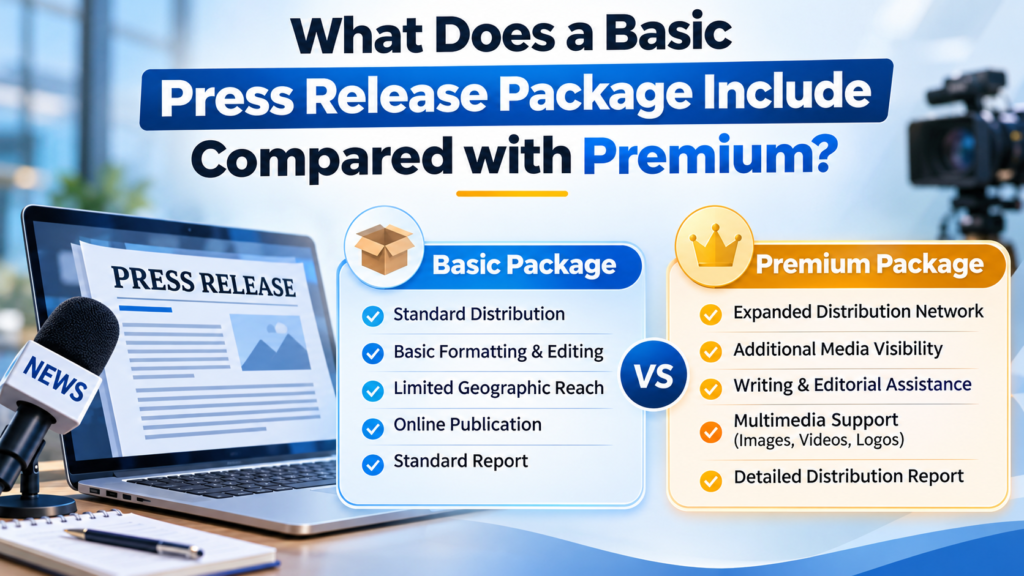
The following comparison illustrates common differences between the two package types.
| Feature | Basic Package | Premium Package |
|---|---|---|
| Standard distribution | Usually included | Usually included |
| Geographic coverage | Limited or standard | Potentially broader |
| Online publication | Selected network | Expanded network or options |
| Writing assistance | Limited or optional | More comprehensive options |
| Editing support | Basic proofreading | Additional editorial support |
| Multimedia | Limited availability | More options may be available |
| Distribution report | Standard report | Potentially detailed report |
| Industry targeting | May be limited | May offer additional targeting |
| Cost | Generally lower | Generally higher |
This comparison represents typical package structures rather than universal industry standards. Individual providers may offer different combinations of features.
How Should Businesses Choose Between Basic and Premium?
Selecting a press release package begins with understanding the purpose of the announcement.
A company should consider what it wants to communicate, who needs to receive the information, and how distribution will support its broader communication strategy.
Consider the Importance of the Announcement
Not every business announcement requires extensive distribution.
A routine operational update may be adequately served by a basic package. A significant product launch, funding announcement, acquisition, or national expansion may require broader communication planning.
The importance of the announcement should influence the distribution strategy.
Evaluate the Target Audience
Businesses should identify whether their announcement is intended for:
- Local customers
- National business audiences
- Industry professionals
- Investors
- Technology communities
- International stakeholders
Audience relevance can be more important than the size of a distribution network.
For example, a technology company introducing a specialized enterprise product may benefit more from relevant industry distribution than from a broad network with limited audience alignment.
Review the Available Budget
A higher-priced package is not automatically the better option.
Companies should evaluate whether additional features support a meaningful communication objective.
When comparing press release distribution pricing, it is useful to review the total cost, included services, publication options, and any additional fees.
Some providers charge separately for writing, multimedia, specialized placements, or revisions.
Understand the Expected Results
Businesses should establish realistic expectations before purchasing a distribution package.
Press release distribution can support:
- Public announcement visibility
- Online availability of company news
- Communication with relevant audiences
- Searchable records of business announcements
- Opportunities for journalists to discover news
However, distribution alone does not guarantee website traffic, sales, backlinks, or independent media coverage.
These outcomes depend on several factors, including the announcement’s newsworthiness, audience relevance, distribution quality, and broader marketing activities.
Why Press Release Quality Matters Across Both Packages
A professionally structured announcement is important regardless of the distribution level.
Even an extensive distribution network cannot compensate for information that lacks clarity, relevance, or genuine news value.
A useful press release should answer several basic questions:
- What happened?
- Who is involved?
- When did the announcement occur?
- Where is the development relevant?
- Why does it matter?
- How can readers obtain additional information?
The headline should communicate the main development clearly. The opening paragraph should summarize the essential news, while the remaining content should provide supporting details.
Companies should avoid exaggerated claims, unnecessary promotional language, and unsupported statistics.
A practical approach is to review the announcement from the perspective of a journalist or reader who has no previous knowledge of the organization.
Communications professionals, including teams working with sptechsolutions, may approach press release planning by considering the announcement’s news value, intended audience, and distribution requirements before selecting a package.
Common Mistakes Businesses Make When Comparing Packages
Several mistakes can make package comparisons less effective.
Focusing Only on the Number of Publications
A package advertising numerous publication opportunities may appear attractive. However, the number of websites alone does not explain audience relevance, editorial quality, or the potential value of the distribution.
Businesses should examine the actual network and understand how publication opportunities are provided.
Assuming Premium Means Guaranteed News Coverage
Premium distribution is not the same as guaranteed editorial attention.
Unless a service explicitly describes a separate editorial arrangement, businesses should not assume journalists will independently cover their announcements.
Overlooking Additional Costs
Some packages advertise a low starting price but charge separately for writing, revisions, multimedia, or specialized distribution.
Reviewing the complete cost helps prevent unexpected expenses.
Ignoring the Newsworthiness of the Announcement
A press release should communicate meaningful information rather than function solely as an advertisement.
Announcements involving new developments, measurable milestones, partnerships, research, or substantial business changes may provide stronger editorial value than general promotional statements.
Measuring the Value of Press Release Distribution
The effectiveness of a press release should be evaluated according to its original purpose.
Businesses can monitor several indicators after distribution.
Publication verification: Confirm whether the release was published and review the available publication URLs.
Referral traffic: Use analytics tools to identify visits originating from publication websites or distribution partners.
Audience engagement: Review measurable interactions where reliable data is available.
Earned media coverage: Track independent articles, interviews, or journalist inquiries resulting from the announcement.
Communication outcomes: Assess whether the release supported awareness, stakeholder communication, or other defined business objectives.
It is useful to establish a baseline before distribution so results can be evaluated more consistently.
Final Thoughts
Basic and premium press release packages serve different communication needs. Basic options generally focus on essential distribution, while premium packages may provide broader networks, additional editorial assistance, multimedia options, or more detailed reporting.
The most appropriate choice depends on the announcement, audience, budget, and desired communication outcomes.
Rather than selecting a package solely because it includes more publications or carries a premium label, businesses should examine its actual features and limitations.
A well-written announcement, realistic expectations, and an audience-focused distribution strategy remain important elements of effective business communication, regardless of package level.