Introduction
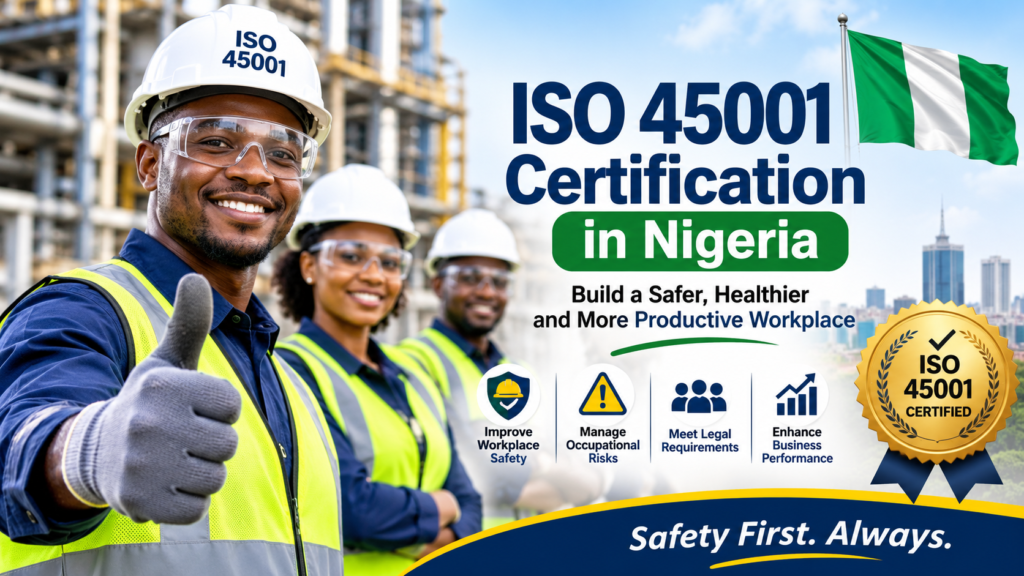
Workplace health and safety are important for every organization. Businesses must identify workplace hazards, protect employees, and prevent accidents that can affect their operations. ISO 45001 certification in Nigeria helps organizations establish an effective Occupational Health and Safety Management System (OHSMS). It provides an internationally recognized framework for managing workplace risks, improving safety practices, and promoting employee well-being.
Organizations in Nigeria can use ISO 45001 to strengthen their safety culture and demonstrate their commitment to providing a healthy working environment.
What Is ISO 45001 Certification?
ISO 45001 is an international standard that specifies requirements for an Occupational Health and Safety Management System. It helps organizations identify hazards, assess risks, establish safety controls, and improve workplace health and safety performance.
The standard is suitable for organizations of all sizes and industries. Companies can implement ISO 45001 to manage occupational risks and seek independent certification to demonstrate that their management system meets the standard’s requirements.
Why Is ISO 45001 Important for Nigerian Businesses?
Many Nigerian industries involve workplace risks that require proper safety management. Construction sites, manufacturing facilities, oil and gas operations, mining activities, warehouses, and transportation companies must pay close attention to employee safety.
ISO 45001 certification offers several benefits:
- Improved Workplace Safety: Helps identify hazards and reduce the possibility of workplace accidents and injuries.
- Better Risk Management: Encourages businesses to assess risks and introduce suitable control measures.
- Legal Compliance: Supports the identification and management of applicable occupational health and safety obligations.
- Employee Awareness: Promotes safety training, communication, and worker participation.
- Business Reputation: Demonstrates a commitment to responsible workplace practices.
- Continuous Improvement: Helps organizations monitor safety performance and improve their processes.
Key Requirements of ISO 45001
To implement ISO 45001 successfully, organizations must establish a management system that addresses important occupational health and safety requirements.
Some key areas include:
- Leadership Commitment: Top management must support workplace safety and provide the necessary resources.
- Hazard Identification: Organizations must identify potential hazards related to their activities and working environments.
- Risk Assessment: Businesses should evaluate workplace risks and determine suitable control measures.
- Worker Participation: Employees should be involved in safety discussions and improvement activities.
- Emergency Preparedness: Organizations must plan how to respond to emergencies and unexpected incidents.
- Performance Evaluation: Regular monitoring, internal audits, and management reviews help assess system effectiveness.
- Continual Improvement: Corrective actions should address problems and strengthen safety performance.
Steps to Obtain ISO 45001 Certification in Nigeria
Organizations can follow a structured process to achieve ISO 45001 certification.
Step 1: Understand the Requirements
Study the ISO 45001 standard and identify how its requirements apply to your organization’s activities.
Step 2: Conduct a Gap Analysis
Review existing health and safety practices to identify areas that need improvement.
Step 3: Develop the Management System
Establish an occupational health and safety policy, define responsibilities, assess risks, and implement suitable procedures.
Step 4: Provide Employee Training
Train employees and supervisors to understand workplace hazards, safety responsibilities, and emergency procedures.
Step 5: Conduct an Internal Audit
Review the management system to identify nonconformities and opportunities for improvement.
Step 6: Complete the Certification Audit
Select a competent certification body to assess your management system. Certification is granted when the organization meets the applicable requirements.
Industries That Benefit from ISO 45001 Certification
ISO 45001 is useful for many Nigerian industries, including construction, manufacturing, oil and gas, mining, logistics, healthcare, agriculture, and engineering. Small and medium-sized businesses can also implement the standard to improve workplace safety.
Conclusion
ISO 45001 certification in Nigeria helps organizations create safer workplaces through effective hazard identification, risk management, employee participation, and continuous improvement. By implementing a strong occupational health and safety management system, businesses can protect workers, improve operational practices, and build stakeholder confidence. Choosing a competent certification body also helps organizations demonstrate that their safety management system meets internationally recognized requirements.