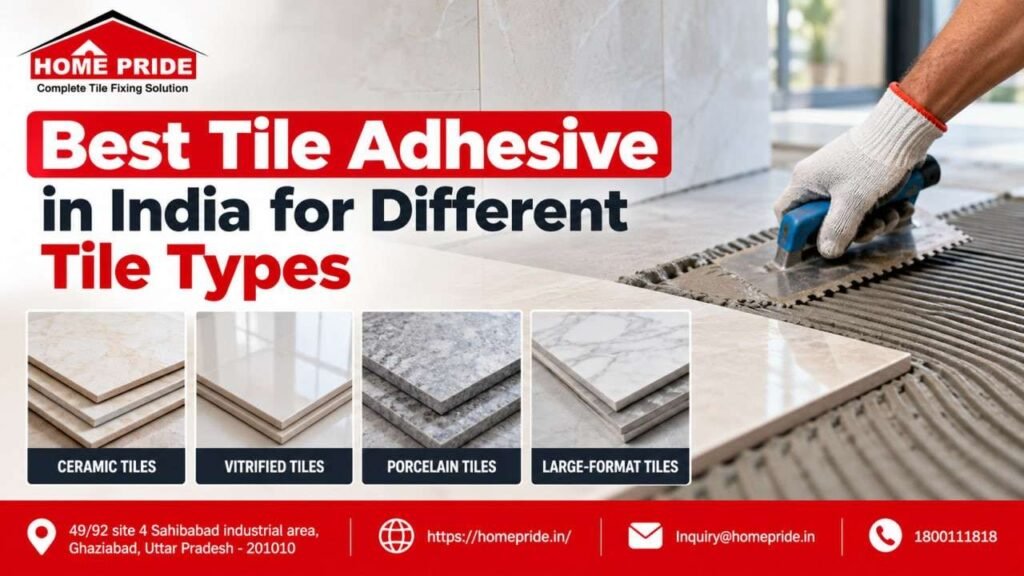
Choosing the Best Tile Adhesive in India depends on more than simply selecting a well-known product. Different tiles have different weights, porosity, sizes, surfaces, and installation conditions. A suitable adhesive must provide strong bonding, good workability, durability, and resistance to moisture or temperature changes where required.
Whether you are installing ceramic tiles in a bedroom, vitrified tiles in a living room, porcelain tiles in a bathroom, or large-format tiles on a wall, selecting the right adhesive can significantly affect the long-term performance of the installation.
This guide explains how to select tile adhesive according to different tile types and application conditions.
What Is Tile Adhesive?
Tile adhesive is a specially formulated bonding material used to fix tiles to surfaces such as concrete, cement plaster, screed, masonry, and other suitable substrates.
Compared with traditional cement-sand methods, modern adhesives are designed to provide more consistent bonding and easier application. Their formulation can include cement, graded fillers, polymers, and other additives that influence adhesion, flexibility, water retention, open time, and workability.
The performance of a tile adhesive chemical depends on its formulation as well as correct surface preparation and application.
For this reason, choosing an adhesive based only on price may not be the best approach. The adhesive should match the tile, substrate, location, and expected service conditions.
How to Choose the Best Tile Adhesive in India?
There is no single adhesive that is automatically the best for every tile installation. The right choice depends on several factors:
- Tile type and porosity
- Tile size and weight
- Floor or wall application
- Indoor or outdoor location
- Moisture exposure
- Substrate condition
- Temperature and environmental conditions
- Manufacturer’s recommended application
For example, a standard adhesive may be suitable for ordinary ceramic tiles, while large-format porcelain tiles may require a higher-performance formulation.
When evaluating the Best Tile Adhesive in India, always consider the complete application rather than the product name alone.
Best Tile Adhesive for Ceramic Tiles
Ceramic tiles are commonly used for residential walls and floors because they are relatively lightweight and available in many designs and sizes.
For standard ceramic tiles, a good-quality cement-based adhesive can generally provide reliable bonding when used on a properly prepared substrate.
The adhesive should have:
- Good initial adhesion
- Smooth workability
- Adequate open time
- Consistent coverage
- Sufficient strength after curing
For wall applications, the adhesive should also have suitable slip resistance so that tiles remain properly positioned during installation.
Home Pride offers tile adhesive solutions designed for construction and renovation applications where consistent bonding and practical installation are important.
Best Tile Adhesive for Vitrified Tiles
Vitrified tiles have very low water absorption compared with conventional ceramic tiles. Their dense surface makes adhesive selection particularly important because the substrate cannot rely on significant water absorption to create a bond.
For vitrified tiles, look for a polymer-modified tile adhesive or a formulation specifically recommended for low-absorption tiles.
Important characteristics include:
- Strong adhesion
- Good contact with the tile and substrate
- Suitable open time
- Adequate flexibility
- Compatibility with the tile and surface
Before installation, always check the manufacturer’s technical instructions to confirm whether the adhesive is appropriate for vitrified tiles.
Best Tile Adhesive for Porcelain Tiles
Porcelain tiles are dense, durable, and generally have very low water absorption. They are frequently used in bathrooms, kitchens, floors, commercial spaces, and exterior applications.
Because porcelain provides less opportunity for mechanical absorption, the adhesive needs to create a reliable bond through its formulated adhesion properties.
When selecting an adhesive for porcelain, consider:
- Tile size: Larger tiles can place greater demands on the bonding system.
- Installation location: A bathroom installation may require different performance characteristics than a dry indoor wall.
- Substrate: Concrete, cement plaster, screed, and other substrates may have different preparation requirements.
- Flexibility: Larger or more demanding installations may benefit from an adhesive with appropriate deformability.
The manufacturer’s product documentation should always be checked before selecting an adhesive for large or technically demanding porcelain installations.
Best Tile Adhesive for Large-Format Tiles
Large-format tiles are becoming increasingly common in modern residential and commercial projects. However, their size and weight make installation more demanding.
For these tiles, adhesive selection is only one part of the process. Proper substrate flatness, adequate adhesive coverage, correct trowel technique, and careful tile placement are equally important.
A suitable adhesive should provide:
- Strong bonding
- Appropriate open time
- Good workability
- Adequate coverage
- Suitable deformability where required
For very large tiles, installers may also use techniques such as back-buttering, depending on the tile and manufacturer’s recommendations.
Avoid relying on small spots or isolated adhesive dabs because they can leave unsupported areas beneath the tile.
Best Tile Adhesive for Bathroom Tiles
Bathrooms are exposed to water, humidity, cleaning chemicals, and frequent temperature changes. Therefore, selecting the right adhesive is particularly important.
A suitable bathroom adhesive should be compatible with the tile and substrate and provide reliable adhesion under humid conditions.
However, one important point should not be overlooked: tile adhesive is not a substitute for waterproofing.
Where waterproofing is required, the substrate should be properly waterproofed using an appropriate system before tile installation. The adhesive is then used to bond the tiles to the prepared surface.
For bathroom projects, consider both the adhesive and the complete installation system.
Why the Tile Adhesive Manufacturer Matters
The quality of an adhesive depends heavily on its formulation, raw materials, manufacturing controls, testing, packaging, and storage.
When evaluating a Tile Adhesive Manufacturer in Ghaziabad or another manufacturing location, buyers should look beyond marketing claims.
Consider whether the manufacturer provides:
- Clear product specifications
- Application instructions
- Recommended coverage
- Mixing instructions
- Suitable applications
- Batch and packaging information
- Technical support where required
- Consistent product quality
A reliable manufacturer should make it easier for installers and project owners to understand where and how the product should be used.
What Makes the Best Tile Adhesive Company in India?
The Best Tile Adhesive Company in India should not be judged solely by brand popularity. Product consistency, technical knowledge, manufacturing practices, application guidance, and suitability for different construction requirements are also important.
A company such as Home Pride can be evaluated based on the range of adhesive solutions it provides, product information, application suitability, and consistency across projects.
For contractors and homeowners, selecting a manufacturer that clearly communicates product limitations and recommended applications can help reduce installation problems.
Common Mistakes When Selecting Tile Adhesive
Even a high-quality adhesive can perform poorly when it is incorrectly selected or applied.
Some common mistakes include:
Using One Adhesive for Every Tile
Different tiles have different characteristics. A product suitable for ordinary ceramic tiles may not be the ideal choice for every porcelain, vitrified, or large-format application.
Ignoring the Substrate
Dust, loose material, excessive moisture, cracks, unevenness, or weak surfaces can affect bonding.
Incorrect Mixing
Adding too much or too little water can change the adhesive’s performance. Always follow the manufacturer’s specified mixing ratio.
Poor Adhesive Coverage
Insufficient adhesive contact can create hollow areas and reduce long-term durability.
Applying Adhesive Beyond Its Working Time
Once the adhesive has formed a surface skin or exceeded its recommended open time, proper bonding may be compromised.
Choosing Only by Price
The cheapest product is not necessarily the most economical option. Installation failure, tile replacement, and rework can cost considerably more than selecting an appropriate adhesive initially.
How to Get Better Results During Tile Installation
For reliable results, follow these basic practices:
- Prepare the substrate properly and remove dust, loose particles, and contaminants.
- Use the correct adhesive for the tile and application.
- Follow the manufacturer’s mixing instructions.
- Apply the adhesive using the appropriate notched trowel.
- Maintain adequate adhesive coverage beneath the tile.
- Avoid using adhesive after its recommended working time.
- Follow recommended curing and grouting times.
- For demanding applications, follow the manufacturer’s technical guidance carefully.
Home Pride emphasizes the importance of selecting an adhesive according to the actual tile and installation requirement rather than using the same solution for every project.
Final Thoughts
The Best Tile Adhesive in India is not necessarily one universal product. The right choice depends on the tile type, tile size, substrate, location, moisture exposure, and installation conditions.
Ceramic tiles may require a different solution from low-absorption vitrified or porcelain tiles, while large-format tiles can demand greater attention to coverage, substrate preparation, and adhesive performance.
For homeowners, contractors, architects, and builders, understanding these factors makes it easier to select a suitable tile adhesive chemical and avoid common installation problems. Manufacturers such as Home Pride can also be considered by evaluating their product specifications, application guidance, and suitability for the intended project.
Ultimately, a successful tile installation depends on three things working together: the right adhesive, the right surface preparation, and the right installation technique.
Frequently Asked Questions
1. Which tile adhesive is best for different types of tiles?
The appropriate adhesive depends on the tile’s absorption, size, weight, and application. Standard ceramic tiles may work well with suitable cement-based adhesives, while porcelain, vitrified, and large-format tiles may require higher-performance or polymer-modified formulations.
2. Is the same tile adhesive suitable for wall and floor tiles?
Not always. Wall and floor installations can have different performance requirements. Tile weight, size, slip resistance, traffic level, and substrate conditions should be considered before selecting an adhesive.
3. What should I check before buying tile adhesive in India?
Check the adhesive’s recommended tile types, substrate compatibility, application area, mixing instructions, coverage, open time, curing requirements, and relevant technical specifications. Choosing a product from an established Tile Adhesive Manufacturer in Ghaziabad or elsewhere should also involve checking product documentation and consistency.
4. Is tile adhesive enough for bathroom waterproofing?
No. Tile adhesive does not replace waterproofing. Bathrooms and other wet areas may require a separate waterproofing system beneath the tile installation. The adhesive should then be selected according to the tile and prepared substrate.
5. How can I choose a reliable tile adhesive manufacturer?
Look for a manufacturer that provides clear technical information, consistent product quality, suitable product options, application instructions, and appropriate technical support. Home Pride is one manufacturer buyers can evaluate alongside other established options based on their specific project requirements.