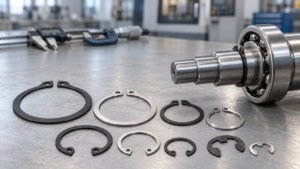
Industrial machinery depends on numerous small components to operate safely and efficiently. Among these, circlips play an important role in retaining mechanical parts and maintaining their intended positions during operation. Although they are often overlooked, these compact retaining rings are widely used in automotive systems, manufacturing equipment, power transmission assemblies, and other engineering applications.
For manufacturers and procurement professionals, selecting the right circlip involves understanding its design, material, dimensional requirements, and operating environment. A well-matched retaining ring can support reliable assembly performance, while an unsuitable component may contribute to premature wear, improper fitting, or equipment failure.
Understanding the Role of Circlips in Mechanical Assemblies
A circlip is a metal retaining ring designed to fit into a groove on a shaft or inside a bore. Once installed, it provides a mechanical stop that restricts unwanted axial movement of components.
Unlike threaded fasteners, circlips generally do not require nuts or bolts to perform their retaining function. Their compact structure makes them suitable for assemblies where space efficiency, accurate positioning, and straightforward installation are important.
Circlips are commonly found in gearboxes, bearings, pumps, electric motors, automotive transmissions, and industrial machinery. Their effectiveness depends on proper selection, suitable groove design, and correct installation according to the equipment’s specifications.
For businesses sourcing precision components, reviewing the available Circlip options can help identify retaining solutions that match the intended mechanical application.
What Are the Different Types of Circlips Used in Industry?
Circlips are manufactured in several designs to accommodate different installation requirements. Understanding their differences helps engineers select components that provide appropriate retention.
External Circlips for Shaft Assemblies
External circlips are installed in grooves machined around shafts. They help retain components such as bearings, gears, spacers, and pulleys, preventing them from moving beyond their designated positions.
These rings are widely used in rotating machinery and power transmission equipment. Their performance depends on shaft dimensions, groove geometry, ring material, and the loads experienced during operation.
Internal Circlips for Housing Assemblies
Internal circlips fit into grooves inside cylindrical bores or housings. They are commonly used to retain bearings, bushings, and other components within an assembly.
Correct bore and groove measurements are essential because an incorrectly sized retaining ring may not provide the intended fit. Engineers should consult the relevant dimensional standard or technical drawing before selecting a replacement.
E-Type Circlips for Compact Applications
E-type circlips have a distinctive profile and are designed to fit into suitable grooves on shafts. They are often used in compact mechanical assemblies where space is restricted and efficient installation is desirable.
Although these rings may look similar in photographs, their dimensions and retaining capabilities can differ. Buyers should verify the required specifications rather than choosing a product based solely on appearance.
How Can You Choose the Right Circlip for Industrial Equipment?
Selecting a retaining ring requires a systematic assessment of the assembly rather than relying on a general product description.
Check the Dimensions and Groove Design
Start by identifying whether the ring will fit around a shaft or inside a bore. Confirm the relevant diameter, groove width, groove depth, and other dimensions specified by the engineering drawing or applicable standard.
Evaluate the Operating Conditions
Consider the expected axial loads, vibration, rotational conditions, temperature, and exposure to moisture or chemicals. These factors can influence the suitable ring design, material, and finish.
Verify Standards and Product Specifications
Where the application requires compliance with a particular standard, verify the exact designation and dimensional requirements. Product documentation should match the intended application and procurement specification.
Consider Installation and Maintenance
The correct installation tool and procedure help reduce the risk of deformation or damage. A retaining ring should seat properly in its groove, and the assembled component should be inspected according to the equipment manufacturer’s instructions.
Industrial buyers can consult experienced Circlip Suppliers to discuss dimensions, material options, applicable standards, and other product requirements before finalizing an order.
Why Are Circlips Important Across Different Industries?
Circlips support component retention in a broad range of industrial applications.
In the automotive sector, they may be used in transmission assemblies and other mechanical systems. Manufacturing equipment uses them to retain bearings, shafts, and gears. Pumps and electric motors may incorporate retaining rings to maintain component positioning, while agricultural machinery and material-handling equipment use them in suitable mechanical assemblies.
Their compact design can help simplify assembly construction and reduce the need for more space-consuming retention arrangements. However, circlips are not universal replacements for other fastening or locking mechanisms. The engineering design must account for the ring’s intended function and the loads involved.
How Does Quality Control Influence Circlip Reliability?
Quality control is essential when sourcing retaining rings for industrial use. Dimensional variation, unsuitable material properties, or inconsistent manufacturing quality can affect assembly fit and retaining performance.
A reliable inspection process may include dimensional checks, material verification, surface-finish inspection, and confirmation of compliance with specified standards. For critical applications, buyers may also require documented inspection results and material traceability.
Procurement teams should evaluate whether a manufacturer can maintain consistent specifications across repeat orders. Clear communication about product dimensions, acceptable tolerances, and operating requirements can also reduce the likelihood of purchasing unsuitable components.
EASCO provides a circlips product page where industrial buyers can review the product range and investigate options for their applications. Before placing an order, buyers should confirm availability, material grades, dimensions, and any special requirements directly with the supplier.
Frequently Asked Questions (FAQs)
What is the main purpose of a circlip?
A circlip acts as a retaining ring that helps prevent unwanted axial movement of components. It fits into a groove on a shaft or inside a housing to maintain the intended position of an assembled part.
Are circlips suitable for heavy-duty industrial machinery?
They can be suitable when the ring, groove, material, and assembly design are engineered for the expected operating conditions. Load capacity should be verified using the relevant technical specifications rather than assumed from the ring’s appearance.
How do internal and external circlips differ?
External circlips fit into grooves on the outside of shafts, while internal circlips fit into grooves inside bores or housings. Each type serves a different installation arrangement.
What information should I provide when ordering circlips?
Provide the required type, dimensions, material grade, finish, applicable standard, quantity, and intended application. An engineering drawing or existing component reference can help clarify requirements.
When should a circlip be replaced?
Replace a circlip if it shows damage, corrosion, permanent deformation, or an inability to fit securely. Follow the equipment manufacturer’s maintenance and replacement recommendations, particularly for critical assemblies.
Conclusion
Circlips are small but important components in modern mechanical engineering. From retaining bearings to supporting shaft assemblies, they help maintain component positioning across numerous industrial applications.
Choosing the correct type, checking dimensional compatibility, selecting a suitable material, and following proper installation procedures are essential steps in achieving dependable performance. For industrial procurement teams, verifying technical specifications and working with knowledgeable suppliers can help ensure that the selected retaining ring meets the needs of the application.