Creating Scalable Frontend Experiences with Headless Architecture
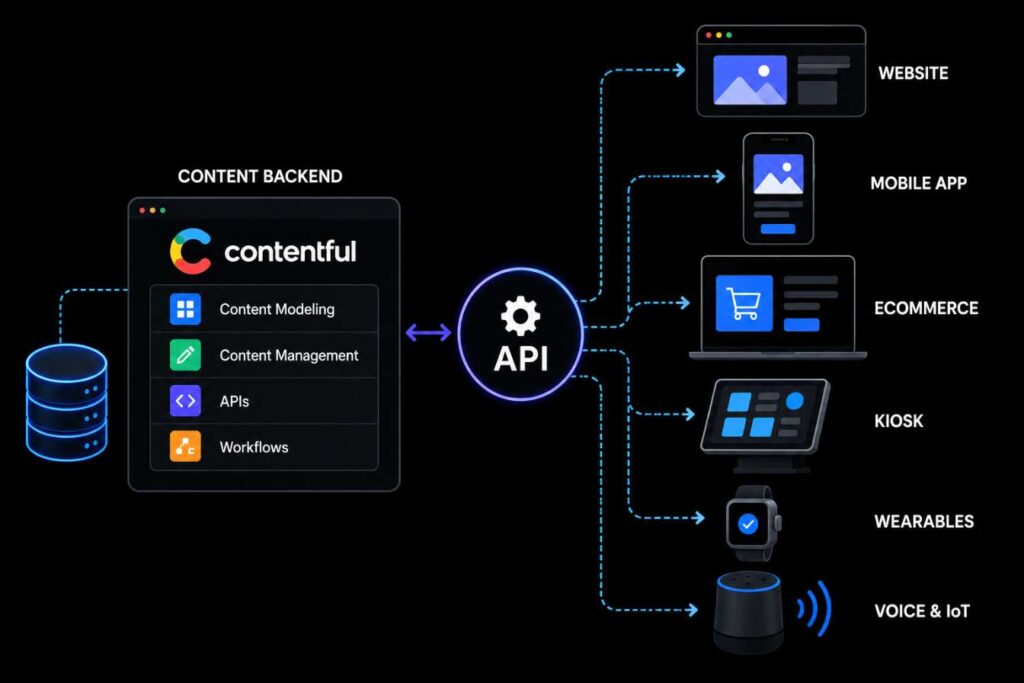
Frontend scalability is no longer just a performance concern. It is an architecture concern, a delivery concern, and often an operating model concern. Once a digital product grows beyond a single website, the limits of tightly coupled systems become obvious. Teams need to support multiple channels, ship changes faster, and keep content consistent without turning every release into a coordination exercise.
Headless architecture solves a large part of that problem by separating content management and backend logic from presentation. The frontend becomes an independent application that consumes content and data through APIs. That separation gives developers more control over user experience, and it gives content teams a cleaner way to manage structured content across channels.
For teams working with Contentful or similar headless platforms, the real value is not only decoupling. It is the ability to build frontend systems that can grow without collapsing under content complexity, traffic spikes, or frequent product changes.
What Headless Architecture Means
In a traditional CMS setup, the backend and frontend are closely tied together. Templates, presentation rules, and content storage often live in the same system. That model works until the business needs more flexibility. At that point, every change tends to affect multiple layers of the stack.
Headless architecture removes that coupling. Content lives in a backend system, and the frontend retrieves it through APIs. The frontend can be a website, a mobile app, a kiosk, a digital display, or any other interface that can consume structured data.
This model shifts the responsibility of presentation into the frontend application. That may sound like a small change, but it changes how teams build, scale, and maintain digital experiences.
For example, in Contentful, content is modeled as structured entries and fields rather than freeform pages. A frontend application then decides how to render those fields. This gives teams a more predictable content model and a more reusable presentation layer. Many organizations also work with a Contentful consulting company to design scalable content models and governance strategies that support long term growth across multiple digital channels.
Why Scalability Matters in Modern Frontend Development
Scalability in the frontend is not only about handling more traffic. It also includes handling more components, more content types, more teams, and more channels.
A frontend that works well for one product page can become fragile when the same codebase has to support a blog, a landing page system, a support portal, and a mobile app. The same happens when content volume increases. Hardcoded layouts and page-specific logic become difficult to maintain.
Scalability matters because modern products rarely stay static. New campaigns launch. New markets open. New devices need support. Traffic patterns change. SEO requirements evolve. Content teams need faster publishing workflows, and developers need enough structure to make changes safely.
A scalable frontend should support growth without forcing repeated rewrites. Headless architecture helps because it makes the presentation layer more modular, and it keeps content delivery separate from rendering concerns.
How Headless Architecture Supports Scalable Frontend Experiences
1. Frontend flexibility
One of the biggest benefits of headless architecture is framework independence. Teams are not locked into a specific CMS-driven rendering model. They can use React, Next.js, Vue, Nuxt, Angular, Svelte, or another framework that fits their product requirements.
That flexibility matters because frontend architecture is rarely one-size-fits-all. A marketing site may benefit from static generation and edge delivery. A SaaS dashboard may need client-side interactivity and API-driven state. A commerce experience may need both.
With a headless setup, the frontend team chooses the rendering pattern that best fits the use case. Contentful provides the content layer, while the frontend handles composition and delivery.
This also allows teams to evolve the frontend over time. A company can start with a simple application, then introduce partial static rendering, component libraries, or edge caching later without rewriting the content system.
2. Omnichannel content delivery
A scalable frontend is rarely limited to one website. Content often needs to appear in apps, kiosks, voice interfaces, product surfaces, email systems, or partner portals.
Headless architecture makes omnichannel delivery much easier because the same structured content can feed multiple frontends. A heading, summary, product specification, or CTA can be reused across surfaces without duplication.
This does not mean every channel should display the same layout. It means the source content is normalized enough that each frontend can render it appropriately.
For a Contentful model, this usually means designing content types carefully. A product description should not be stored as one large HTML blob if it needs to appear in web cards, app views, and search snippets. Structured fields give each frontend enough context to render the content in the right format.
3. Better performance
Performance is a core part of scalability. A frontend that becomes slower under load is not scalable, even if the backend can handle traffic.
Headless architecture improves performance because it allows the frontend to be optimized independently. Teams can use static site generation, server-side rendering, incremental regeneration, edge caching, and CDN delivery based on the needs of the page or route.
Since content is fetched through APIs, only the necessary data is requested. This can reduce page weight and improve rendering efficiency, especially when the frontend is designed around reusable components.
A common pattern is to keep content delivery fast through caching and CDN distribution, while letting the frontend control how and when data is pulled. That separation gives developers more room to optimize without affecting editorial workflows.
4. Independent scaling of frontend and backend
In a tightly coupled system, frontend and backend usually scale together even when only one side needs more capacity. That creates unnecessary cost and complexity.
Headless architecture lets teams scale the frontend and backend separately. If traffic increases on a marketing site, the frontend can be optimized and deployed to a CDN without changing the content infrastructure. If the content team publishes more frequently, the content API can be tuned without redesigning the interface.
This independent scaling also helps during peak traffic periods. For example, a campaign page may receive a sudden spike in visits. A properly cached frontend can absorb much of that load, while the content API remains stable behind it.
This pattern is especially useful in enterprise environments where one backend may serve many frontends. The architecture remains manageable because the presentation layer is not tied to a single monolithic delivery path.
5. Faster development cycles
Frontend scalability also depends on team throughput. If developers cannot ship changes quickly, the system becomes hard to evolve.
Headless architecture supports faster development because frontend and content work can happen in parallel. Content editors can build and update structured entries while developers work on layout components and API integration.
That separation reduces the need for constant backend changes when a frontend evolves. A component can be updated to support a new content field without touching the content model for unrelated pages. Likewise, content teams can create new entries within existing schemas without asking developers to rebuild templates each time.
In practice, this leads to better release discipline. Teams can version components, test content rendering safely, and reduce the risk that one page change breaks another.
Best Practices for Scalable Frontend Architecture
Use component driven design
A scalable frontend should be built from reusable components, not page specific te mplates. Buttons, cards, hero sections, article blocks, banners, and forms should each be isolated and predictable.
This approach works well with headless content because each component can map cleanly to structured fields. It also makes frontend maintenance easier. A change in one component can be tested and deployed without affecting the entire application.
Model content with structure, not layout
Content models should describe meaning, not presentation. For example, store title, summary, body, image, call to action, and metadata as separate fields. Avoid putting too much layout logic into the content layer.
This is important in Contentful because flexible content models can easily become too loose if governance is weak. The goal is to give the frontend enough semantic data to render consistently across channels.
Plan for caching early
Caching is not an afterthought in scalable systems. It should be part of the rendering strategy from the start. Decide which routes should be cached, which data can be statically generated, and which parts need real time updates.
The right caching strategy depends on the page type. A blog article can often be cached for a long time. A stock price widget cannot. A product listing may need partial revalidation. A scalable frontend should support all of those patterns.
Keep API usage efficient
A headless frontend can still become slow if it overfetches data or makes too many round trips. Keep API queries focused. Fetch only the fields needed for a specific page or component.
Also consider how content is composed. Multiple small API calls may be fine during development but become a bottleneck at scale. A well designed frontend usually includes data shaping, aggregation, or prefetching where it makes sense.
Separate rendering concerns from business logic
The frontend should not become a dumping ground for business rules, content rules, and presentation rules all at once. Keep data transformation in a layer that is testable and reusable.
That usually means having clear boundaries between API adapters, page composition, and component rendering. The cleaner the separation, the easier it is to scale the codebase and onboard new developers.
Monitor performance continuously
Scalability should be measured, not assumed. Track page load times, API latency, cache hit rates, error rates, and rendering performance. Watch how changes affect real users, not just local builds.
A frontend can look clean in development and still perform poorly under real traffic. Observability gives teams the feedback loop they need to keep the system healthy as it grows.
Common Challenges and How to Handle Them
Headless architecture is not free of tradeoffs. One common issue is content model complexity. When content types are too generic, frontend rendering becomes inconsistent. When they are too rigid, editors lose flexibility. The best approach is to define models around real use cases and revisit them as the product evolves.
Another challenge is integration sprawl. Once multiple APIs, services, and frontends are involved, coordination matters more. Clear ownership, schema discipline, and documentation help prevent fragmentation.
Security also needs attention. API access should be controlled, and preview environments should be isolated from production data where necessary.
Finally, governance matters. A scalable frontend cannot compensate for inconsistent content practices. Content structure, naming conventions, and workflow rules all affect long term stability.
Real World Use Cases
Headless architecture is especially useful in ecommerce, media, SaaS, and enterprise digital platforms.
In ecommerce, content needs to support product pages, category pages, campaign pages, and app experiences. A headless setup lets teams reuse content across those surfaces while keeping the frontend flexible.
In media and publishing, large volumes of content must be delivered quickly and consistently. A structured content model helps editors move fast without forcing every article into a rigid template system.
In SaaS, the frontend often includes product marketing pages, help content, documentation, and logged in application views. These surfaces have different performance and rendering needs, so separating the content layer from the frontend is practical.
In enterprise environments, multiple teams may own different digital experiences. Headless architecture supports that organizational reality better than a monolithic CMS model.
Final Thoughts
Scalable frontend experiences depend on more than framework choice. They depend on architecture, content structure, delivery strategy, and team workflow.
Headless architecture gives frontend teams more control over rendering, performance, and channel expansion. It also gives content teams a structured way to manage reusable content without forcing every experience through the same template system.
For teams using Contentful, the main advantage is the separation of concerns. Content stays structured and portable. The frontend stays flexible and independently scalable. That combination is what makes the architecture practical for long term growth.
When the content model is clean, the components are reusable, and the delivery strategy is planned well, the frontend can grow without becoming difficult to maintain. That is the real value of headless architecture.