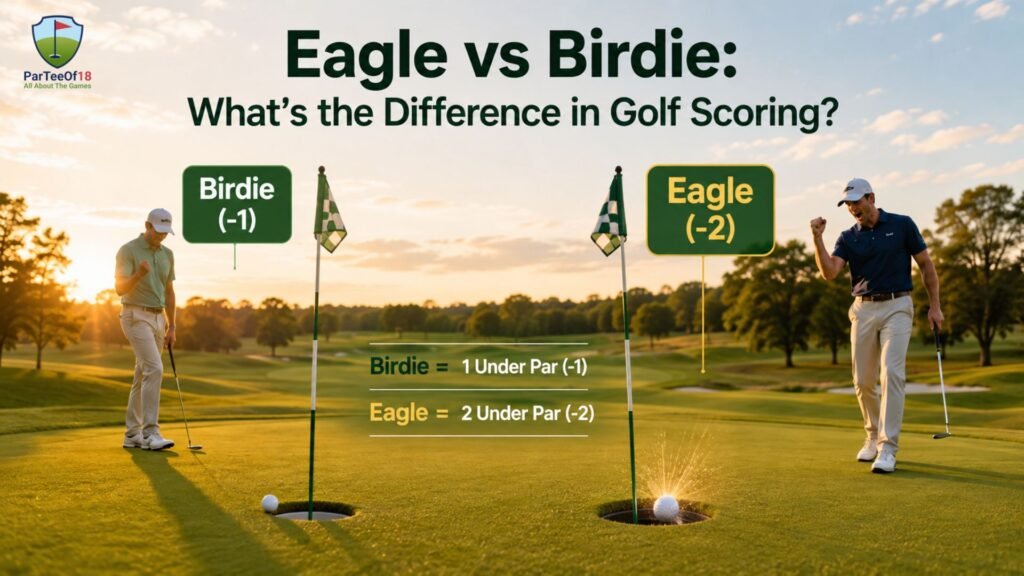
If you have ever stood on a green watching your buddy pump his fist after sinking a putt, only to hear him shout “eagle” instead of “birdie,” you might have wondered what the big deal was. Aren’t they both just good scores? Well, sort of. But there’s a real difference between the two, and understanding it can change how you watch golf, talk about golf, and even how you play it.
Golf has its own quirky language, and honestly, that’s part of the charm. Birdies, eagles, bogeys, they all sound like something out of a bird watching guide rather than a sport. But once you get the hang of it, the terms make the game a lot more fun to follow. Let’s break down exactly what separates an eagle from a birdie, and why one gets golfers a lot more excited than the other.
What Does Par Mean in Golf?
Before you can understand birdies and eagles, you need to understand par. Par is the number of strokes a skilled golfer is expected to need to finish a hole. Most holes are par 3, par 4, or par 5, depending on their length and difficulty.
Why Par Is the Baseline for Everything?
Every scoring term in golf, birdie, eagle, bogey, all revolve around par. It’s the reference point. Score better than par, and you’re in birdie or eagle territory. Score worse, and you’re looking at a bogey or worse.
What Is a Birdie in Golf?
A birdie happens when a golfer completes a hole in one stroke less than par. So on a par 4, that means finishing in three strokes. On a par 3, it means finishing in two. It’s a solid, satisfying result that most golfers celebrate.
A Real-Life Birdie Example
Picture this: you’re playing a par 4, your drive lands nicely in the fairway, your second shot rolls onto the green, and you sink the putt in two. That’s three total strokes on a par 4, and just like that, you’ve got yourself a birdie.
Why Birdies Matter for Everyday Golfers?
For weekend golfers, a birdie is often the highlight of the round. It doesn’t happen every hole, sometimes not even every round, so when it does, it’s worth celebrating. Ask any golfer about their best birdie and watch their face light up.
What Is an Eagle in Golf?
An Eagle in Golf is two strokes under par. On a par 5, that means finishing in three strokes. On a par 4, it means finishing in just two, which usually requires a long, accurate drive followed by a holed approach shot. Eagles are rare and thrilling.
A Real-Life Eagle Example
Say you’re playing a par 5. Your drive is long and straight, your second shot somehow finds the green from 220 yards out, and you two putt for a three. That’s an eagle, and trust me, that’s the kind of shot golfers talk about for years.
Why Eagles Feel So Special?
Eagles don’t happen often, even for professional golfers. They usually require a bit of power, a lot of precision, and sometimes a little luck. That combination is exactly why an eagle gets a bigger reaction than a birdie almost every time.
Eagle vs Birdie: The Key Differences
At their core, both terms describe scoring under par, but the gap between them is significant. Here’s a simple way to look at it side by side.
- Birdie: One stroke under par. Common, achievable, still exciting.
- Eagle: Two strokes under par. Rare, harder to pull off, more celebrated.
- Frequency: Birdies happen regularly in a round. Eagles might happen once in several rounds, if at all.
- Skill required: Birdies need good iron play and putting. Eagles usually need power off the tee or a precise long shot.
Where Do These Bird Names Come From?
Golf scoring terms have a surprisingly fun history rooted in American slang. In the early 1900s, “bird” was American slang for something excellent. A great shot was called a “bird of a shot,” and eventually that got shortened to “birdie.”
How Eagle and Albatross Followed?
Once birdie caught on, golfers naturally extended the bird theme. An eagle, being bigger and more impressive than a regular bird, represented two strokes under par. An albatross, even rarer, represents three strokes under par, the biggest bird of them all.
Why the Difference Matters When Watching Golf?
Understanding eagle vs birdie makes watching tournaments a lot more enjoyable. When commentators get excited over an eagle putt on the back nine of a major, you’ll actually understand why that moment carries so much weight for the leaderboard.
It Changes How You Read Golf Scorecards
Once you know the difference, scorecards stop looking like confusing rows of numbers. You’ll notice patterns, like which players are consistently scoring birdies versus who occasionally pulls off a jaw dropping eagle to shake up the standings.
How to Score More Birdies and Eagles Yourself?
Chasing birdies and eagles isn’t just for the pros. With the right approach, everyday golfers can chase these scores too, even if eagles remain a rare treat.
Practical Tips for More Birdies
- Focus on consistent iron play into greens.
- Practice lag putting so three putts become rare.
- Play smart, not just aggressive, off the tee.
- Study the greens before you putt, not just after.
Practical Tips for Chasing an Eagle
- Look for reachable par 5s where a strong drive sets up a scoring chance.
- Work on distance control with your long irons or hybrids.
- Take calculated risks on short par 4s when conditions allow.
- Don’t force it. Eagles usually come when you’re playing loose and confident, not desperate.
Final Thoughts
At the end of the day, both birdies and eagles represent something every golfer chases: playing better than expected. A birdie is the steady, reliable reward for solid play, the kind of score that keeps your round moving in the right direction. An eagle, on the other hand, is that rare spark of brilliance, the shot you’ll be telling your friends about long after the round is over.
Next time you’re out on the course, or just watching a tournament on a lazy Sunday afternoon, you’ll know exactly what’s happening when someone mentions a birdie or an eagle. And who knows, maybe understanding the difference will inspire you to chase one of your own the next time you tee it up.
Frequently Asked Questions
1. What is the difference between an eagle and a birdie in golf?
A birdie is one stroke under par, while an eagle is two strokes under par. Both are good scores, but an eagle is rarer and considered a bigger achievement since it requires more skill or a bit of luck.
2. Is an eagle better than a birdie in golf?
Yes, an eagle is considered better than a birdie because it represents a bigger improvement over par. Eagles happen far less often, which is why they’re seen as a more impressive accomplishment on the course.
3. Can you get an eagle on a par 3?
It’s extremely rare but technically possible. An eagle on a par 3 would mean scoring a hole in one, since that’s two strokes under par. It’s one of the most difficult feats in golf.
4. What comes after an eagle in golf scoring?
The score above an eagle is called an albatross, which means three strokes under par. It’s even rarer than an eagle and considered one of the most exceptional achievements in the sport.
5. Do amateur golfers ever score eagles?
Yes, though not often. Amateur golfers can score eagles, especially on shorter par 5s where a strong drive and a good approach shot can set up a realistic chance at reaching the green in two.
6. Why are golf scores named after birds?
The tradition started with American slang in the early 1900s, where “bird” meant something excellent. Birdie came first, and eagle followed as an even more impressive term, continuing the bird theme in golf scoring.