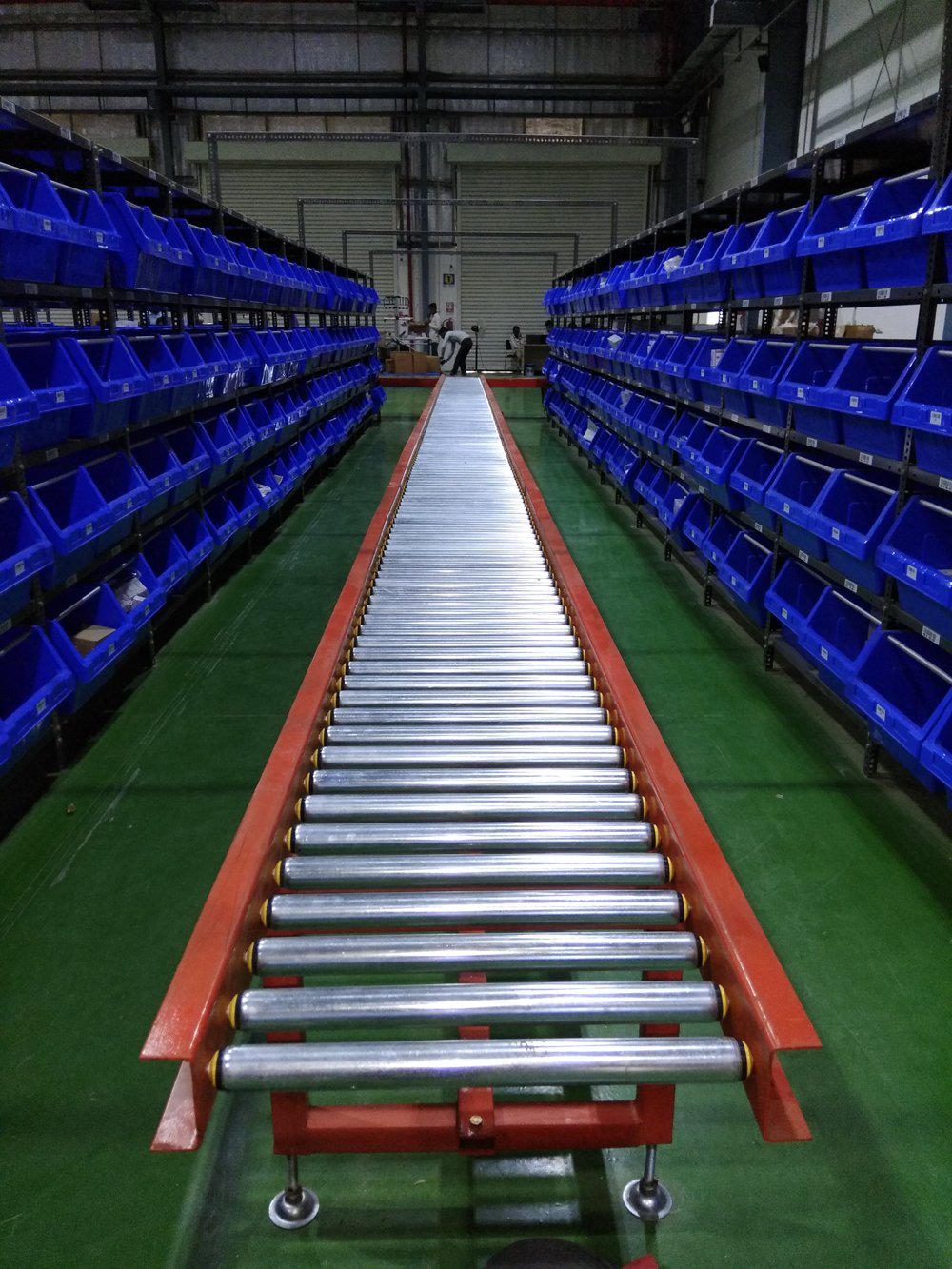
Efficient material movement is essential for keeping warehouses, production units, and distribution centers organized. Businesses often need a reliable way to transfer boxes, containers, and packaged products between workstations without investing in complicated machinery. A gravity roller conveyor provides a practical solution by allowing suitable products to move over rotating rollers through manual pushing or gravity. Its straightforward construction makes it useful for many material handling applications.
What Makes a Gravity Roller Conveyor Different?
A gravity roller conveyor is a non-powered conveying system consisting of rollers fitted into a supporting frame. Unlike motorized conveyors, it does not require an electric drive to move products along its route. The rollers rotate when items are pushed forward or when the conveyor is installed at an appropriate downward slope.
This simple design makes the equipment suitable for facilities that need to transfer products over short or medium distances. Depending on operational requirements, businesses can choose different roller diameters, frame materials, widths, and conveyor lengths.
Working Principle and Design
The working principle of a gravity roller conveyor depends on reducing friction between the product and the conveying surface. When a box or container is placed on the rollers, it can move forward with a push or travel down a carefully designed incline.
Roller spacing is an important design consideration. The product should remain supported by multiple rollers during transportation to prevent instability. The conveyor frame must also be strong enough to carry the expected load safely.
For inclined systems, the slope should be selected according to product weight, packaging, and movement requirements. End stops and side guides can help control product positioning and reduce the risk of goods leaving the conveyor.
Industrial Applications of Gravity Roller Conveyors
A gravity roller conveyor is commonly used in warehouses, packaging facilities, manufacturing plants, and distribution centers. In warehouses, it can move cartons from storage areas to packing or dispatch stations. Packaging businesses may use it to transfer finished boxes between sealing, labeling, and inspection points.
Manufacturing units can install gravity conveyors beside assembly workstations to move components and finished products. Retail distribution facilities may also use them to organize order preparation and parcel handling.
These conveyors are especially useful when products have stable, reasonably flat bases that can travel safely over rollers.
Benefits for Businesses
One of the biggest advantages of gravity roller conveyors is their simple construction. Since they do not require powered drive components, they can reduce electricity requirements and avoid the maintenance associated with motors and drive mechanisms.
Their modular design also allows businesses to arrange conveyor sections according to the available workspace. Straight and curved sections can help connect different operational areas, while portable configurations may provide flexibility for changing work requirements.
Gravity conveyors can reduce repeated carrying over short distances and create a defined route for products. This can help employees organize handling tasks and maintain a more consistent workflow.
How to Select the Right Conveyor
Before purchasing a gravity roller conveyor, evaluate the weight, dimensions, shape, and bottom surface of the products being handled. These factors determine the required roller spacing, diameter, and load capacity.
Consider the conveyor’s length, working height, incline, and installation environment. For heavier goods, a reinforced frame and appropriately rated rollers may be necessary. Facilities handling fragile products should also assess movement speed and stopping arrangements.
It is important to review the supplier’s specifications and ensure the conveyor suits the intended application.
Maintenance and Safety Practices
Regular inspection helps maintain reliable performance. Check rollers for smooth rotation, examine the frame and joints for damage, and remove debris that may obstruct product movement. Replace worn components when necessary and follow the manufacturer’s maintenance instructions.
Workers should avoid placing their hands near moving rollers while products are travelling. Suitable end stops, side guides, and safe loading practices should be provided according to the installation.
Conclusion
A gravity roller conveyor offers a straightforward and economical approach to moving suitable goods through industrial and commercial facilities. Its simple design, flexible layout, and low power requirements make it a valuable option for everyday material handling. By selecting appropriate rollers, load capacity, and safety features, businesses can improve product movement and maintain a more organized working environment.