In any manufacturing environment where parts must meet exact tolerances, the human eye and a pair of calipers simply aren’t enough. Gears, stamped components, threads, plastic moldings, and machined parts all carry contours and edges that demand a level of scrutiny only optical instruments can provide. This is where the profile projector earns its place on the quality control bench.
A profile projector, sometimes called an optical comparator, magnifies the silhouette of a part and casts it onto a large viewing screen, allowing inspectors to compare the projected shape against a master drawing or overlay chart. It remains one of the most trusted tools in dimensional metrology, and at Sipcon Technologies Pvt Ltd, we manufacture and supply a full range of these instruments to manufacturers, toolrooms, and quality labs across the United States.
What Is a Profile Projector?
At its core, an optical projector works on a simple but powerful principle: light passes through or reflects off a component, and a lens system magnifies the resulting silhouette before projecting it onto a frosted glass screen. The magnified image can then be measured directly on the screen using a calibrated overlay chart, or analyzed using digital readout systems and software for far greater accuracy.
Unlike contact-based measuring instruments, a profile projector measures without touching the part. This non-contact approach prevents damage to delicate, soft, or thin components and eliminates the measurement error that can come from probe deflection. It is especially valuable for inspecting complex profiles, fine threads, sharp edges, and intricate tooling where traditional calipers or micrometers fall short.
Why Manufacturers Rely on Profile Projectors
Quality control teams across automotive, aerospace, electronics, medical device, and tool-and-die industries depend on profile projectors for several reasons:
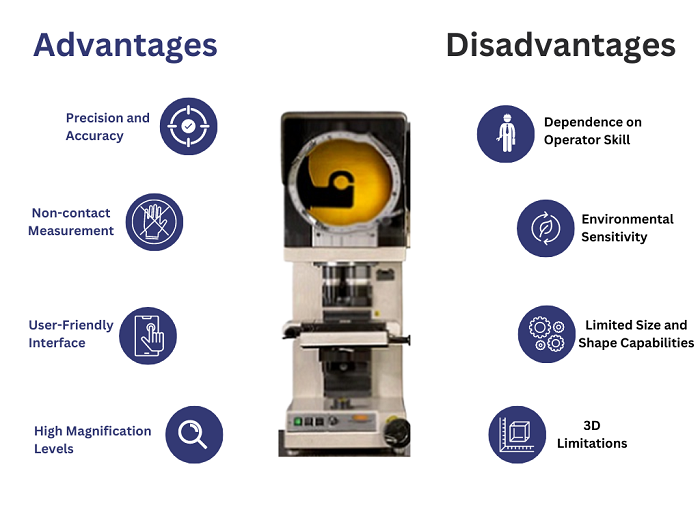
Magnification levels typically ranging from 10x to 100x reveal details invisible to the naked eye. Measurements taken through projection avoid the contact pressure that can distort soft or fragile parts. A single instrument can check angles, radii, diameters, and linear dimensions simultaneously, reducing the need for multiple gauges. Comparing a part’s silhouette to a reference overlay also makes pass/fail decisions fast and visually intuitive, even for less experienced operators.
These advantages make the profile projector an essential machine in any serious inspection department, not a luxury reserved for high-volume producers alone.
Types of Profile Projectors
Vertical Profile Projector
In a vertical profile projector, the optical axis runs vertically, with the light source positioned beneath the worktable and the screen mounted above or to the side. This configuration is well suited for inspecting flat components, stampings, gaskets, and parts that rest naturally on a horizontal stage. Vertical models are common in workshops where floor space is limited, since the compact footprint suits benchtop or floor-standing installations without requiring extensive lateral clearance.
Horizontal Profile Projector
A horizontal profile projector positions the optical path along a horizontal axis, with the light source, lens, and screen aligned side by side. This design is particularly effective for inspecting longer components, shafts, and parts that benefit from being mounted vertically on a fixture in front of the lens. Horizontal projectors are widely used in toolrooms for checking thread profiles, form tools, and cutting tool geometry, where the orientation of the part makes horizontal viewing more practical than vertical projection.
Both vertical and horizontal configurations typically include X-Y coordinate measuring stages, fine focus adjustment, and protractor or digital angle measurement, but the right choice depends on the size, shape, and typical orientation of the components your facility inspects most often.
Camera-Based Profile Projectors: The Digital Evolution
Traditional profile projectors rely on an analog screen and a physical overlay chart, which works well but depends heavily on operator skill and consistent lighting conditions. A camera-based profile projector modernizes this process by replacing or supplementing the projection screen with a high-resolution digital camera connected to a monitor or computer.
This shift brings several practical benefits. Captured images can be measured automatically using edge-detection software, dramatically reducing operator-to-operator variation. Measurement data can be stored, exported, and integrated into quality management systems for traceability and SPC reporting. Many camera-based systems also support automatic edge detection, multi-point measurement, and CAD overlay comparison, which speeds up repetitive inspection tasks considerably.
For manufacturers pursuing tighter quality documentation and digital traceability, a camera-based profile projector often represents the next logical step beyond a conventional optical comparator.
What to Look for in a Profile Projector Machine
Choosing the right profile projector machine depends on the parts you inspect and the precision your process demands. Consider the following factors before making a purchase:
Screen size matters because a larger projection screen allows clearer viewing of fine details, particularly for complex profiles. Magnification range should match your typical part sizes; very small components may require higher lens magnification, while larger parts need lower magnification with a wide field of view. Look closely at the resolution and accuracy of the measuring stage, since the X-Y table’s positioning accuracy directly affects measurement repeatability. Decide whether a digital readout or full digital imaging system fits your throughput and documentation needs, and confirm the availability of accessories such as protractor heads, edge sensors, and various illumination modes (surface, profile, and combination lighting).
A reputable profile projector manufacturer will also offer calibration support, spare parts availability, and application guidance tailored to your industry, all of which matter as much as the machine specifications themselves.
Why Choose Sipcon Technologies
Sipcon Technologies Pvt Ltd designs and manufactures precision optical instruments built for the demands of modern American manufacturing floors. Our range includes vertical profile projectors, horizontal profile projectors, and advanced camera-based systems, each engineered for consistent accuracy, durable construction, and ease of operation.
Whether your team is inspecting gears, stampings, plastic components, or precision-machined tooling, our optical measurement instruments are designed to integrate smoothly into existing quality workflows. We work closely with toolrooms, automotive suppliers, electronics manufacturers, and contract inspection labs throughout the United States to specify the right configuration for their parts, tolerances, and throughput requirements.
Final Thoughts
A profile projector is far more than a magnifying glass on a stand. It’s a precision optical measurement system that bridges the gap between visual inspection and certified dimensional accuracy. Whether you need the compact footprint of a vertical profile projector, the long-part capability of a horizontal model, or the digital efficiency of a camera-based system, selecting the right machine has a direct impact on inspection speed, consistency, and product quality.
If your facility is evaluating new optical measurement equipment, the team at Sipcon Technologies is ready to help you select the right profile projector for your application.
Contact Sipcon Technologies Pvt Ltd Phone: +1 (262) 391-4785 Email: us@sipconinstrument.com