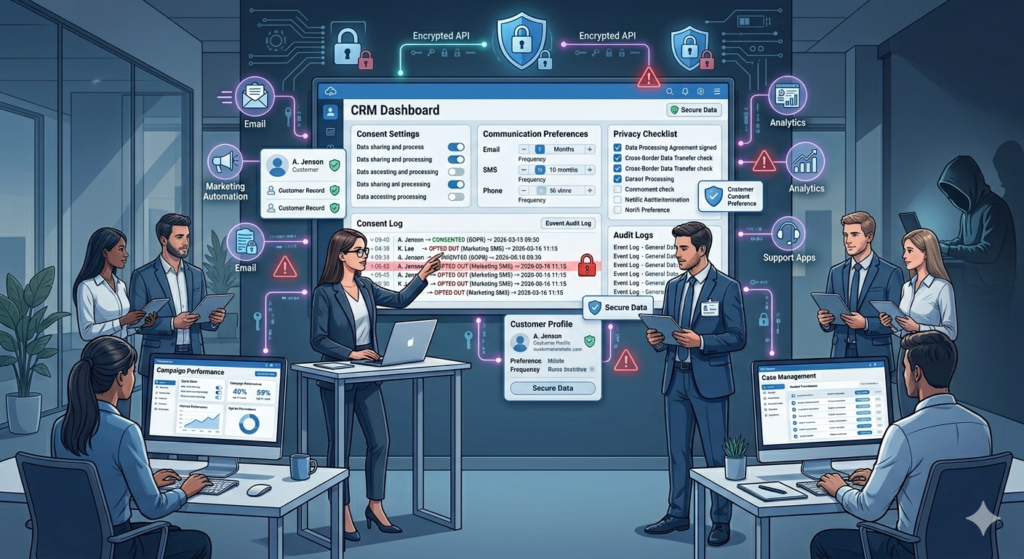
API-based CRM integrations have transformed how businesses manage customer relationships, automate workflows, and improve productivity. Companies now connect their CRM platforms with email systems, marketing tools, payment gateways, analytics software, and customer support applications. These integrations reduce manual work and improve operational efficiency.
However, these connected systems also create major security challenges. Every API connection expands the attack surface of a business. If one integration becomes compromised, attackers may gain access to sensitive customer records, internal communications, or financial information.
Modern businesses depend heavily on connected workflows. For example, a Salesforce to Outlook Integration helps sales teams synchronize emails, calendars, contacts, and customer interactions automatically. While this improves efficiency, it also increases exposure to security threats if authentication, permissions, or data-sharing policies are weak.
As organizations continue adopting cloud-based systems, API security has become a critical business priority. Companies must understand the risks involved before integrating CRM platforms with external tools.
Why CRM APIs Are High-Value Targets
CRM systems store some of the most valuable business information. They often contain customer names, phone numbers, email addresses, contracts, deal values, support conversations, and internal sales notes. Attackers target this data because it can be used for fraud, phishing campaigns, identity theft, or corporate espionage.
Unlike isolated systems, APIs continuously exchange data between platforms. This constant movement creates more opportunities for attackers to exploit weaknesses. A poorly secured integration can expose an entire customer database within minutes.
Cybercriminals also prefer APIs because many organizations focus more on securing user interfaces than backend connections. As a result, APIs sometimes receive weaker monitoring and fewer security controls.
Additionally, attackers know businesses increasingly rely on automation. Disrupting API workflows can damage operations, delay communication, and interrupt revenue-generating activities.
Common Security Risks in API-Based CRM Integrations
Weak Authentication
Weak authentication remains one of the most common API security problems. Many businesses still rely on static API keys or poorly protected access tokens. If attackers steal these credentials, they can access CRM systems without triggering traditional login protections.
Developers sometimes store API keys in source code, spreadsheets, or unsecured messaging platforms. This practice creates unnecessary exposure. Attackers regularly scan public repositories looking for leaked credentials.
Organizations should use OAuth 2.0, multi-factor authentication, and short-lived tokens to reduce this risk.
Excessive Permissions
Many integrations request more permissions than necessary. This happens because broad access is easier to configure during development. However, excessive permissions create serious security concerns.
For example, a scheduling tool may only need calendar access. Yet developers may grant full CRM administrator privileges for convenience. If attackers compromise the tool, they inherit those permissions immediately.
Businesses should always follow the principle of least privilege. Every integration should access only the data and functions it truly requires.
Data Leakage
Sensitive customer information can leak through logs, error messages, backups, or analytics systems. Developers often log full API responses during troubleshooting. Unfortunately, those logs may include private customer details.
Data leakage also occurs when APIs return unnecessary information. Even if applications display limited fields, the API response may expose hidden data in the background.
Organizations must review API responses carefully and sanitize logs regularly.
Insecure Third-Party Applications
Third-party integrations create additional risk because businesses cannot fully control external vendors. Many CRM platforms connect with marketing tools, automation software, and analytics services.
If one vendor experiences a breach, connected CRM systems may also become vulnerable. Attackers often target smaller vendors because their security controls are weaker than enterprise systems.
Before approving integrations, companies should evaluate vendor security practices, compliance certifications, and incident response procedures.
Poor API Rate Limiting
Without rate limiting, attackers can overwhelm APIs with automated requests. This allows brute force attacks, credential stuffing, and large-scale data scraping.
Some attackers avoid detection by sending requests slowly over time. As a result, businesses may not notice unusual activity until significant damage occurs.
Rate limits help reduce abuse by restricting how many requests users can send within a specific timeframe.
Webhook Vulnerabilities
Webhooks allow CRM systems to send real-time updates between applications. Although webhooks improve automation, they also introduce security concerns.
Unsigned webhooks can be spoofed easily. Attackers may send fake requests to trigger unauthorized actions or manipulate workflows.
Replay attacks are another major issue. In these attacks, hackers reuse old webhook requests to repeat valid actions maliciously.
Organizations should sign webhook payloads and validate timestamps before processing requests.
Broken Access Control
Broken access control happens when users or applications access records they should not see. APIs commonly use object IDs to retrieve customer records. Attackers may manipulate these IDs to access unauthorized information.
This issue becomes dangerous because requests may appear legitimate in system logs. Businesses often discover the problem only after data exposure occurs.
Strong authorization checks should exist at every API endpoint.
Insecure Data Transmission
Some organizations still fail to encrypt internal API traffic properly. They assume internal networks are safe from attacks. However, modern cybersecurity threats prove otherwise.
Without strong encryption, attackers may intercept customer information during transmission. Sensitive CRM data should always move through encrypted channels using secure protocols like TLS.
Encryption should protect both external and internal API communications.
Token Theft and Session Hijacking
API integrations commonly rely on bearer tokens for authentication. Whoever possesses the token can access the associated system.
If attackers steal tokens from browsers, logs, or compromised devices, they may bypass login security entirely. Long-lived refresh tokens increase this risk significantly.
Secure token storage and regular rotation help reduce exposure.
Shadow Integrations
Employees sometimes create unauthorized integrations using automation platforms or personal accounts. These unofficial workflows are known as shadow integrations.
Although they improve convenience temporarily, shadow integrations create major visibility problems. Security teams cannot protect systems they do not know exist.
Organizations should maintain a complete inventory of all CRM integrations and connected applications.
Real-World Attack Scenarios
Stolen API Key Exposure
An employee accidentally uploads source code containing API credentials to a public repository. Attackers discover the key and access thousands of customer records before detection occurs.
Over-Permissioned Integration Breach
A third-party marketing tool receives full CRM administrator privileges. Attackers compromise the vendor and gain unrestricted access to customer data, contracts, and sales pipelines.
Compromised Third-Party App
A productivity plugin connected to the CRM experiences a malware infection. The malware steals authentication tokens and exports sensitive business information externally.
Business Impact
API-based CRM breaches can create severe financial and operational consequences. Businesses may lose customer trust, revenue, and competitive advantage after a security incident.
Data breaches also create legal exposure. Organizations handling regulated data may face penalties under GDPR, HIPAA, PCI DSS, or similar compliance frameworks.
Operational disruption represents another major concern. Compromised integrations can interrupt workflows, delay customer communication, and affect sales operations.
In many cases, reputational damage lasts longer than the technical incident itself.
Risk Assessment Checklist
Businesses should evaluate every CRM integration carefully. Important questions include:
- What data does the integration access?
- Who owns the API credentials?
- Are permissions limited properly?
- Are API keys stored securely?
- Are webhooks signed and validated?
- Is sensitive data appearing in logs?
- Are unused integrations disabled?
- Is unusual API activity monitored?
Regular assessments help identify weaknesses before attackers exploit them.
Best Practices and Mitigation
Strong Authentication
Businesses should use OAuth 2.0, multi-factor authentication, and short-lived access tokens whenever possible. Strong authentication reduces the likelihood of unauthorized access.
Least Privilege Access
Every integration should receive only the permissions required for its function. Restricted access minimizes damage if an integration becomes compromised.
Secure Secrets Management
API keys and tokens should never appear in source code or unsecured documents. Organizations should use encrypted secret management solutions instead.
Encryption and Data Protection
All API traffic should use strong encryption protocols. Sensitive customer information should also remain encrypted while stored.
Monitoring and Alerting
Security teams should monitor API traffic continuously. Alerts should trigger when systems detect abnormal behavior, excessive exports, or suspicious login attempts.
Webhook Security
Webhook payloads should include signatures and timestamps. Systems must validate these values before accepting requests.
Vendor Risk Management
Businesses should review vendor security controls before approving integrations. Strong vendors provide transparency regarding data handling and incident response practices.
API Gateway Controls
API gateways help enforce authentication, rate limiting, request validation, and traffic filtering. These controls reduce exposure to automated attacks.
Compliance Considerations
Many industries face strict regulations regarding customer data protection. API-based CRM integrations must comply with relevant legal requirements.
For example, GDPR requires businesses to protect personal information and limit unnecessary data sharing. HIPAA applies similar requirements to healthcare organizations handling patient information.
Compliance depends on real security practices, not documentation alone. Businesses must understand where customer data travels and who can access it.
Implementation Roadmap
Step 1: Discover All Integrations
Create a complete inventory of all CRM integrations, webhooks, plugins, and connected applications.
Step 2: Classify Accessed Data
Identify which integrations access sensitive customer information or regulated data.
Step 3: Audit Permissions
Review access scopes and remove unnecessary privileges immediately.
Step 4: Secure Credentials
Store API keys and tokens using encrypted secret management systems.
Step 5: Monitor Activity
Track API traffic continuously and investigate suspicious behavior quickly.
Step 6: Review Vendors
Evaluate third-party security practices before approving new integrations.
Step 7: Test Regularly
Perform penetration testing and security assessments regularly to identify weaknesses.
Conclusion
API-based CRM integrations improve efficiency, automation, and customer experience significantly. However, they also introduce serious cybersecurity risks when poorly managed.
Weak authentication, excessive permissions, insecure vendors, and poor monitoring create opportunities for attackers to exploit connected systems. Businesses must treat APIs as critical security assets rather than simple technical connections.
Organizations that prioritize visibility, least privilege access, encryption, and monitoring can reduce exposure substantially. Secure CRM integrations support business growth while protecting valuable customer data and operational integrity.