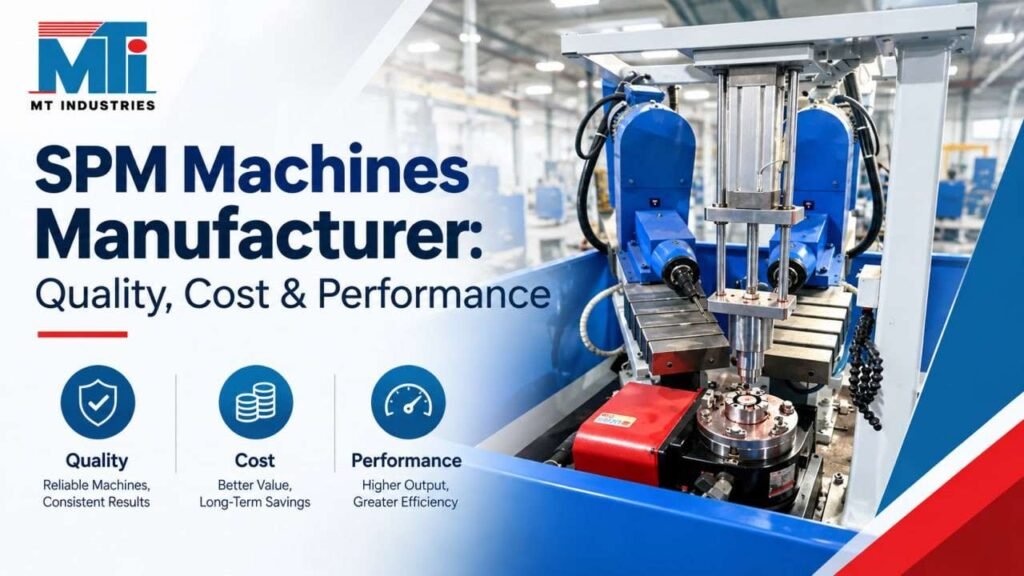
Choosing the right SPM Machines Manufacturer is an important decision for manufacturers looking to improve productivity, consistency, and production efficiency. Special Purpose Machines (SPMs) are designed for specific manufacturing operations, which means their performance depends heavily on engineering quality, machine configuration, tooling, automation, and application requirements.
Unlike standard machines that are built for general-purpose machining, an SPM is usually developed around a particular component, operation, cycle time, and production volume. Therefore, selecting a machine based only on its initial price can lead to higher operating costs or performance issues later.
A better approach is to evaluate three major factors together: quality, cost, and performance.
What Is an SPM Machine?
A Special Purpose Machine is a machine designed to perform one or more specific manufacturing operations efficiently. Depending on the application, an SPM may combine processes such as drilling, tapping, milling, boring, reaming, facing, or other operations into a dedicated production setup.
SPM machines are commonly used where manufacturers require:
- High production volumes
- Consistent component quality
- Reduced machining cycle time
- Repeatable operations
- Lower manual intervention
- Better process control
- Application-specific automation
Multi-drilling, multi-tapping, multi-operation, and combined drilling-tapping machines are examples of SPM solutions used in different manufacturing environments.
Why Does the Manufacturer Matter?
The machine itself is only one part of the investment. The engineering experience behind its design can significantly influence reliability and long-term performance.
A capable Special Purpose Machines Manufacturer should understand the complete production requirement rather than simply supplying a machine based on a standard configuration.
Before recommending a machine, the manufacturer should consider factors such as:
- Component geometry
- Material being machined
- Number and type of operations
- Required cycle time
- Production volume
- Accuracy requirements
- Tooling requirements
- Workholding arrangement
- Automation level
- Available floor space
- Future production requirements
This application-based approach helps ensure that the machine is designed around the actual manufacturing process.
Quality: What Should You Evaluate?
Quality in an SPM is not limited to the appearance or finish of the machine. It includes the structural design, components, precision, assembly, control system, tooling, workholding, and testing.
1. Machine Structure
The machine structure should provide sufficient rigidity for the intended operation. A rigid structure helps minimize vibration and maintain machining consistency, particularly during high-volume production.
2. Precision and Repeatability
For production applications, repeatability is critical. The machine should consistently position and process components within the required tolerances.
The appropriate accuracy level depends on the component and operation, so buyers should evaluate actual application requirements rather than selecting specifications simply because they appear higher.
3. Spindle and Drive System
Spindle selection should match the machining operation, material, tooling, speed, and required production rate.
For drilling and tapping applications, spindle configuration can have a significant effect on cycle time and productivity.
4. Workholding and Fixtures
A well-designed fixture ensures that the component remains securely positioned throughout the machining cycle.
Poor workholding can cause dimensional variation, tool problems, vibration, and inconsistent results even when the machine itself is technically capable.
5. Control and Automation
The control system should provide reliable operation and appropriate monitoring for the intended application. Depending on production requirements, automation can include component loading, unloading, indexing, sensing, tool monitoring, and other process-control features.
Cost: Look Beyond the Purchase Price
One of the most common mistakes when purchasing an SPM is comparing machines only by their initial price.
The actual cost of a machine includes much more than its purchase price.
Consider the following:
Initial investment + tooling + installation + maintenance + energy + consumables + downtime + labour + productivity
A machine with a lower purchase price may not necessarily be the more economical option if it has higher maintenance requirements, slower production, or frequent downtime.
Cost per Component Matters
A more useful comparison is often the cost per component.
For example, suppose Machine A costs less initially but produces components more slowly than Machine B. If Machine B achieves a significantly lower cycle time and requires less manual intervention, its higher initial investment may be recovered through increased production over time.
This is why manufacturers should evaluate return on investment (ROI) rather than simply asking, “Which machine is cheaper?”
Performance: The Numbers That Matter
When evaluating an SPM, performance should be measured against actual production requirements.
Important parameters include:
- Cycle time
- Output per shift
- Machine availability
- Accuracy and repeatability
- Tool life
- Changeover requirements
- Rejection rate
- Automation level
- Maintenance requirements
Cycle Time
Cycle time is one of the most important performance indicators for high-volume production.
A properly engineered SPM can combine multiple operations or perform them simultaneously, potentially reducing the time required to produce each component.
However, cycle-time claims should always be evaluated against the actual component, material, tooling, machining parameters, and inspection requirements.
Machine Availability
High production output is useful only when the machine remains available for production.
A reliable machine should be designed with maintainability in mind. Easy access to serviceable components, appropriate lubrication systems, suitable sensors, and practical maintenance access can help reduce unnecessary downtime.
How to Compare SPM Machines Manufacturers
When comparing an SPM Machines Manufacturer in India, avoid relying on a single specification or quotation.
Instead, ask each manufacturer the same set of questions.
1. Do They Understand Your Application?
Share component drawings, material information, production targets, and machining requirements. A manufacturer should be able to discuss how the proposed machine addresses your specific process.
2. Can They Provide Application-Specific Engineering?
A genuine SPM solution is normally developed around the manufacturing requirement. Ask about machine layout, tooling, fixtures, automation, and process sequencing.
3. How Is the Machine Tested?
Understand what testing is performed before dispatch. Depending on the machine, this may include dimensional checks, trial production, cycle-time verification, and operational testing.
4. What Support Is Available After Installation?
After-sales support can become important when the machine is integrated into continuous production.
Ask about installation, commissioning, operator training, maintenance guidance, troubleshooting, and availability of replacement components.
5. Can the Machine Adapt to Future Requirements?
Production requirements can change. A machine may need tooling modifications, process changes, or additional automation later.
Discuss possible future modifications with the manufacturer before finalizing the design.
Why Indian Manufacturers Can Be Considered
Manufacturers evaluating a Special Purpose Machines Manufacturer in India may benefit from working with suppliers that understand local manufacturing conditions, component requirements, service expectations, and industrial supply chains.
However, location should not be the only selection criterion.
When comparing an SPM Machines Manufacturer in India, evaluate engineering capability, quality practices, machine performance, application expertise, service support, and total cost of ownership together.
For example, MT Industries has experience in developing application-focused SPM solutions for manufacturing requirements involving multi-drilling, multi-tapping, and multi-operation processes.
Common Mistakes When Buying an SPM
Choosing Only on Price
The cheapest quotation may not provide the lowest long-term production cost.
Focusing Only on Cycle Time
A very fast cycle is not useful if the machine cannot maintain required quality or availability.
Ignoring Fixtures and Tooling
Fixtures and tooling directly influence machining stability, accuracy, tool life, and cycle time.
Not Defining Acceptance Criteria
Buyers should establish measurable requirements before machine development, including cycle time, accuracy, output, and component quality.
Overlooking Future Requirements
A machine designed only for today’s production may become difficult to modify when product requirements change.
A Practical SPM Buying Checklist
Before selecting an SPM Machines Manufacturer, prepare the following information:
- Component drawing and specifications
- Material and hardness details
- Required machining operations
- Production volume
- Target cycle time
- Required accuracy and tolerances
- Tooling requirements
- Fixture and workholding requirements
- Desired automation level
- Quality inspection requirements
- Maintenance expectations
- Installation and service requirements
Providing complete information allows the manufacturer to propose a more suitable machine configuration.
How MT Industries Approaches SPM Machine Development
An SPM should be treated as a production solution rather than simply a piece of equipment. The engineering process generally begins by understanding the component and manufacturing operation, followed by decisions regarding machine configuration, tooling, fixtures, automation, and controls.
MT Industries develops Special Purpose Machine solutions around specific production requirements, including multi-drilling, multi-tapping, and multi-operation applications.
The objective is to achieve an appropriate balance between precision, productivity, reliability, maintainability, and overall production cost.
For manufacturers, this application-focused approach can make it easier to evaluate whether an SPM is genuinely suitable for their production process.
Final Takeaway
Selecting an SPM Machines Manufacturer should involve more than comparing quotations. The right machine needs to deliver the required quality while achieving practical production performance at an acceptable total cost.
Look closely at machine rigidity, precision, tooling, fixtures, cycle time, automation, maintainability, testing, and after-sales support. Most importantly, evaluate the machine against your actual component and production requirements.
Whether you are comparing a Special Purpose Machines Manufacturer, assessing an SPM Machines Manufacturer in India, or planning a completely customized production system, the best decision is one based on measurable manufacturing requirements rather than price alone.
A well-engineered SPM can become an important part of a high-volume production process—but its value ultimately depends on how well the machine is designed for the job it needs to perform.
Frequently Asked Questions
1. How do I choose the right SPM Machines Manufacturer?
Look for a manufacturer with relevant application experience, engineering capability, quality practices, testing procedures, and after-sales support. Compare cycle time, accuracy, reliability, tooling, automation, and total cost rather than only the purchase price.
2. What factors affect the cost of an SPM machine?
The cost depends on machine configuration, number of operations, automation level, tooling, fixtures, controls, component requirements, accuracy, and production capacity. Customized machines generally require application-specific engineering.
3. Are SPM machines suitable for high-volume production?
Yes. SPM machines are particularly useful for repetitive, high-volume manufacturing because they can be designed for specific operations and optimized for consistent cycle times and repeatable production.
4. What should I ask an SPM Machines Manufacturer before buying?
Ask about expected cycle time, accuracy, machine availability, tooling, fixtures, automation, testing, maintenance, installation, operator training, service support, and potential future modifications.
5. Why is total cost more important than the machine’s purchase price?
The purchase price is only one part of the investment. Maintenance, tooling, labour, energy consumption, downtime, rejection rates, and production output can significantly affect the machine’s long-term economics. Evaluating total cost of ownership gives a more realistic picture of value.
For More Information Click Here:- https://mtindustries.in/service-spm