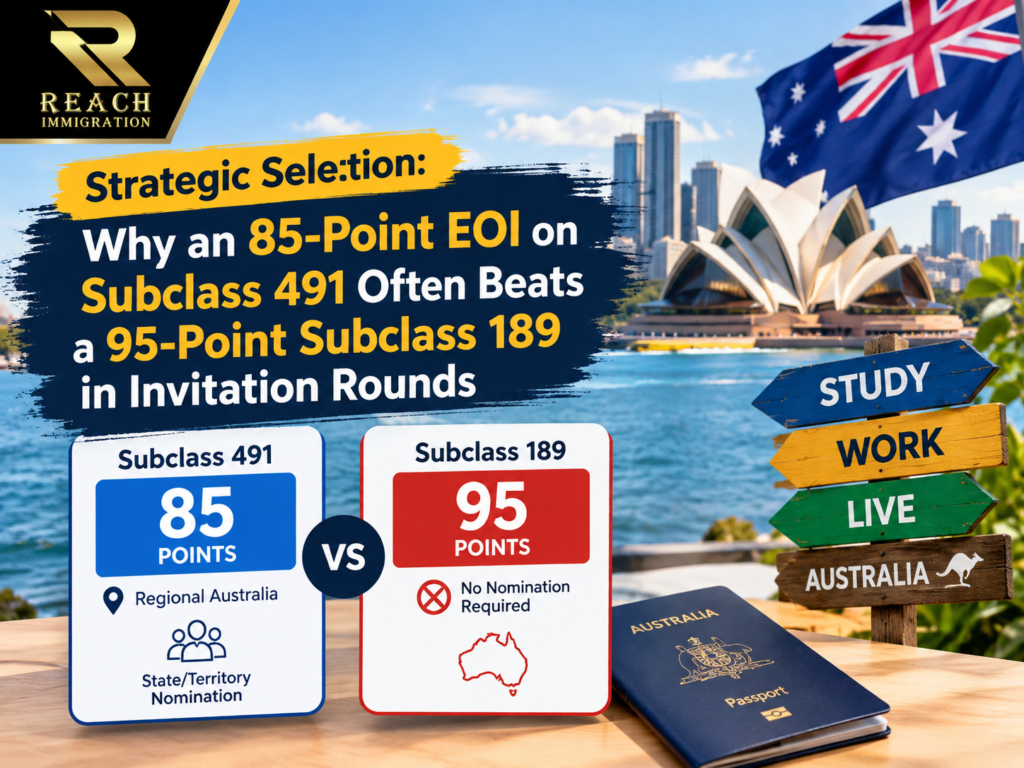
A higher SkillSelect points score does not automatically produce an invitation. That is one of the most important strategic realities for applicants assessing Skilled Migration Visa Australia options.
An applicant with 95 points targeting subclass 189 may appear stronger on paper than someone with 85 points targeting subclass 491. But the two EOIs are not competing under identical selection conditions. Subclass 491 can include 15 points for eligible nomination or sponsorship, while subclass 189 does not receive that regional nomination component. More importantly, invitation availability, occupation demand, state or territory priorities and the relevant invitation round all influence outcomes.
The practical question is therefore not simply, “How many points do I have?” It is:
Which visa pathway gives my particular profile a realistic route into an invitation pool?
85 Points on 491 vs 95 Points on 189: The Mathematics
The points-tested skilled visa framework includes subclass 189, 190 and 491. Home Affairs states that applicants need to meet the minimum points threshold of 65, but reaching 65 does not guarantee an invitation.
The critical difference is how nomination affects the points calculation.
For a qualifying subclass 491 nomination, the applicant can receive 15 additional points. This means a candidate with a 70-point base profile can potentially reach 85 points after nomination.
Consider this simplified comparison:
| Profile | Base Points | Nomination Points | EOI Total |
|---|---|---|---|
| Subclass 189 | 95 | 0 | 95 |
| Subclass 491 | 70 | +15 | 85 |
The 95-point 189 candidate has the higher numerical score. But the 491 applicant may be entering a different selection mechanism, particularly where a state or territory has an occupation-specific need and is inviting suitable candidates.
That does not mean an 85-point 491 EOI will automatically receive an invitation ahead of a 95-point 189 EOI. Invitation rounds are competitive, and the relevant authority controls selection according to its applicable program settings.
Why Total Points Alone Can Mislead Applicants
Many applicants treat their points score as if SkillSelect were a single nationwide queue.
It is not that simple.
The Department of Home Affairs operates SkillSelect for multiple points-tested visas, including subclasses 189, 190 and 491. Applicants submit an EOI and can update it before receiving an invitation.
The invitation environment can differ according to:
- Visa subclass
- Occupation
- State or territory nomination
- Available nomination allocation
- English proficiency
- Skilled employment
- Age
- Qualification
- Applicant location
- State-specific criteria
- Invitation-round settings
Therefore, an applicant should not make a migration strategy based solely on the headline number displayed in the EOI.
A 95-point profile may look impressive, but if the applicant’s occupation is subject to intense competition in the 189 pool, the higher score alone does not establish when or whether an invitation will be issued.
The Strategic Value of Subclass 491
Subclass 491 is a regional provisional visa designed for skilled applicants who meet the relevant requirements and receive eligible nomination or sponsorship.
For applicants who are prepared to live and work in a designated regional area, it can create an additional strategic pathway that may not exist through subclass 189.
This is where Skilled Worker Visa Australia planning needs to move beyond generic points calculators.
The applicant should examine:
1. Is the occupation eligible?
Occupation eligibility is not identical across every skilled visa. Home Affairs specifies occupations and assessing authorities through legislative instruments, and the applicable list must be checked against the particular visa pathway.
2. Is state nomination actually available?
A theoretical 491 strategy is meaningless if the relevant state or territory is not accepting applicants under a pathway that fits the profile.
3. Does the applicant satisfy state-specific requirements?
States can apply their own nomination criteria in addition to federal visa requirements.
This is why Skilled Migration Consultant Australia advice should begin with occupation, skills assessment, points and state eligibility rather than simply recommending the visa with the highest theoretical points.
State Nomination Can Change the Calculation
State nomination is not simply an extra 15 points added at the end of an application.
It is a separate selection process.
For example, NSW currently states that its subclass 491 nomination is competitive and operates through defined pathways. Its published criteria include occupation, residence or employment circumstances and other requirements depending on the pathway.
NSW also states that invitation selection can consider factors including age, English proficiency, education, points score and years of skilled work experience.
This demonstrates why an applicant should not assume:
“I have 85 points, therefore NSW must nominate me.”
The correct analysis is:
“I have 85 points, my occupation is eligible, my evidence satisfies the relevant state pathway, and my profile fits the current selection criteria.”
That is a materially different assessment.
When a 491 Strategy May Be More Practical
A 491 strategy may become relevant when an applicant has:
- A competitive but not exceptional points score
- An occupation with regional demand
- A valid skills assessment
- Strong English results
- Eligible regional employment or study circumstances
- A state nomination pathway matching their profile
- Genuine willingness to live and work regionally
For such applicants, Skilled Migration Agent Australia strategy should focus on pathway fit rather than chasing points indefinitely.
An applicant might spend another year trying to increase a score from 85 to 95 through additional experience or English points, while a suitable regional pathway could potentially provide another route into the skilled migration program sooner.
That is not a promise of an invitation. It is a question of pathway design.
Why 189 Still Requires Serious Consideration
The argument should not be interpreted as “491 is better than 189.”
Subclass 189 remains an important independent skilled pathway. It does not require state or territory nomination, which can make it attractive to applicants whose occupation and profile are competitive within the independent stream.
The correct comparison should therefore examine:
| Factor | Subclass 189 | Subclass 491 |
|---|---|---|
| Nomination | Not required | Required through eligible pathway |
| Regional commitment | No regional condition of this type | Regional living/work requirements apply |
| Nomination points | None | 15 points |
| Selection | SkillSelect invitation | SkillSelect plus relevant nomination process |
| Long-term planning | Direct permanent skilled visa pathway | Provisional regional pathway with later requirements |
An experienced Skilled Visa Consultant Australia should therefore assess both the immediate invitation strategy and the applicant’s longer-term migration objective.
The EOI Must Be Evidence-Ready
A high points score is only useful when every claimed point can be substantiated.
Before submitting an EOI, applicants should audit:
- Age calculation
- English test validity
- Skills assessment validity
- Qualification claims
- Skilled employment periods
- Australian employment
- Partner points
- Regional study claims
- Nomination eligibility
- Occupation code
- Passport and identity details
Home Affairs requires skills assessment information when submitting an EOI and asks for work-history details covering the previous 10 years.
After submission, the EOI can remain active for two years and should be updated when circumstances change, such as gaining additional work experience, obtaining a qualification, improving English or receiving a new skills assessment.
This is an important part of Skilled Visa Australia strategy: the EOI should remain accurate throughout its active period.
A Better Way to Compare 189 and 491
Instead of asking, “Which visa has the lower cutoff?”, assess the profile through five filters:
Profile Audit
Confirm age, English, qualification, experience and partner points.
Occupation Audit
Confirm the correct ANZSCO occupation, assessing authority and visa eligibility.
Points Audit
Calculate the base score before adding nomination points.
Nomination Audit
Check which states or territories currently offer a realistic pathway for the occupation and applicant profile.
Evidence Audit
Confirm every claimed point can be supported by appropriate documentation.
This five-stage process is more useful than relying on historical invitation screenshots or informal cutoff tables.
Why Historical Cutoffs Need Careful Interpretation
Previous invitation rounds can help establish what has happened, but they cannot guarantee the next round.
Home Affairs publishes invitation-round information and previous-round data, but invitation outcomes remain dependent on the applicable round and program settings.
State nomination can be even more dynamic. NSW, for example, states that its 491 invitation rounds have no predetermined publicly announced dates and that selection is discretionary.
That makes Australia Skilled Migration Consultant analysis particularly valuable when comparing pathways that operate under different selection conditions.
Building the Right Strategy for Your Profile
The central lesson is straightforward: points are a component of the strategy, not the entire strategy.
An 85-point subclass 491 profile can have a viable pathway where a 95-point subclass 189 profile faces stronger competition. But the reverse can also occur depending on occupation, invitation rounds, nomination availability and applicant circumstances.
For applicants comparing independent and regional options, Skilled Migration Services Australia should involve a structured assessment of occupation eligibility, skills assessment, points, state criteria, evidence and long-term visa objectives.
Reach Immigration can assess your profile across these factors and help determine whether a 189, 190 or 491 strategy aligns with your current qualifications and migration circumstances. If you are planning Skilled Worker Migration Australia, the objective should be to build an evidence-supported pathway rather than simply chase the highest theoretical points score.
A well-designed Australian Skilled Migration strategy starts with the applicant’s actual profile, then works backward from the available visa and nomination pathways.