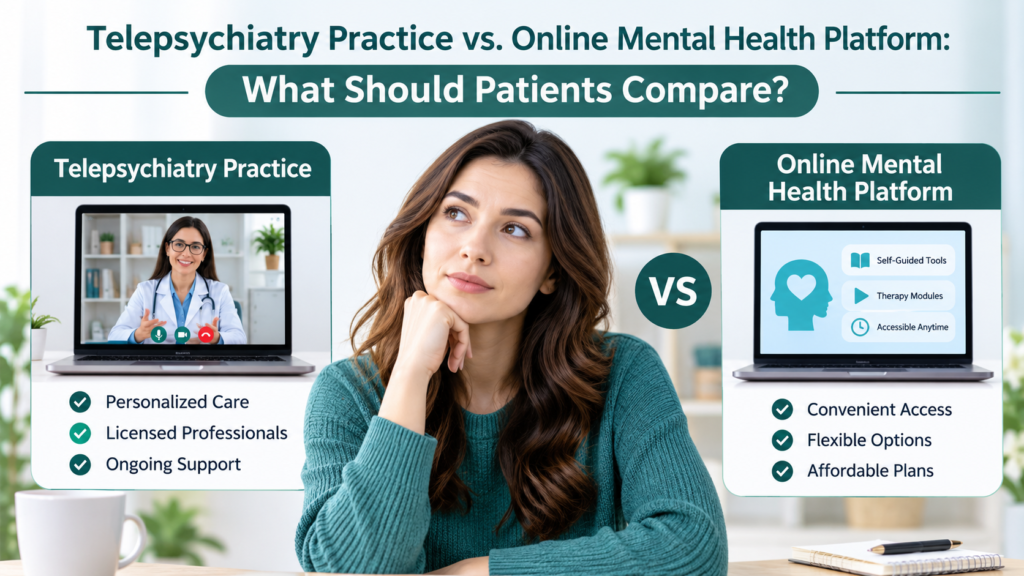
Telepsychiatry Practice vs. Online Mental Health Platform: What Should Patients Compare?
Choosing mental health care online can feel confusing. Some services connect patients with individual psychiatric practices, while others operate as larger digital platforms offering access to different mental health professionals. Both options may provide convenient care, but their services, treatment processes, costs, and follow-up arrangements can differ.
When comparing telepsychiatry companies, it is important to look beyond advertisements, quick appointment options, or introductory prices. Patients should understand who will provide their care, how treatment decisions are made, and what support is available after the first appointment.
Understanding the difference between a dedicated telepsychiatry practice and a broader online mental health platform can help patients make a more informed decision. This guide explains the main factors to consider when choosing an online psychiatric provider and deciding which care model may better suit individual needs.
1. Understanding the Difference Between a Telepsychiatry Practice and an Online Platform
Although these services can overlap, their care models may be different.
What Is a Telepsychiatry Practice?
A telepsychiatry practice provides psychiatric care remotely, usually through secure video appointments or other appropriate telehealth methods. Depending on the practice, services may include psychiatric evaluations, medication management, symptom monitoring, and follow-up appointments.
Patients generally work with a psychiatric clinician who evaluates their concerns, reviews relevant medical history, and discusses possible treatment options. The exact approach depends on the practice and the patient’s needs.
A dedicated practice may suit people who prefer a more direct relationship with their psychiatric provider and a consistent treatment plan.
What Is an Online Mental Health Platform?
An online mental health platform is a digital service that connects patients with mental health professionals through a website, application, or patient portal. Some platforms offer therapy, psychiatric appointments, medication management, or a combination of services.
The platform may manage scheduling, payments, patient communication, and technology while independent clinicians or employed providers deliver clinical care. However, the structure varies between companies.
Some platforms focus on matching patients with professionals, while others offer more integrated care.
Why Does the Difference Matter?
The business model alone does not determine the quality of treatment. A large platform may offer convenient scheduling and several types of care, while a smaller practice may provide a more direct route to a particular clinician.
The important question is how the service works for you as a patient. Compare the actual clinical services, provider qualifications, continuity of care, and communication arrangements rather than assuming that one model is automatically better.
2. Compare Provider Qualifications and Clinical Oversight
One of the most important steps in evaluating telepsychiatry companies is checking who will actually provide your psychiatric care.
The term “mental health professional” can refer to different licensed or credentialed roles. Psychiatrists are physicians who specialize in mental health and can assess psychiatric conditions and prescribe medication when clinically appropriate and legally permitted. Psychologists, therapists, and other clinicians have different qualifications and scopes of practice.
Before booking, consider the following questions:
- Is the clinician’s full name and professional qualification available?
- Is the provider licensed to treat patients in the state where you will attend the appointment?
- Does the clinician have experience addressing your concerns?
- Who will evaluate your symptoms and make treatment recommendations?
- Is clinical supervision or consultation available when needed?
In the United States, providers generally must meet applicable state licensing requirements to deliver telepsychiatry services to patients located in that state.
The American Psychiatric Association’s guidance on state licensure explains why a psychiatrist’s location alone does not determine where they may legally provide care.
A trustworthy service should make it reasonably easy to identify the treating clinician and understand their role. Do not rely only on a company’s reputation or the number of professionals listed on its website.
3. Look at the Range of Psychiatric Services
Not every online mental health service provides the same level or type of care. Some primarily offer psychotherapy, while others include psychiatric evaluations and medication management.
When comparing telepsychiatry companies, check whether their services match what you need now and what you may need later.
Psychiatric Evaluations
An initial psychiatric evaluation helps a qualified clinician understand your symptoms, medical history, current concerns, and relevant background. The clinician may ask about sleep, mood, concentration, daily functioning, medications, and previous treatment.
A meaningful evaluation should allow time for questions and discussion. Be cautious of services that make treatment decisions appear automatic or guaranteed before an appropriate assessment.
Medication Management
Some patients need medication as part of their treatment plan. Ask whether the service offers medication management, how follow-up appointments work, and how questions about side effects or treatment changes are handled.
Medication is not appropriate for every patient or every condition. A clinician should explain the potential benefits, risks, alternatives, and monitoring requirements of any recommended treatment.
Prescribing policies also depend on applicable laws and the medication involved.
Ongoing Psychiatric Care
Mental health needs can change over time. Follow-up visits allow a clinician to review symptoms, discuss treatment response, and determine whether adjustments are appropriate.
Check whether you can continue with the same clinician and how the service handles referrals when additional care is needed.
The American Psychiatric Association’s overview of telepsychiatry describes how remote psychiatric services can include evaluations, medication management, and ongoing clinical support.
4. Evaluate Continuity of Care and Follow-Up
Your first appointment is only one part of the treatment process. For many patients, the ability to receive appropriate follow-up care is just as important as finding an available appointment.
Different telepsychiatry companies may have different arrangements for scheduling return visits, communicating with clinicians, and reviewing treatment progress.
Before selecting a service, find out:
- Can you request follow-up appointments with the same clinician?
- How far in advance can appointments be scheduled?
- How can you ask routine questions between appointments?
- Who responds if you experience a medication concern?
- Can your treatment plan be reviewed and updated over time?
- What happens if your clinician leaves the service?
A larger platform may provide several clinicians and administrative support, but you should confirm whether these features translate into consistent care. A private practice may offer direct contact with its clinical team, although its availability and communication policies also need to be checked.
Continuity does not mean that you must always see the same person. Sometimes a referral or change in provider is appropriate. What matters is that changes are communicated clearly and that responsibility for ongoing care is understood.
5. Compare Costs, Insurance, and Payment Policies
Price is another important factor when comparing telepsychiatry companies. An inexpensive initial consultation may not reflect the total cost of ongoing treatment.
Look at the complete fee structure before committing to a service.
Questions to Ask About Pricing
- What is the cost of the initial psychiatric evaluation?
- How much do follow-up appointments cost?
- Does the service accept your insurance plan?
- Are medication management visits billed separately?
- Are there membership fees or recurring subscription charges?
- What are the cancellation and missed-appointment policies?
Some platforms use subscription models, while others charge per appointment. Private practices may accept insurance, offer self-pay appointments, or use a combination of payment options.
Neither approach is automatically less expensive. Your total cost will depend on the services you need, appointment frequency, insurance benefits, and any additional charges.
If you plan to use insurance, verify coverage directly with your insurer and the provider. Ask whether the clinician is in-network and whether your plan requires a referral or prior authorization.
Clear pricing helps you plan for care without unexpected expenses.
6. Review Privacy, Confidentiality, and Technology
Online appointments involve sharing personal information through digital systems. Patients should understand how their information is handled before discussing sensitive mental health concerns.
When comparing online psychiatry services, review their privacy policies and ask how clinical records, appointment details, messages, and payment information are protected.
Useful questions include:
- Does the service explain how patient information is collected and used?
- How are video appointments and patient communications protected?
- Who can access your medical records?
- Are appointments recorded, and under what circumstances?
- How can you request records or update your information?
- What happens to your records if you stop using the service?
Do not assume that every digital platform offers the same privacy protections. Ask for clear information about the safeguards that apply to your care.
The U.S. Department of Health and Human Services provides practical advice in its guide to protecting patient privacy during telehealth.
Patients can also take simple precautions. Use a private room, choose a password-protected device, and avoid public Wi-Fi when possible. Headphones may help prevent others from overhearing a confidential conversation.
A professional service should be able to explain its privacy practices without making unrealistic promises of absolute security.
7. Consider Appointment Access and Communication
Convenience is one reason patients explore telepsychiatry. Remote appointments can reduce travel and make it easier to fit care around work, family responsibilities, or other commitments.
However, convenience involves more than how quickly you can book an appointment.
Consider the entire patient experience. Is the scheduling system easy to use? Can you access appointment instructions without difficulty? Does the provider explain how to prepare for the evaluation? Is technical support available if the video connection fails?
Communication matters, too. Patients should feel comfortable asking questions and discussing concerns without feeling rushed.
The U.S. Department of Health and Human Services’ telehealth guidance for patients encourages patients to choose providers who listen, ask questions when something is unclear, and explain how personal health information is handled.
A well-designed application can improve access, but technology cannot replace thoughtful clinical communication.
8. Understand Treatment Personalization and Coordination
Mental health care should respond to the individual rather than rely on a one-size-fits-all approach.
During an evaluation, a psychiatric clinician may consider symptoms, medical history, previous treatment, daily responsibilities, personal preferences, and other relevant factors. These details help guide discussions about appropriate care.
When comparing a virtual psychiatrist through a platform with one working in a dedicated practice, ask how treatment decisions are made and whether your concerns will be reviewed over time.
For example, a patient experiencing persistent anxiety may need a detailed assessment, discussion of treatment options, and follow-up to evaluate progress. Another patient may need a review of existing medication or referral for a different type of support.
Ask whether the service can coordinate with other healthcare professionals when appropriate and how information is shared with your permission.
A larger platform may offer access to different types of professionals, while a dedicated psychiatric practice may focus more narrowly on psychiatric services. Either model can be suitable if its services match your needs and appropriate coordination is available.
9. Know When Online Psychiatric Care May Not Be Enough
Online appointments can make psychiatric care more accessible, but they are not the right solution for every situation.
A clinician should consider whether remote assessment and treatment are appropriate for the patient’s symptoms, circumstances, and safety needs. Some situations may require an in-person examination, additional medical assessment, a specialist referral, or a higher level of care.
Before enrolling, ask how the provider handles urgent concerns and what alternatives are available if online appointments are not clinically suitable.
Routine messaging and scheduled appointments should not be treated as emergency services unless the provider explicitly offers and explains such a service.
If you or someone else is in immediate danger or experiencing a psychiatric emergency in the United States, call 911 or go to the nearest emergency department. You can also call or text 988 for crisis support.
Understanding these limits is part of choosing a responsible service, not a reason to dismiss online care altogether.
10. A Practical Checklist for Comparing Providers
Use the following checklist when reviewing telepsychiatry companies and dedicated psychiatric practices.
| Comparison factor | What to check |
| Provider qualifications | Verified credentials and applicable state licensure |
| Clinical services | Evaluations, medication management, and other available care |
| Follow-up | Appointment availability and continuity with your clinician |
| Pricing | Evaluation fees, follow-up costs, insurance, and cancellation policies |
| Privacy | Clear policies for medical records and digital communication |
| Communication | Instructions, response times, and access to clinical support |
| Personalization | Individual assessment and treatment discussions |
| Coordination | Referrals and communication with other providers when appropriate |
| Safety | Clear guidance for urgent concerns and situations needing in-person care |
You do not need to choose the service with the most features. Instead, prioritize the factors that matter most to your circumstances and verify important details before booking.
Frequently Asked Questions
1. What Is the Difference Between Telepsychiatry Companies and Online Mental Health Platforms?
Telepsychiatry companies may operate dedicated psychiatric practices or provide technology and administrative services connecting patients with clinicians. Broader online mental health platforms may offer psychiatry, therapy, or other mental health resources. Their services and business models vary, so review the actual care provided.
2. Are Online Psychiatry Platforms as Effective as Dedicated Practices?
The care model alone does not determine effectiveness. The quality of the clinical assessment, provider qualifications, treatment plan, and follow-up arrangements are important. The American Psychiatric Association reports evidence supporting telepsychiatry as an effective option for many patients when appropriately provided.
3. Can a Virtual Psychiatrist Prescribe Medication?
A qualified psychiatrist may prescribe medication when clinically appropriate and legally permitted. Prescribing depends on the patient’s assessment, the medication involved, and applicable federal and state requirements. Not every appointment results in a prescription.
4. What Should Patients Ask Before Choosing an Online Psychiatric Provider?
Ask about provider credentials, available services, evaluation and follow-up fees, insurance coverage, privacy practices, communication policies, and access to ongoing care. Confirm that the clinician is authorized to treat patients in your location.
5. Is a Telepsychiatry Practice Better Than a Large Online Platform?
Neither option is universally better. A dedicated practice may suit patients who prefer a direct relationship with a psychiatric clinician, while a larger platform may offer more service options or administrative convenience. Compare the individual provider, clinical approach, and ongoing support.
6. How Can Patients Check Whether a Telepsychiatry Provider Is Legitimate?
Verify the clinician’s qualifications and state license through the appropriate licensing board. Review the service’s contact information, privacy policies, fees, and clinical procedures. Be cautious of guaranteed results or claims that prescriptions are assured before an evaluation.
Conclusion
Choosing between telepsychiatry companies and broader online mental health platforms requires more than comparing appointment prices or website features. Provider qualifications, clinical services, follow-up arrangements, privacy practices, and transparent communication all contribute to an informed decision.
Patients exploring online psychiatric care can use these factors to identify a service that aligns with their needs and preferences. The goal is not simply to find an appointment online, but to understand what type of professional care is available and how that care may continue over time.
Cordial Psychiatry is a mental health practice serving patients in New York, with information about psychiatric evaluations, medication management, and ongoing psychiatric care. Its website can be used as an informational resource for people exploring psychiatric services and learning about available care options. Reviewing the practice’s services and appointment information can help prospective patients understand whether its offerings align with their needs.