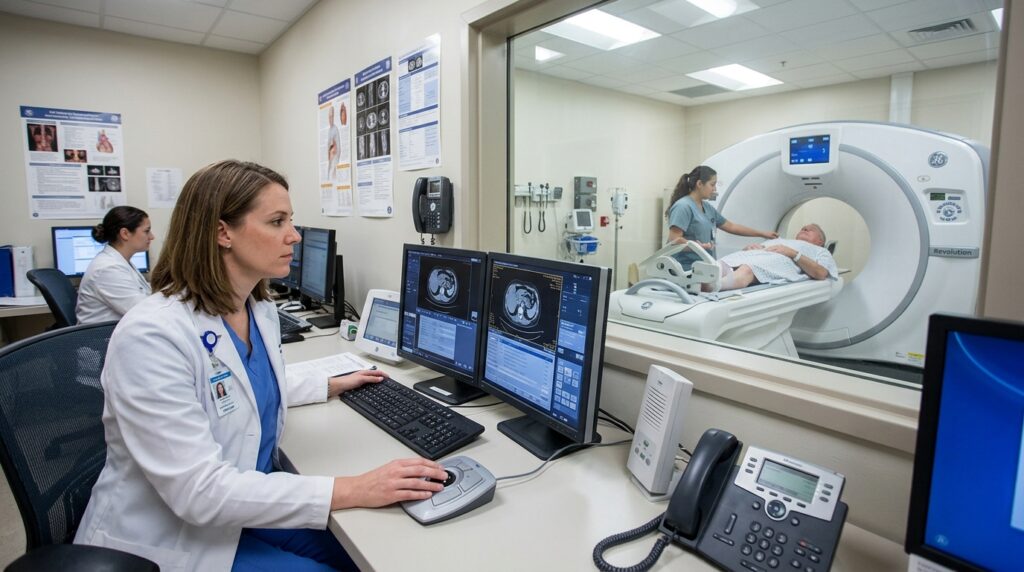
Bangalore has solidified its reputation as India’s primary healthcare destination, blending Silicon Valley’s technological prowess with advanced medical infrastructure. For a patient or a caregiver, the sheer number of diagnostic facilities can be overwhelming. Choosing between a multi-speciality hospital and a standalone diagnostic hub involves more than just looking at the price tag. In 2026, the criteria for “quality” have shifted toward precision technology, artificial intelligence integration, and rigorous accreditation standards.
This guide is designed to help you navigate the landscape of CT scan centres in Bangalore. Whether you are looking for a routine chest CT or a complex cardiac angiography, understanding the technical and operational benchmarks will ensure you receive an accurate diagnosis without unnecessary radiation exposure or financial strain.
Understanding CT Technology: Why Slices Determine Your Diagnostic Quality
The most common technical term you will encounter is the “slice count” of the CT scanner. This refers to the number of cross-sectional images the machine captures in a single 360-degree rotation. While a 16-slice or 64-slice machine was the standard a decade ago, Bangalore’s top-tier centres in 2026 now utilize 128-slice, 256-slice, and even 512-slice Spectral CT technology. Higher slice counts mean faster scan times, which is critical for patients who have trouble holding their breath or for children who cannot stay still.
Beyond speed, higher slice counts provide superior image resolution. This is particularly vital for cardiac imaging, where the machine must capture the heart between beats. Modern 256-slice scanners can image the entire heart in less than a second, significantly reducing “motion blur” and the need for beta-blockers to slow the heart rate. Additionally, newer machines are equipped with “iterative reconstruction” software, which allows radiologists to produce high-quality images using up to 80% less radiation than older models.
| Scanner Type | Best Used For | Key Advantages |
| :— | :— | :— |
| 16-32 Slices | Routine bone scans, dental CTs, sinus (PNS) imaging. | Lower cost, widely available in local clinics. |
| 64 Slices | Standard chest and abdomen scans, basic trauma. | Good balance of speed and detail for routine diagnostics. |
| 128 Slices | Detailed lung studies (HRCT), vascular imaging. | High resolution, significantly reduced radiation dose. |
| 256-512 Slices | Cardiac angiography, complex neurovascular, pediatric. | Ultra-fast (sub-second), ideal for emergency and cardiac care. |
Accreditation Audit: How NABL and NABH Safeguard Your Results
In the diagnostic industry, accreditation is the only objective proof of quality. When comparing centres, you must distinguish between NABL and NABH certifications. NABL (National Accreditation Board for Testing and Calibration Laboratories) focuses specifically on the technical competence of the lab. As of 2026, the updated ISO 15189:2022 standard is the benchmark for NABL-accredited centres in Bangalore. This ensures that the equipment is calibrated correctly, the reagents are high-quality, and the final report is medically accurate.
NABH (National Accreditation Board for Hospitals and Healthcare Providers) focuses more on patient safety and the overall healthcare environment. While hospitals are typically NABH-accredited, standalone diagnostic centres often pursue NABL as their primary quality badge. Choosing an accredited centre means your reports are more likely to be accepted by specialists across India and abroad, preventing the need for expensive and redundant re-testing.
- Verify the Scope: Ensure the centre is accredited specifically for “Radiology” and “CT Imaging,” not just blood tests.
- Check the Validity: Look for the NABL logo with a current certificate number, usually displayed in the reception or on their digital portal.
- Radiologist Expertise: Quality is as much about the “reader” as the machine. Confirm if the centre has sub-specialised radiologists (e.g., neuro-radiologists or cardiac-radiologists).
- Standardization: Accredited centres follow strict protocols for contrast administration, minimizing the risk of allergic reactions or kidney strain.
Cost Analysis: Navigating CT Scan Prices Across Bangalore Neighbourhoods
The cost of a CT scan in Bangalore is influenced by the location of the centre, the technology used, and the complexity of the scan. Generally, standalone diagnostic chains offer more competitive pricing than large multi-speciality hospitals. In 2026, a basic NCCT (Non-Contrast Computed Tomography) of the brain in areas like Jayanagar or Indiranagar might cost between ₹1,500 and ₹2,500. However, in high-demand hubs like Whitefield or Electronic City, prices may lean toward the higher end of that spectrum.
Contrast-enhanced scans (CECT) are more expensive because they require the injection of a radio-opaque dye and the presence of a doctor to monitor for reactions. These typically add ₹2,000 to ₹3,500 to the base price. Specialized procedures like a CT Coronary Angiogram or a 3D CT for reconstructive surgery can range from ₹9,000 to ₹18,000. Many centres now offer “Early Bird” or “Sunday Discounts,” making it worthwhile to enquire about off-peak slots.
Estimated 2026 Price Ranges in Bangalore:
- CT Brain (Plain): ₹1,400 – ₹2,800
- CT Chest / HRCT Lungs: ₹3,500 – ₹5,500
- CT Abdomen & Pelvis (CECT): ₹6,000 – ₹9,000
- CT Coronary Angiography: ₹9,500 – ₹15,000
- CT Guided Biopsy: ₹8,000 – ₹12,000
The AI Factor: How Modern Centres are Reducing Human Error
Artificial Intelligence has moved from being a buzzword to a core component of Bangalore’s diagnostic workflow. In 2026, many top-rated CT scan centres utilize AI-powered platforms to assist radiologists. These algorithms act as a “second pair of eyes,” flagging critical findings like small lung nodules, early-stage strokes, or subtle bone fractures that might be missed during a busy shift. AI-driven “Teleradiology” also ensures that even if you visit a smaller branch, your images can be reviewed by a senior specialist in real-time.
Another significant benefit of AI is the reduction in Turnaround Time (TAT). Automated drafting tools allow radiologists to finalize reports faster, with many centres now promising digital delivery within 30 to 60 minutes for emergency cases. Some centres in Bangalore even provide “Smart Reports,” which include visual trend charts and layman-friendly explanations of the findings, helping patients better understand their health status before meeting their doctor.
- Workflow Prioritization: AI automatically moves critical cases (like a brain hemorrhage) to the top of the radiologist’s queue.
- Quantification Accuracy: Algorithms can precisely measure tumor volumes or the percentage of lung involvement in infections, providing data that is more objective than manual estimation.
- Dose Tracking: Smart software now tracks the cumulative radiation dose a patient receives across multiple scans, ensuring lifelong safety.
- Error Reduction: AI cross-references findings with millions of previous cases to alert the doctor to rare pathologies.
Insurance, Schemes, and Cashless Tie-ups in 2026
Navigating the financial aspect of diagnostics has become easier with expanded insurance coverage. While diagnostic tests were traditionally only covered during hospitalization, many private health insurance plans in 2026 include “OPD Riders” that cover high-cost scans like CTs and MRIs. Additionally, Bangalore’s network of empanelled hospitals under the Ayushman Bharat (PMJAY) and Karnataka’s Jyothi Sanjeevini schemes provide cashless or highly subsidized CT services for eligible beneficiaries.
If you are using private insurance, the “Cashless” facility is often restricted to scans performed within a hospital. Standalone centres usually operate on a “Reimbursement” basis, where you pay upfront and claim the amount later. To ensure a smooth claim process, always carry a valid doctor’s prescription and ensure the centre provides a detailed invoice with the NABL accreditation number clearly visible.
Steps for a Successful Insurance Claim:
- Check Coverage: Confirm if your policy covers “Outpatient Diagnostics” or if the scan is part of “Pre-hospitalization” expenses.
- Pre-Authorization: For expensive scans like PET-CT, some insurers require a pre-approval form signed by your specialist.
- Documentation: Keep the original prescription, the bill, the payment receipt, and the final signed report.
- Corporate Tie-ups: Many IT companies in Bangalore have direct tie-ups with diagnostic chains, offering 10% to 30% discounts for employees and their families.
Accessibility and Convenience: 24/7 Service and Home Prep
For many patients, the quality of the machine is secondary to the ease of the experience. In a city like Bangalore, traffic and parking are significant factors. Leading centres have addressed this by offering home-based preparation services. For example, if you require a CECT abdomen, the centre can deliver the oral contrast material to your home so you can begin the preparation process in comfort before traveling for the scan.
Accessibility also means 24/7 availability for emergencies. Major hospitals in Whitefield, Jayanagar, and Hebbal provide round-the-clock CT services, though you should expect a “night charge” or emergency fee after 10 PM. Digital accessibility is the final piece of the puzzle. In 2026, you should expect your reports and high-resolution DICOM images to be delivered via WhatsApp or a secure cloud portal, eliminating the need for a second trip to collect physical films.
- Location Strategy: Choose a centre near your treating physician; this often facilitates faster consultation once the report is ready.
- Elderly Care: Check if the centre is wheelchair accessible and if they provide “Priority Slots” for senior citizens to minimize wait times.
- Prep Support: Ask if the centre provides a dedicated coordinator to explain fasting requirements or contrast protocols over the phone.
- Digital Archives: Opt for centres that store your scans in a permanent digital locker, allowing you to compare current results with future scans easily.
In conclusion, comparing CT scan centres in Bangalore requires looking beyond the basic price. By prioritizing high-slice technology (128+), verifying NABL accreditation, and choosing centres that leverage AI for accuracy, you ensure that your diagnostic journey is both safe and precise. In a city that leads the nation in medical innovation, the “best” centre is the one that combines cutting-edge hardware with a patient-first approach to reporting and convenience.