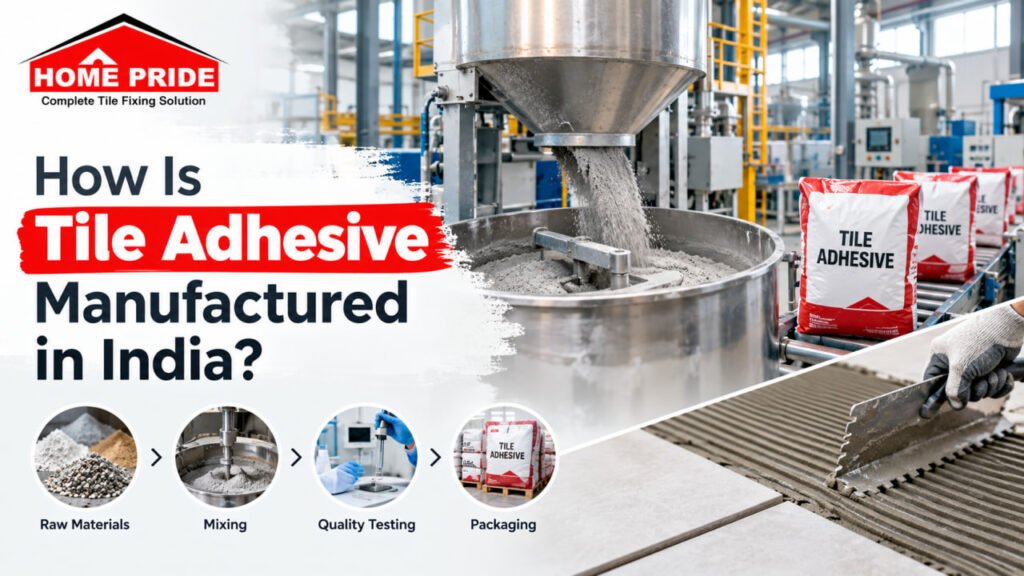
Tile adhesive is an engineered bonding material used to fix ceramic, porcelain, vitrified, and other types of tiles to suitable surfaces. Unlike traditional cement-sand mortar, modern adhesive formulations are designed to provide controlled workability, adhesion, water retention, and other performance characteristics required for different tiling applications.
But how does a dry powder become a tile adhesive that can reliably bond tiles?
The answer lies in material selection, formulation, accurate batching, controlled mixing, quality testing, and proper packaging. Although the exact recipe varies between products, the manufacturing principle remains broadly similar.
For anyone looking to understand how a Tile Adhesive Manufacturer in India produces these materials, the process can be divided into several important stages.
What Is Tile Adhesive Made Of?
Most cement-based tile adhesives contain four broad categories of ingredients:
- Cementitious binders – provide the primary binding action after water is added.
- Mineral fillers – provide body and help control the physical characteristics of the dry mix.
- Polymer modifiers – can improve adhesion, flexibility, and other performance properties.
- Chemical additives – are used in controlled quantities to influence properties such as water retention, workability, open time, and slip.
The proportion and type of each component depend on the intended application.
For example, an adhesive intended for a small ceramic wall tile does not necessarily require the same formulation as one designed for a large-format porcelain tile.
How Is Tile Adhesive Manufactured?
The manufacturing process generally follows a controlled sequence rather than simply mixing cement with other materials.
1. Raw Material Selection
Manufacturing starts with the selection of suitable raw materials.
Cement, mineral fillers, polymers, and additives are evaluated according to the manufacturer’s specifications. Factors such as particle size, moisture content, purity, and consistency can influence the final product.
This stage is particularly important because inconsistent raw materials can create variations between batches.
A responsible manufacturer therefore establishes specifications for incoming materials and checks them before they enter production.
2. Raw Material Storage
After inspection, materials are stored in designated areas.
Dry materials need protection from moisture and contamination. This is especially important for cementitious powders because exposure to moisture can affect their properties before they are even used.
Specialty additives may also require controlled storage conditions according to their technical requirements.
Good storage practices help maintain consistency from the beginning of the manufacturing cycle.
3. Accurate Weighing and Batching
Once the required formulation is selected, individual materials are weighed according to the specified proportions.
This is known as batching.
Accurate batching is one of the most important parts of dry-mix manufacturing. A small variation in the amount of a performance additive can influence properties such as water retention, workability, or setting behaviour.
Modern production systems may use automated weighing and dosing equipment to improve accuracy and repeatability.
4. Controlled Dry Mixing
The measured materials are then transferred into an industrial mixer.
The objective is to distribute every component uniformly throughout the mixture. This is more complicated than simply stirring different powders together.
Mineral fillers may represent a much larger proportion of the formulation, while polymers and specialty additives may be present in much smaller quantities. The mixing process therefore needs to achieve sufficient uniformity so that each portion of the finished product has a consistent formulation.
Mixing time, mixer design, loading sequence, and material characteristics can all affect the result.
5. In-Process Quality Checks
Quality control does not necessarily begin only after manufacturing is complete.
Samples may be collected during production to check whether the batch is behaving as expected. Depending on the product and its intended application, manufacturers may evaluate parameters associated with consistency, workability, setting, adhesion, open time, and other relevant characteristics.
If a batch does not meet the defined requirements, it should not simply be released without investigation.
This process-oriented approach helps manufacturers identify problems before the product reaches the customer.
How Is the Finished Adhesive Tested?
Testing is essential because appearance alone cannot tell whether a tile adhesive is suitable for a particular application.
Depending on the formulation and applicable requirements, testing can cover properties such as:
Adhesion
Adhesion indicates how effectively the adhesive bonds with the relevant surfaces under specified test conditions.
Open Time
Open time relates to the period during which an applied adhesive can continue to provide the required bonding performance under defined conditions.
Slip
For wall applications, resistance to tile slipping can be an important consideration.
Workability
The adhesive should have application characteristics appropriate for its intended use. Mixing and spreading behaviour are therefore important practical considerations.
Setting and Curing Behaviour
The way the adhesive develops its properties after mixing with water is also evaluated.
The specific tests, methods, and acceptance criteria depend on the product category and applicable standards or specifications.
Why Polymer Modification Matters
One of the major differences between basic cementitious mixes and modern formulated adhesives is the use of polymer modification.
Polymers can influence several properties of an adhesive, including adhesion and flexibility. They can also help a formulation meet performance requirements that may be difficult to achieve with cement and mineral fillers alone.
However, adding a polymer does not automatically make an adhesive suitable for every application.
The complete formulation matters. The type of polymer, dosage, compatibility with other ingredients, and manufacturing process all influence the final characteristics.
Does Tile Size Affect Adhesive Selection?
Yes.
Tile dimensions and weight are important factors when selecting an adhesive.
Large-format tiles can create different installation challenges because of their size, weight, substrate flatness requirements, and need for adequate adhesive coverage.
Porcelain and vitrified tiles may also have relatively low water absorption compared with some conventional ceramic tiles. Consequently, the bonding requirements should be considered rather than assuming that one adhesive is suitable for every tile.
This is why product selection should always be based on the manufacturer’s stated application range and the actual installation conditions.
What Role Does the Substrate Play?
The tile is only one side of the bonding system. The condition and type of the substrate are equally important.
Common substrates can include:
- Concrete
- Cement-based screeds
- Cement plaster
- Masonry
- Suitable existing tiled surfaces
- Other substrates specifically approved by the product manufacturer
The surface should generally be sound, clean, and appropriately prepared.
Dust, loose particles, excessive moisture, weak surfaces, contamination, or significant unevenness can negatively affect installation performance regardless of the quality of the adhesive.
Therefore, choosing a product is only one part of successful tile installation.
How Does a Tile Adhesive Manufacturer in India Maintain Consistency?
Consistency is one of the most important challenges in dry-mix manufacturing.
A manufacturer needs to control multiple stages, including:
Raw materials → batching → mixing → testing → packaging → storage
If any stage is poorly controlled, the finished product can vary.
For example, inaccurate dosing can change the formulation, while inadequate mixing can result in uneven distribution of additives. Poor packaging or storage can allow moisture to affect the product before installation.
Manufacturers such as Home Pride operate within this broader quality-control framework, where consistent production and appropriate product information are important parts of supplying construction materials.
What Should Buyers Look for in a Tile Adhesive?
Instead of choosing a product simply because it is described as the Best Tile Adhesive in India, buyers should first identify what the project actually requires.
Consider these factors:
Tile Type
Identify whether the tiles are ceramic, porcelain, vitrified, natural stone, or another material.
Tile Size
Large-format tiles may have different adhesive and installation requirements from smaller tiles.
Surface
Check whether the adhesive is approved for the particular substrate.
Location
Interior walls, floors, bathrooms, balconies, terraces, and exterior areas can have significantly different exposure conditions.
Installation Method
Follow the recommended mixing, spreading, trowelling, and curing instructions supplied with the product.
Technical Documentation
A credible manufacturer should provide clear information about intended applications, preparation, mixing, coverage guidance, and relevant technical characteristics.
These factors are much more useful than relying on a generic claim that a product or company is the “best.”
What Is the Role of a Tile Adhesive Manufacturer in Ghaziabad?
Ghaziabad is part of the wider industrial and manufacturing ecosystem surrounding the Delhi-NCR region. A Tile Adhesive Manufacturer in Ghaziabad may serve construction-material requirements across the local market as well as other parts of India.
However, geographical location alone does not determine product quality.
When evaluating any manufacturer, buyers should focus on manufacturing controls, raw-material management, quality testing, technical documentation, product consistency, and suitability for the intended application.
The same principle applies when researching a Best Tile Adhesive Company in India: manufacturing capability and technical suitability are more meaningful evaluation criteria than a marketing label.
Common Mistakes That Can Affect Tile Adhesive Performance
Even a properly manufactured adhesive can perform poorly if it is used incorrectly.
Some common installation mistakes include:
- Applying adhesive over a weak or contaminated substrate
- Using an incorrect water-to-powder ratio
- Adding extra water after the mixture has started to set
- Using a product outside its recommended application range
- Applying more adhesive than can be covered within the recommended open time
- Failing to achieve adequate adhesive coverage
- Ignoring the manufacturer’s instructions
- Using material that has been damaged by moisture during storage
- Installing tiles over surfaces that have not been properly prepared
This demonstrates an important point: adhesive quality and installation quality work together.
How Should Tile Adhesive Be Stored?
Dry adhesive should generally be protected from moisture and stored according to the manufacturer’s instructions.
Bags should remain sealed until use and should be kept in appropriate conditions rather than exposed directly to rain, damp floors, or excessive humidity.
The manufacturer’s stated shelf life should also be followed.
Even a correctly manufactured product can lose its intended characteristics if it is improperly stored for an extended period.
Frequently Asked Questions
Is tile adhesive better than cement for fixing tiles?
Neither material is universally “better” for every situation. Modern tile adhesives are specifically formulated for tile bonding and can offer controlled performance characteristics that differ from conventional cement-sand mortar. The appropriate choice depends on the tile, substrate, location, and installation requirements.
How is tile adhesive manufactured?
The general process involves selecting and testing raw materials, accurately batching them, dry mixing the ingredients, performing quality checks, testing the finished material, and packaging it in moisture-protective bags. The formulation varies according to the intended application.
Which tile adhesive is best for large tiles?
There is no single adhesive that is best for every large tile. The correct product should be specifically suitable for the tile type, dimensions, substrate, and installation conditions. Always check the manufacturer’s technical recommendations before installation.
How can I identify a reliable tile adhesive manufacturer?
Look for evidence of controlled raw-material sourcing, consistent manufacturing, documented quality testing, clear technical specifications, batch information, and practical application guidance. These factors provide more useful information than promotional claims alone.
What should I check before buying tile adhesive in India?
Check the tile material and size, substrate, indoor or outdoor location, moisture exposure, recommended application, mixing instructions, coverage guidance, storage requirements, and technical specifications. If the application is unusual or demanding, seek technical guidance from the manufacturer. Brands such as Home Pride can be evaluated using these same practical criteria.
Conclusion
Manufacturing tile adhesive is a controlled industrial process that combines material science with precise production and quality management. From selecting raw materials to batching, mixing, testing, and packaging, every stage can influence the consistency and suitability of the finished product.
For buyers, understanding this process makes it easier to evaluate manufacturers and products objectively. Whether researching a Tile Adhesive Manufacturer in India, comparing suppliers in a particular region, or trying to identify the right adhesive for a specific tile installation, the most useful approach is to focus on technical suitability, quality control, product documentation, and correct installation practices.
Ultimately, the right adhesive is not simply the one with the strongest marketing claim. It is the one whose formulation and performance characteristics are appropriate for the tile, substrate, environment, and installation method in question.
For More Information Click Here:- https://homepride.in/