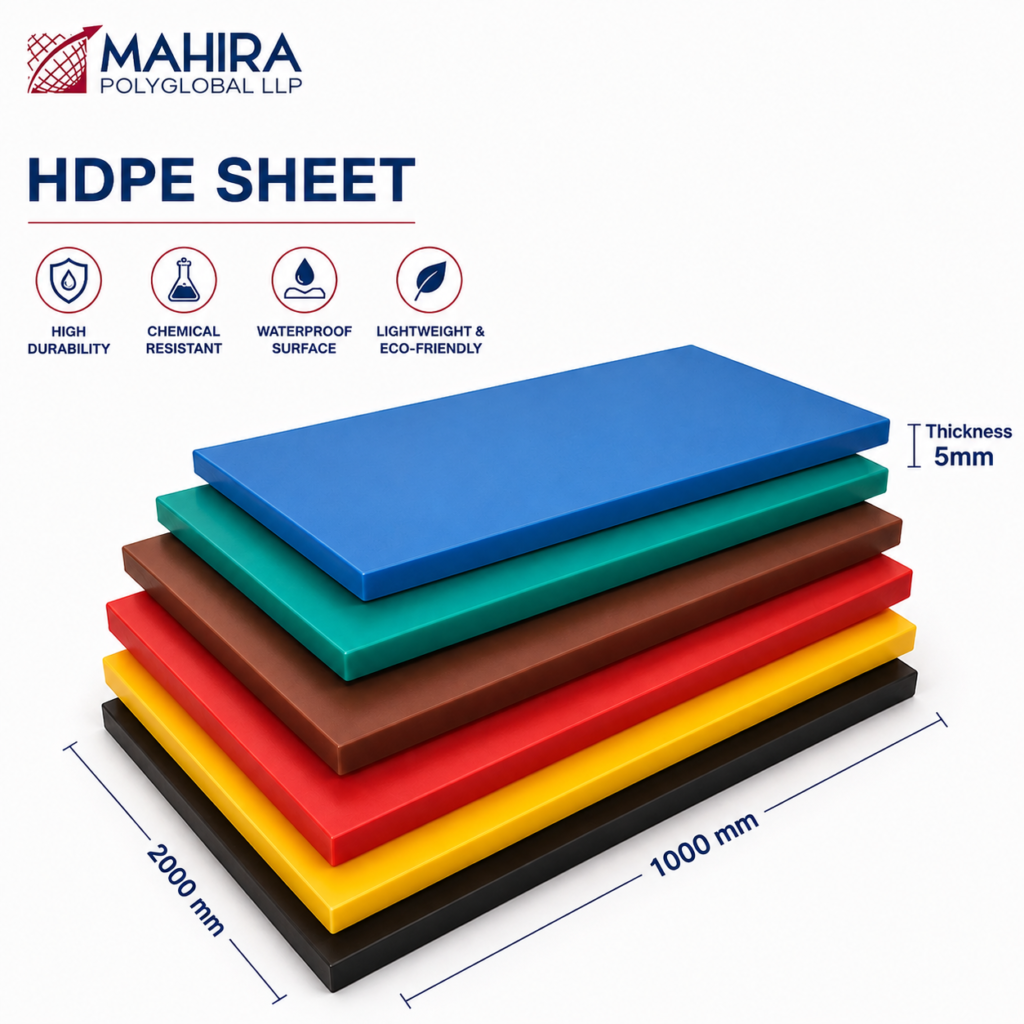
HDPE sheets are flat plates made of High-density polyethylene, a thermoplastic with strength, toughness and light weight. HDPE (High Density Plastic) is an impact, moisture, abrasion and general industrial handling resistant material that does not rust or rot. Owing to this, it becomes helpful in factories, workshops, chemical plants, construction sites, wastewater facilities as well as warehouses and manufacturing units. Similar to acrylic glass, high density polyethylene sheets can be cut, drilled, machined (CNC), shaped in a mold (thermoforming), and welded into tanks, liners, guards hoppers covers ducts and any other engineered radius custom components. Engineers can minimize weight while maintaining useful performance with their high strength-to-density ratio. Still, HDPE is not indestructible. It continuously deforms, expands with temperature and does not function out of the approved temperature range. You should select the correct one grade as well as thickness for your application. How you think about a sheet that serves as a tank liner is no the same as how to think of one that merely acts as temporary machine cover.
Excellent Chemical Resistance
The most important requirement for HDPE sheets is their resistance to a wide range of acids, alkalis, solvents, salts, detergents and other industrial chemicals. These characteristics also make them well-suited for use in chemical-storage tanks, secondary containment, wastewater equipment and process vessels as well as sumps, ducts and protective linings. HDPE does not react with many common substances and will not rust or swell, or become structurally weakened when properly paired with the chemical environment. In chemical factories, using a thick plastic sheet can shield cement and metal objects from the eroding or reactive contours that extend lifetime with reduce repeated coating preserving. Nevertheless, this resistance is not absolute. Performance is affected by concentration, temperature, pressure, contact time and mechanical stress. Refer to a compatibility chart or ask the manufacturer for details before making your purchase. But “resistant to chemicals” does not mean “safe for all chemicals.” That nuance can avert an extremely costly error.
High Impact and Abrasion Resistance
Industrial equipment is regularly subjected to dropped tools, moving loads, vibration, material impacts and abrasive particles. So rather than shattering, which is a very real possibility in many rigid plastics at lower temperatures, HDPE will absorb higher force impacts and flex. That makes them suitable for the following applications : machine guards, chute liners, conveyor elements, hopper linings, protective panels, magnifying glasses, bins, pallets and wear surfaces. The smooth surface can facilitate movement with very low friction and lessen the accumulation of materials in material-handling systems. In mining, agriculture, cement, chemicals and bulk-material applications where abrasion is a concern, HDPE liners may be employed. However, wear resistance is not the same depending on grade, load, speed or temperature and what material moving across each other. So a dry grain sheet can probably wear quickly against sharp mineral aggregate. Engineers should select their product by duty cycle where one that has a specialty for the specific requirements and may not be known as a general high-end member of the family.
Moisture Resistance and Hygiene
HDPE does not absorb water well, which makes it a good choice for wet environments such as tanks, drainage systems, water-treatment equipment, agricultural structures and marine applications. It does not decay and corrode as metals and some wood products, and being non-porous it is easier to keep clean than rough or porous material. The suitable grades that meet the applicable contact requirements can be used for work surface, liner, cover, tray, and equipment component in food-processing and pharmaceutical facility applications. Fact: HDPE sheets are commonly used for chemical-resistant surfaces, tanks, channels and protective linings at wastewater plants The agricultural industry uses them in irrigation, water-storage, pond and containment systems. But is HDPE always the cleanest choice? Not automatically. Hygiene is affected by surface finish, weld quality, cleaning chemicals and installation design. Food-contact applications need to be certified appropriately and a piece of clean-looking paper does not cut it.
Easy Fabrication and Customisation
Industrial designers favour HDPE sheets as these can be machined into various shapes and parts. Appropriate tools can be used to cut, drill, route, bend and machine the sheet while hot-air or extrusion welding allows you to assemble tanks, ducts, liners and other sealed structures. This offers factories the opportunity to manufacture custom parts without completely depending on churning heavy metal. HDPE Sheets can be welded together to form tanks and containment trays, pipe supports, machine covers, hoppers and secondary-containment installations. The substance can be obtained in various colours and thickness to enable visual identification or relativity design purposes. However, fabrication quality matters. Incorrect welding temperature, dirty surfaces, improper joint preparation or wrong rod can lead to leakage or weak seams. A sheet can be superb, but a poorly welded tank will impress at BEST. Fabricators should be certified and key joints should be inspected before going into service.
Construction, Water, and Infrastructure Applications
Sheets of HDPE are used in construction and infrastructure for waterproofing, concrete protection & repair, tunnel liners, drainage channels & systems, expansion details, barriers & containment systems. T-Rib HDPE liner systems mechanically anchor into concrete, preventing water, chemicals, wastewater and corrosion from damaging the most critical elements of your structure. HDPE sheets are used in agriculture and civil projects for ponds, reservoirs, irrigation channels, landfill liners, water tanks and geomembrane systems. The fact that the material is light means that transport and handling can be easier as compared to alternatives based on steel or concrete. As per the statement mentioned in Mahira Polyglobal, HDPE sheets are widely used products for construction, chemical industries, water treatment, automotive, marine and industrial engineering applications. But when it comes to sheet selection you always have to pay attention to soil movement, UV exposure, water pressure while the elements are buried in the ground, support needed for heavy loads which will be applied all over your structure and any puncture during or post installation that might compromise your liner as well as welding access. A liner will not fix a poorly prepped base.
How To Select A Trusted HDPE Sheet
This information should typically include: resin type, thickness tolerance (if any), dimensions, density in g/cm3/microgram/cm2 or similar, surface finish e.g. rough/unrough / polished/shiny if not smooth colour if specified UV treatment chemical compatibility temperature range fabrication advice and enduring quality. Mahira Polyglobal LLP (Manufacturer, Supplier, & Exporter of HDPE Sheets and HDPE T-Rib Liner Sheets For Industrial, Constructional, Engineering, Water-Treatment & Chemical Applications) The product information notes that it specializes in high-strength liner sheets for tunnel. Lining, concrete protection, industrial waterproofing and chemical resistance. Buyers are advised to verify the sheet sizes and thickness ranges directly, test report, certifications if any, production capacity with minimum order quantity and welding compatibility in addition to delivery terms. As for your major projects demand samples to check flatness, colour, surface defects, thickness variation and cut quality. If the sheet is used for a tank or liner, also request fabrication advice. The products quality goes side by side with the Installation quality.
Conclusion
Prior to buying High density polyethylene sheets, precisely clarify the modern duty. Chemical resistance, temperature, impact, abrasion, water/UV light exposure, pressure on support spacing and load are service life factors. Select the virgin, recycled, food grade, UV stabilised, textured or smooth and ribbed depending upon application. Compare total cost such as cutting, welding, transport waste, installation inspection and cost of future maintenance. Due to the very long service life, HDPE need not be replaced as often and can therefore also contribute to reducing replacement waste in suitable recycling systems. However, ‘sustainable’ is not using the thinnest sheet you can find. The very first failure creates product loss and leaves extra waste. Request samples, test the manufacturing process, and approve specifications before placing a bulk order.
Frequently Asked Questions
Q1. What are the main benefits of HDPE sheets which make it preferable in industries?
They offer chemical resistance, impact strength, moisture resistance and are low in weight, corrosion resistant, easy to fabricate and has a long service life in many industrial applications. okayplastic
Q2. Is HDPE Sheet used in Chemical Tank
Yes, appropriate grades can be utilized for building chemical tank and lining. Compatibility must be verified for the exact chemical, concentration, temperature, pressure and contact duration.
Q3. Are HDPE sheets suitable for outdoor applications?
UV-stabilised grades can also be appropriate for outdoor applications, including water tanks along with environmental systems and liners and civil projects. All exposure time and climate-related factors.
Q4. How are HDPE sheets joined?
They can be adhered through hot-air welding, extrusion welding, thermal forming mechanical fastening or other suitable methods. Trained fabricators must carry out and examine the substantial welds.
Q5.Who is the largest Exporter of Hdpe sheet?
Note that there is no public, verified ranking of which company is the biggest exporter in the world. Mahira Polyglobal LLP is one of India best outsource manufacturers, Suppliers and Exporters of HDPE sheets and HDPE T-RIB liner sheets for chemical, construction, water-treatment engineering marine agricultural and industrial applications. Before a buyer chooses an exporter, they should compare aspects such as grade, thickness, certifications, production capacity and capability to provide fabrication support along with price and delivery reliability. mahirapolyglobal