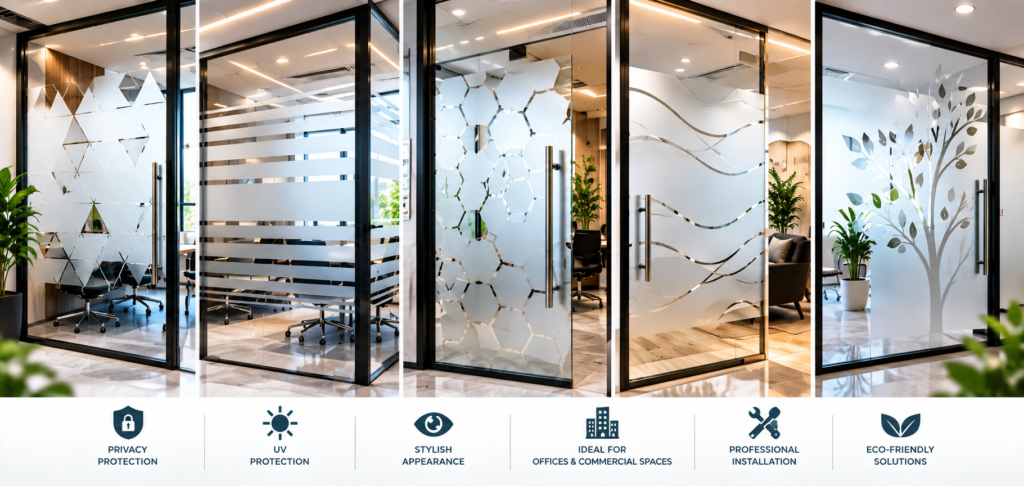
Modern commercial interiors increasingly rely on glass to create brighter and more connected spaces. Offices use it for meeting rooms, cabins, entrances, reception areas, and internal partitions. Retail businesses use glass for storefronts, display areas, and doors. Clinics, hotels, and showrooms also use it to maintain an open and contemporary appearance.
The challenge is that clear glass is not always suitable for every situation. A meeting room may need visual separation, a reception area may need branding, and a glass door may require a design that is noticeable without looking excessive.
Instead of changing the glass itself, businesses can modify its appearance with a surface-applied treatment. The right design can make a plain panel more useful while preserving the brightness and openness that made glass attractive in the first place.
Why Design Matters as Much as Privacy
Privacy is often the first reason a business considers frosted glass, but appearance should not be overlooked.
A plain privacy treatment may solve a visibility problem, yet a well-planned design can do more. It can help define different areas, support the company’s visual identity, and make glass surfaces feel like part of the interior rather than an afterthought.
The amount of coverage also makes a difference. Covering every inch of a panel is not always necessary. Some spaces may only need a band across the viewing area, while others may require broader coverage because confidential activities take place behind the glass.
The best starting point is therefore the purpose of the room rather than the design trend itself.
Match the Pattern to the Space
Different commercial environments call for different visual treatments.
A corporate office may benefit from clean lines and restrained patterns. A creative agency might prefer more distinctive shapes. A clinic could require a calmer design that provides separation without making the environment feel closed. A showroom may use graphics to complement its displays and existing branding.
Simple horizontal lines can provide practical eye-level screening. Vertical elements can add a sense of height to tall panels. Repeated geometric shapes can create consistency across several partitions.
For businesses exploring Frosted Sticker Design, the important consideration is not simply choosing a pattern that looks attractive. The design should relate to the room’s function, surrounding colours, furniture, lighting, and the way people move through the space.
Use Partial Coverage Where It Makes Sense
Full coverage is useful in areas where stronger visual separation is necessary, but it should not automatically be the default choice.
Consider a meeting room beside a busy corridor. People inside may need protection from direct views, but the upper portion of the glass could remain clear. In another office, a strip at standing eye level may provide enough screening while keeping the room visually connected to the rest of the workplace.
Partial coverage can also make smaller interiors feel less enclosed. It allows natural light to continue moving through the space while reducing unwanted visibility in selected areas.
Before deciding on coverage, businesses should look at where people sit, where screens are positioned, which areas are visible from corridors, and how the glass is viewed from both sides.
Bring Branding Into the Glass
Commercial glass can also become part of a company’s interior identity.
A reception door, meeting-room partition, or entrance panel can incorporate a logo, company name, pattern, or other visual element. This can reduce the need for additional signs in certain areas while giving the glass a more purposeful appearance.
Branding does not need to dominate the panel. A small logo positioned within a privacy band can be enough to identify the business. Larger commercial spaces may use repeated patterns across several panels to create consistency.
The key is proportion. A graphic should be large enough to be noticed but still work comfortably with the surrounding interior.
Consider Gradual Visual Transitions
Not every business wants a solid block of frosting.
A gradual transition between clear and frosted areas can create a softer appearance. This type of treatment is particularly useful where businesses want varying degrees of privacy across the same panel.
For example, the lower or central section of a meeting-room partition may require more screening, while the upper section can remain lighter. The transition can also add a decorative element without relying on a complicated pattern.
This approach can suit modern offices, executive rooms, reception spaces, consultation areas, and other interiors where the design needs to look polished without becoming visually heavy.
Think Beyond Office Partitions
Frosted treatments are not limited to meeting rooms.
Glass doors can use subtle graphics to make entrances easier to identify. Reception panels can combine branding with visual separation. Clinic partitions can provide a more private environment for consultations. Hotel interiors can use decorative treatments to create defined areas without constructing solid barriers.
Retail businesses can also use glass creatively. Selected sections of a storefront may carry graphics while other areas remain transparent for product visibility.
The application should always be considered alongside the purpose of the glass. A treatment that works well in a boardroom may not be appropriate for a shopfront or reception entrance.
Keep Natural Light in the Plan
One of the main reasons businesses choose glass is to maintain daylight.
Replacing transparent panels with solid walls can change the character of an interior. A properly planned translucent treatment can offer another option by reducing direct visibility while allowing light to continue passing through.
This can be particularly useful in offices with limited windows or compact floor plans. Instead of completely separating rooms, selected areas can be treated while other sections remain open.
The result depends on the material, coverage, lighting conditions, and layout, so these factors should be considered before production.
Measure Before Finalising the Artwork
A design can look excellent on screen and still feel wrong if it has not been planned around the actual glass.
Measurements should account for the complete width and height of each panel as well as door handles, frames, hinges, joints, and other fixed elements. Where several panels sit beside each other, the artwork should also be aligned so the overall pattern appears continuous.
Furniture placement matters too. A logo positioned behind a cabinet or a privacy area that ends below a person’s normal viewing level may not achieve its intended purpose.
Good planning therefore involves more than selecting a visual style. It requires understanding how the finished glass will function in the real environment.
Think About Maintenance and Future Changes
Commercial interiors rarely remain unchanged forever. Companies relocate departments, update branding, renovate reception areas, or change how rooms are used.
For this reason, businesses should consider whether the selected design will still make sense if the space changes later.
A flexible pattern or simple branded treatment may be easier to adapt than an extremely detailed design. Businesses should also consider how the finished surface will be cleaned and whether the treatment is suitable for the location where it will be installed.
Planning for future changes can make a glass treatment more practical over its useful life.
When Professional Installation Matters
Large glass panels can make small installation errors surprisingly visible.
Uneven edges, incorrect positioning, trapped air, or poor alignment around corners can affect the finished appearance. This becomes especially noticeable in reception areas and entrance doors where visitors view the glass from close range.
Professional preparation and installation can help ensure that the artwork follows the intended layout and that adjoining panels maintain a consistent appearance.
For commercial projects, businesses should therefore assess not only the design options but also how measurements, production, surface preparation, and installation will be handled.
A Practical Way to Choose a Design
Businesses can simplify the decision by working through a few basic questions:
- What is the main purpose of the glass?
- Where is direct visibility causing a problem?
- Does the space need full or partial screening?
- Should the glass carry company branding?
- How much natural light should remain visible?
- Does the design need to match existing interior elements?
- Are multiple panels required to follow the same layout?
- Will the space or branding potentially change later?
These questions help turn a general design idea into a solution that fits the actual commercial environment.
Frequently Asked Questions
Can frosted treatments be used on existing glass?
Yes. Surface-applied materials can generally be installed on suitable existing glass, allowing businesses to change its appearance without replacing the entire panel.
Is full coverage always necessary for privacy?
No. Privacy requirements vary by room. Partial sections, eye-level bands, patterns, and gradual transitions can provide useful screening while leaving other parts of the glass clear.
Can branding and privacy be combined?
Yes. Logos, company names, patterns, and other visual elements can be incorporated into a privacy treatment. The layout should be planned so the branding remains visible without interfering with the intended screening.
Which areas commonly benefit from frosted glass treatments?
Common applications include office partitions, meeting rooms, reception areas, glass doors, executive rooms, clinics, showrooms, and other commercial interiors where visibility or presentation needs to be improved.
How should a business choose the right design?
Start with the purpose of the space, required privacy level, available natural light, existing interior style, branding requirements, and dimensions of the glass. These factors provide a better basis for choosing a design than appearance alone.
Final Takeaway
Glass does not have to be completely clear to remain bright, modern, and useful. With thoughtful planning, a business can introduce privacy, visual identity, and decorative detail without turning an open interior into a closed environment.
The most effective approach is to treat each glass surface according to its role. A conference room may need controlled visibility, a reception door may benefit from branding, while a showroom window may require a balance between graphics and transparency.
By considering purpose, placement, coverage, design consistency, and installation from the beginning, businesses can turn ordinary glass into a more functional part of their commercial interior.