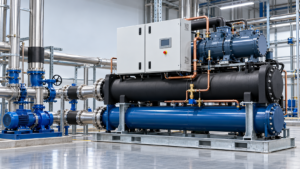
Maintaining the right temperature is essential for industrial productivity, product quality, and equipment reliability. In sectors such as pharmaceuticals, food and beverage processing, plastics, chemicals, and large commercial facilities, uncontrolled heat can interrupt production and increase operating expenses. A properly designed Water Cooled Chiller helps businesses manage these challenges by removing unwanted heat from process fluids and transferring it to a separate cooling-water circuit.
Choosing the right industrial cooling system requires an understanding of refrigeration technology, energy consumption, operating conditions, and maintenance requirements. This guide explores how water-cooled chillers work, where they are used, and what businesses should consider before investing in one.
Understanding Water Cooled Chiller Technology
A water-cooled chiller is a refrigeration system that cools water or another compatible fluid for industrial processes or building air conditioning. It typically uses a water-cooled condenser connected to a cooling tower or another suitable heat-rejection arrangement.
The system absorbs heat from the chilled fluid in the evaporator and transfers it through the refrigerant circuit to the condenser. The condenser water then carries the rejected heat away from the equipment. This arrangement can be suitable for facilities requiring substantial cooling capacity or extended operating hours.
Unlike air-cooled chillers, which reject heat directly into the surrounding air, water-cooled systems depend on condenser-water circulation and appropriate water management. Their suitability therefore depends on the site’s infrastructure, water availability, climate, and cooling requirements.
How Does a Water Cooled Chiller Operate?
The refrigeration process generally involves four major components working together.
Evaporator
The evaporator transfers heat from the process water to the refrigerant. As the refrigerant absorbs heat and evaporates, the process water becomes cooler and returns to the equipment or application requiring cooling.
Compressor
The compressor increases the refrigerant’s pressure and temperature, enabling it to release absorbed heat in the condenser. Compressor technology influences the system’s capacity, operating characteristics, and energy performance.
Condenser
The condenser transfers heat from the refrigerant to circulating condenser water. The heated water usually travels to a cooling tower, where heat is rejected to the atmosphere.
Expansion Valve
The expansion valve reduces refrigerant pressure before the refrigerant returns to the evaporator. The cycle then repeats to maintain the required cooling conditions.
The overall performance depends on component selection, water flow, heat-exchanger cleanliness, control settings, and operating temperatures.
Why Industries Invest in Water Cooled Chillers
Improved Cooling Performance
Water cooled chillers can provide effective heat transfer under suitable operating conditions. Maintaining correct condenser-water temperatures and flow rates helps the refrigeration system operate as intended.
Support for Continuous Production
Many industrial processes generate heat throughout the working day. A correctly sized chiller helps control process temperatures, protect temperature-sensitive equipment, and support consistent manufacturing conditions.
Energy Management Opportunities
Large facilities may benefit from water-cooled systems when their cooling loads and operating conditions favour this configuration. To evaluate energy efficiency properly, businesses should consider compressor power, cooling-tower fans, water pumps, and other auxiliary equipment rather than looking at one component in isolation.
Flexible Equipment Configurations
Industrial cooling requirements vary widely. Depending on the capacity and operating conditions, buyers may consider scroll, screw, or centrifugal compressor technologies. The appropriate selection should be based on verified performance data and the required operating range.
Long-Term Operational Planning
A system selected according to actual cooling demand can help avoid unnecessary energy consumption and inadequate cooling. Preventive maintenance and proper water treatment also contribute to reliable operation throughout the equipment’s service life.
Important Factors When Selecting an Industrial Chiller
Before purchasing equipment, businesses should assess several technical and commercial considerations.
1. Calculate the Cooling Load
Determine the heat generated by the process, fluid flow rate, inlet and outlet temperatures, and expected peak operating conditions. Accurate calculations help avoid equipment that is either undersized or unnecessarily large.
2. Check Temperature Requirements
Identify the required chilled-fluid supply temperature and allowable temperature variation. If the application requires glycol or another fluid, account for its effect on heat transfer, viscosity, and pumping requirements.
3. Evaluate Energy Consumption
Compare performance at the anticipated operating conditions, including partial-load performance where applicable. Review the estimated electricity consumption of the entire cooling system.
6. Review Supplier Capabilities
Look for clear technical documentation, relevant application experience, suitable equipment configurations, warranty terms, and accessible service support.
Businesses evaluating industrial cooling options can explore the Water Cooled Chiller solutions offered by Aquatech Plus. Reviewing the available product information and discussing site-specific operating requirements can help identify an appropriate configuration. When comparing Water Cooled Chiller Manufacturers, buyers should consider technical suitability and lifecycle costs alongside the initial purchase price.
Maintenance Practices That Protect Chiller Performance
Regular maintenance is necessary to preserve cooling capacity and identify developing problems before they cause production interruptions.
Routine checks should include condenser-water flow, chilled-water flow, operating temperatures, pressure readings, electrical connections, and control-system performance. Condenser and evaporator surfaces should be inspected and cleaned when required.
Cooling towers and condenser-water circuits need appropriate treatment to manage scaling, corrosion, and biological contamination. Pumps, valves, sensors, and safety devices should be checked according to the equipment manufacturer’s recommendations.
Facilities should also track energy consumption and operating conditions over time. Unusual changes in power use, temperature differences, or pressure readings may indicate fouling, reduced flow, or another issue requiring investigation by a qualified technician.
Frequently Asked Questions
What is a water cooled chiller used for?
It removes heat from water or another compatible fluid for industrial process cooling and central HVAC applications. Common uses include plastics manufacturing, food processing, pharmaceuticals, chemical production, and large commercial buildings.
What is the difference between a water-cooled and an air-cooled chiller?
A water-cooled chiller transfers condenser heat to circulating water, usually connected to a cooling tower. An air-cooled chiller releases condenser heat directly into the surrounding air. The best choice depends on cooling demand, installation conditions, water availability, and lifecycle costs.
Can a water cooled chiller operate continuously?
Yes, suitable industrial models can be designed for extended operation. Continuous use requires correct sizing, operation within specified limits, reliable water circulation, appropriate controls, and regular preventive maintenance.
How can businesses improve chiller energy efficiency?
They can maintain clean heat-transfer surfaces, optimise water flow, monitor condenser-water temperatures, maintain appropriate refrigerant-system operation, and assess pump and cooling-tower performance. Equipment controls should also be configured for the actual cooling demand.
How should I choose a water cooled chiller manufacturer?
Evaluate technical expertise, model specifications, application suitability, customisation options, documentation, warranty conditions, commissioning assistance, and after-sales service. Confirm that the proposed equipment matches your site’s cooling load and operating conditions.
Conclusion
Water-cooled chillers are an important cooling option for industries that need dependable temperature control and effective heat rejection. Selecting the correct capacity, evaluating total system energy use, maintaining water quality, and following a preventive maintenance programme can help businesses achieve reliable operation.
By working with experienced Water Cooled Chiller Manufacturers, industrial buyers can assess their cooling requirements, compare appropriate equipment configurations, and make better-informed decisions for long-term production needs. A carefully planned cooling system can support process consistency, equipment protection, and efficient facility operation.