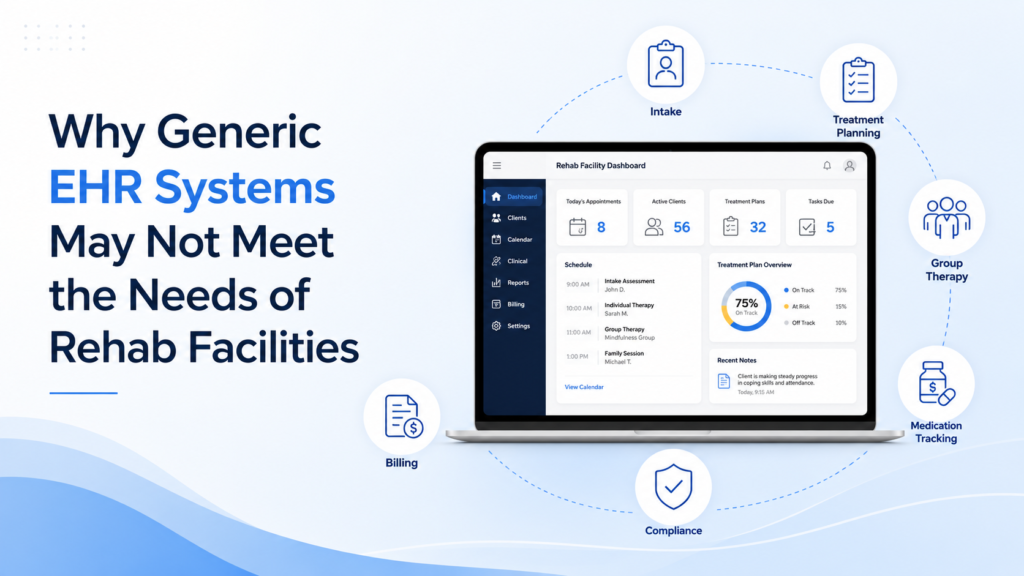
Electronic health record systems have become essential tools for managing patient information, clinical documentation, scheduling, billing, and reporting. However, not every EHR platform is designed for the operational realities of rehab facilities.
Generic EHR systems are often built for broad healthcare use. They may work well for primary care practices, outpatient clinics, or general medical environments, but addiction treatment programs require more specialized workflows.
Rehab facilities manage complex patient journeys that involve intake assessments, individualized treatment plans, group therapy, medication-assisted treatment, case management, compliance, billing, discharge planning, and aftercare. When a platform cannot support these activities effectively, staff may rely on manual workarounds, spreadsheets, paper documents, and disconnected tools.
This can increase administrative workload, reduce visibility, and create gaps in care coordination.
Rehab Facilities Have Specialized Workflows
Addiction treatment is different from many general medical services.
A patient may interact with admissions coordinators, counselors, physicians, nurses, therapists, case managers, billing teams, and aftercare staff throughout the recovery journey.
Each team contributes different information and depends on updates from other departments.
A rehab-specific workflow may include:
- Pre-admission screening
- Substance use assessments
- Risk and withdrawal evaluations
- Individual treatment planning
- Group therapy documentation
- Medication-assisted treatment
- Family communication
- Program attendance
- Case management
- Insurance authorization
- Discharge planning
- Recovery follow-up
Generic EHR systems may not offer the depth required to manage these activities in a connected way.
Limited Support for Patient Intake
Patient intake is one of the most important workflows in a rehab facility.
Admissions teams may need to collect demographic details, referral information, substance use history, medical information, insurance data, consent forms, risk factors, and program eligibility details.
A generic EHR may provide basic registration fields, but it may not support specialized admission steps or status tracking.
As a result, teams may create separate forms, spreadsheets, or email-based processes.
This makes it harder to understand where a patient is in the admission journey. Staff may not know whether insurance verification is complete, a clinical assessment is pending, or additional documents are required.
A more specialized system can organize intake activities and create a smoother transition into treatment.
Insufficient Addiction-Specific Assessments
General healthcare platforms often focus on standard medical histories, diagnoses, and physical health documentation.
Rehab facilities require assessments that address substance use patterns, withdrawal risks, behavioral health concerns, relapse history, previous treatment, family support, and recovery goals.
If the EHR does not support these assessments, clinicians may have to use external documents or create custom templates with limited functionality.
This can make it difficult to connect assessment results with treatment planning and ongoing care.
Specialized workflows allow assessment data to support clinical decisions throughout the recovery process.
Treatment Planning May Be Too Basic
Treatment planning is central to addiction recovery.
Care teams must define patient goals, interventions, responsibilities, timelines, and review dates. Plans may also need regular updates based on progress, attendance, medication changes, or clinical observations.
Generic EHR systems may provide basic care plan features, but they may not support the level of collaboration required in rehab environments.
Staff may struggle to:
- Assign responsibilities
- Track treatment plan reviews
- Record patient participation
- Monitor goal progress
- Document approvals
- Share updates across care teams
A structured treatment planning workflow helps ensure that all authorized professionals are working toward the same objectives.
Group Therapy Documentation Can Be Difficult
Group therapy is a major component of many rehab programs.
Counselors need to manage session schedules, attendance, session topics, participation, and individual observations.
Generic EHR platforms are often designed around one patient and one provider per appointment. This makes group documentation difficult.
Staff may have to open each patient record separately and repeat the same session details multiple times.
This increases documentation time and creates inconsistencies.
A specialized platform can allow counselors to document shared session information once while adding patient-specific notes where needed.
Medication-Assisted Treatment Requires Better Coordination
Medication-assisted treatment involves coordination between medication records, clinical notes, appointments, adherence tracking, and patient follow-ups.
Physicians and nurses may need to monitor dosage, side effects, refill schedules, missed appointments, and treatment response.
Generic EHR systems may support medication lists and prescriptions, but they may not connect these details with the broader addiction recovery workflow.
Counselors and case managers may not have the relevant information needed to understand how medication management affects treatment progress.
A specialized system can improve visibility while maintaining appropriate access controls.
Clinical Documentation May Not Match Rehab Requirements
Rehab facilities generate different types of clinical documentation, including:
- Individual therapy notes
- Group session records
- Progress notes
- Case management notes
- Psychiatric notes
- Medication records
- Treatment plan updates
- Discharge summaries
- Aftercare documentation
Generic EHR templates may be too broad or too medically focused.
When templates do not match actual workflows, clinicians often create workarounds. They may use free-text fields, external documents, or duplicate notes.
This increases documentation burden and makes reporting more difficult.
Specialized templates can improve consistency without restricting clinical judgment.
Billing Workflows May Remain Disconnected
Billing for addiction treatment depends on accurate documentation, service records, insurance verification, and active authorizations.
If the EHR does not connect clinical and financial workflows, billing staff may spend significant time contacting providers for missing information.
Common problems include:
- Incomplete progress notes
- Missing signatures
- Incorrect service dates
- Expired authorizations
- Inconsistent attendance records
- Delayed claim submission
A specialized platform can help teams identify missing documentation before claims are submitted.
This improves claim readiness and reduces avoidable administrative follow-up.
Compliance Requirements Need Stronger Controls
Rehab facilities manage highly sensitive patient information.
They need strong controls for consent, access permissions, record sharing, documentation changes, and audit activity.
A generic EHR may provide standard security features, but it may not fully support the privacy and documentation requirements of addiction treatment programs.
Specialized workflows can include:
- Role-based access
- Consent tracking
- Audit trails
- Secure record exchange
- Documentation histories
- Access monitoring
- Encryption
- User authentication
These features support greater accountability and make compliance reviews easier to manage.
Discharge and Aftercare May Be Treated as Separate Processes
Recovery often continues after formal treatment ends.
Patients may require outpatient counseling, medication follow-ups, peer support, family involvement, housing services, or additional healthcare referrals.
Generic EHR systems may focus primarily on active clinical encounters and provide limited support for long-term aftercare.
This can lead to missed follow-ups, incomplete referrals, and poor visibility into post-discharge engagement.
A specialized workflow can help staff create discharge plans, assign responsibilities, schedule appointments, and track aftercare activities.
This supports continuity beyond the formal treatment program.
Limited Operational Visibility
Rehab center leaders need more than patient-level documentation.
They require insights into admissions, program occupancy, staff workload, treatment plan reviews, appointment attendance, billing readiness, discharge activity, and patient engagement.
Generic EHR reports may not include these addiction treatment metrics.
As a result, managers may need to create spreadsheets or manually combine information from different sources.
Specialized dashboards provide a more complete view of clinical and operational performance.
This allows leadership to identify bottlenecks and make better decisions.
Customization Can Become Expensive and Difficult
Some generic EHR systems can be customized, but extensive customization may require significant time, technical support, and ongoing maintenance.
Each additional workaround can make the platform harder to use.
Facilities may need to add external tools for group therapy, intake, billing, communication, or reporting. These integrations can increase cost and create new data gaps.
Before selecting a system, rehab centers should evaluate how much configuration is required to support daily operations.
A platform that already understands rehab workflows may provide a more sustainable foundation.
User Experience Affects Staff Adoption
Even a feature-rich system can fail if staff members find it difficult to use.
Counselors and clinicians often manage high caseloads and detailed documentation requirements. If an EHR requires too many clicks, duplicate entries, or complicated navigation, employees may resist adoption.
This can lead to incomplete records and continued reliance on manual processes.
The right solution should support the way staff actually work.
Usability, training, workflow design, and mobile access should all be considered during evaluation.
Evaluating a More Specialized Solution
Rehab facilities should assess whether their current EHR supports the complete patient journey.
Important questions include:
- Can it manage rehab-specific intake workflows?
- Does it support substance use assessments?
- Can teams create and review individualized treatment plans?
- Does it handle group therapy efficiently?
- Can it support medication-assisted treatment?
- Are billing and documentation connected?
- Does it provide strong compliance controls?
- Can staff manage discharge and aftercare?
- Does it offer meaningful operational reporting?
Organizations seeking deeper insights into purpose-built workflows can explore this guide on substance abuse treatment software.
The goal is not to replace technology simply because it is generic. The goal is to ensure that the platform supports the organization’s actual clinical and operational needs.
Final Thoughts
Generic EHR systems can provide useful recordkeeping and administrative capabilities, but they may not address the full complexity of rehab facility workflows.
Addiction treatment requires connected processes across intake, assessments, treatment planning, therapy, medication management, billing, compliance, discharge, and aftercare.
When a platform cannot support these activities effectively, staff members are forced to create manual workarounds that increase administrative burden and reduce visibility.
A more specialized system can help rehab facilities improve coordination, simplify documentation, strengthen compliance, and deliver a more consistent patient experience.