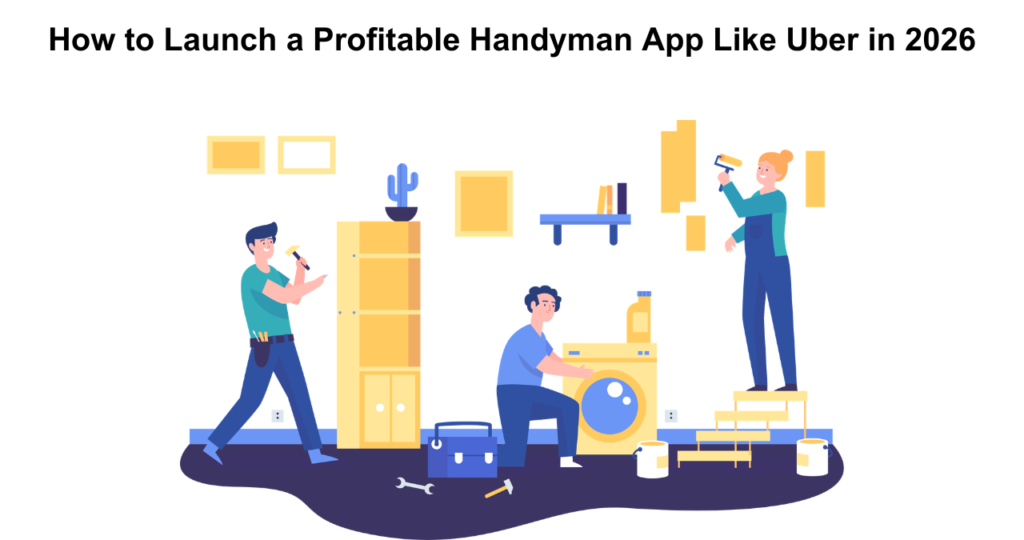
The demand for convenient home services is growing as customers increasingly prefer booking professionals through mobile apps instead of searching for service providers manually. From plumbing and electrical work to cleaning, appliance repair, painting, carpentry, and general maintenance, people want reliable help that can be requested from their smartphones.
This shift has created a strong opportunity for entrepreneurs and startups to build digital platforms that connect customers with skilled professionals. A Handyman App Like Uber can simplify this process by bringing customers, service providers, and administrators together through one organized platform.
The concept is straightforward. Customers select a service, choose a convenient time, share their location, review available professionals, and place a booking. Service providers can receive requests, accept suitable jobs, manage schedules, communicate with customers, and track their earnings. The business owner manages the overall marketplace and controls operations through an administration system.
For entrepreneurs entering this market in 2026, the objective should not be to simply copy an existing service platform. The better approach is to understand the business model, identify a specific market opportunity, select the right services, and launch a platform that can adapt to local customer expectations.
Why the Handyman Services Market Is Attractive in 2026
Home maintenance is a recurring requirement. Customers may need a plumber today, an electrician next week, an appliance technician next month, or a cleaner at regular intervals. This creates opportunities for platforms that can turn individual service requests into long-term customer relationships.
Traditional local handyman businesses often depend on phone calls, referrals, social media messages, or local directories. These methods can work, but they may not provide an efficient way to manage growing demand.
A mobile marketplace can make the entire process more structured. Customers can discover professionals, compare services, request appointments, receive notifications, and make payments through a single digital channel.
For startups, this model also offers the opportunity to begin with a focused category and expand later. Instead of attempting to cover every service from day one, a business can initially concentrate on categories that have strong demand in its target location.
The rise of on-demand platforms has also changed customer expectations. People are becoming accustomed to services that provide convenient booking, transparent communication, digital payments, real-time updates, and quick support.
This makes the Uber for Home Services model particularly relevant for modern service marketplaces.
What Does a Handyman App Like Uber Actually Do?
At its core, an on-demand handyman platform connects people who need home services with professionals who can complete those jobs.
The customer starts by selecting a required service. Depending on the business model, the customer may describe the issue, upload photos, select a service package, choose a preferred appointment time, or request immediate assistance.
The platform then helps identify suitable service providers. Matching can be based on location, availability, service category, ratings, experience, and other business rules.
Once a professional accepts the request, both parties receive relevant information. The customer can follow the booking status, while the professional can view job details and navigate to the customer’s location.
After the work is completed, the customer can make a payment, provide feedback, and potentially book the same professional again.
This model is useful because it replaces several disconnected processes with one digital workflow.
Choose the Right Business Model Before Development
Technology alone does not make a home services marketplace profitable. Entrepreneurs need a clear business model before starting handyman app development.
One approach is a commission-based marketplace. The platform receives a percentage from each completed booking. This model can work well when the platform manages a large volume of transactions.
Another option is a lead-generation model where professionals pay to receive qualified service requests. This can be useful in markets where customers typically contact providers directly before confirming a job.
A subscription model can also be considered. Professionals may pay a recurring fee to access customer leads, marketplace tools, analytics, or premium visibility.
Some businesses can combine these approaches. For example, the platform may charge professionals a subscription while also applying a transaction fee for selected services.
The right model depends on the target market, customer behavior, service categories, competition, and local regulations.
Entrepreneurs should avoid choosing a monetization strategy simply because another marketplace uses it. The business model should support both customer acquisition and provider participation.
Identify Your Target Market
A successful Uber Like App For Handyman should solve a specific market problem rather than attempting to serve everyone immediately.
Start by defining the geographic market. This could be a single city, metropolitan area, region, or multiple locations.
Then identify the most frequently requested services. Common categories may include:
- Plumbing
- Electrical services
- Carpentry
- Painting
- Appliance repair
- Cleaning
- Furniture assembly
- Air conditioning services
- Gardening
- Pest control
- Home installation
- General maintenance
Local demand should determine which categories receive priority.
For example, a platform targeting apartment communities may focus on appliance repair, plumbing, electrical work, cleaning, and furniture installation. A platform operating in suburban areas may have stronger opportunities in gardening, exterior maintenance, painting, and general repairs.
Understanding the audience also helps determine how the application should work. Busy professionals may value instant bookings and scheduled appointments, while property managers may require recurring service management and multiple property support.
Build a Strong Service Provider Network
A marketplace cannot operate successfully without reliable professionals.
One of the biggest challenges for an On-Demand Handyman Services App is balancing customer demand with provider availability. If customers cannot find professionals when they need them, they may stop using the platform. If professionals receive too few jobs, they may leave the marketplace.
The onboarding process should therefore focus on quality as well as quantity.
Depending on the market and applicable regulations, the business may collect professional information, service categories, working areas, identity details, certifications, experience, and other verification information.
Provider profiles should give customers enough information to make an informed decision. Ratings, reviews, completed jobs, service categories, availability, and response behavior can help establish trust.
A strong provider network is not only about recruiting professionals. It also requires retention. Fair marketplace policies, clear communication, timely payments, useful job information, and reliable support can encourage skilled professionals to remain active.

Essential Customer Features
The customer application should make booking a service simple.
Easy Registration and Profile Management
Customers should be able to create an account quickly and manage basic information such as their name, contact details, saved addresses, and booking preferences.
Social login or other convenient authentication methods can reduce friction during registration.
Service Discovery
Customers should be able to browse available services by category. Clear descriptions can help users understand what each service includes.
Search and filtering become especially useful when the platform offers many service categories.
Location-Based Service Discovery
Location is central to a home services marketplace. Customers should be able to provide their address or select their location so that the platform can identify professionals serving that area.
This is especially important for users searching for local handyman services.
Service Details and Booking
The booking flow should allow customers to describe their requirements, select an appointment time, provide relevant instructions, and confirm the request.
For complex jobs, the customer may also upload images or additional information so the professional can understand the requirement before arriving.
Professional Profiles
Customers should be able to view relevant information about service providers. Ratings, reviews, service experience, completed jobs, and supported categories can help customers choose confidently.
Booking Tracking
Customers need visibility after placing an order. Status updates can show whether a request is pending, accepted, scheduled, in progress, or completed.
Digital Payments
A modern service marketplace should support convenient digital payment methods appropriate for its target market. Payment options may include cards, digital wallets, bank-based methods, or other locally supported systems.
Reviews and Ratings
Feedback helps customers evaluate professionals and gives the marketplace useful information about service quality.
Reviews can also help businesses identify providers who consistently deliver strong customer experiences.
Important Features for Service Providers
The professional side of the platform should be designed around efficient job management.
Provider Registration
Professionals should be able to submit their details, select service categories, define service areas, and provide required verification information.
Job Request Management
Providers should receive relevant job requests and have the ability to accept or decline them based on availability and suitability.
Availability Management
Professionals should be able to manage their working hours and unavailable periods. This reduces scheduling conflicts and improves the customer experience.
Navigation and Location Support
Navigation tools can help providers reach customer locations efficiently. Location information is particularly important for emergency or same-day services.
Earnings Management
Providers need access to information about completed jobs, earnings, payments, and transaction history.
Booking History
A history of completed and cancelled jobs helps professionals maintain an organized record of their marketplace activity.
Ratings and Reviews
Professionals should be able to view customer feedback and understand how their service performance is perceived.
The Role of the Admin Platform
The business owner needs centralized control over the marketplace.
The administration system can be used to manage customers, service providers, bookings, service categories, locations, transactions, promotions, reviews, and support requests.
Administrators can also monitor marketplace activity and identify operational problems.
For example, if one service category has high demand but insufficient provider availability, the business can use marketplace data to recruit additional professionals in that category.
The administration side should therefore support decision-making rather than simply managing records.
Create a Smooth Booking Experience
A major advantage of an Uber for Handyman Services App is the ability to simplify service booking.
The customer journey should ideally move through a clear sequence:
Service selection → location → service details → provider availability → appointment → confirmation → service delivery → payment → review.
The fewer unnecessary steps customers encounter, the easier it becomes to complete bookings.
However, simplicity should not mean removing useful information. Customers should understand what they are booking, when the professional is expected to arrive, what the service includes, and how they can get support.
Clear communication can have a direct impact on customer satisfaction.
Add Scheduled and On-Demand Services
Not every home service needs immediate assistance.
Some customers may require urgent plumbing or electrical support, while others may want to schedule painting, cleaning, furniture assembly, or appliance maintenance several days in advance.
A flexible platform can support both models.
The on-demand option can help customers request available professionals immediately, while scheduled bookings allow customers and providers to plan appointments.
This flexibility makes an on demand handyman app suitable for a wider range of customer requirements.
Build Trust Into the Platform
Trust is one of the most important factors in home services.
Customers are allowing professionals to enter their homes, so they need confidence in the people they hire.
The platform can strengthen trust through professional verification, ratings, reviews, profile information, service records, customer support, transparent booking details, and clear policies.
Where applicable, the business can also establish additional verification standards based on local requirements.
Trust should not be treated as a marketing feature added after launch. It should be part of the marketplace design from the beginning.
Use Technology to Improve Service Matching
A service marketplace becomes more useful when it can match customers with appropriate professionals efficiently.
Matching rules can consider factors such as location, service category, availability, customer preferences, professional ratings, previous performance, and response time.
For example, someone requesting a handyman plumber should not receive recommendations for a professional who only handles electrical services.
As the marketplace grows, intelligent matching can help improve operational efficiency and reduce the time customers spend searching for suitable providers.
Personalize the Customer Experience
Personalization can encourage repeat bookings.
If a customer frequently books cleaning services, the platform can make those services easier to access. If another customer regularly requests appliance repair, relevant categories can be displayed prominently.
Saved addresses, previous bookings, favorite professionals, repeat-service options, and personalized recommendations can reduce friction.
The goal is not to overload users with features. It is to make frequently used actions easier.
Develop a Strong Local Strategy
Unlike many purely digital products, home services depend heavily on local operations.
An app may have excellent technology, but customers still need professionals who can physically reach them.
This makes local market development important.
Entrepreneurs should identify neighborhoods with strong demand, recruit enough professionals in those areas, and build awareness among potential customers.
Location-based marketing can also support customer acquisition. Content around terms such as handyman near me app can attract users actively searching for local assistance.
The business can also build partnerships with property managers, residential communities, real estate companies, landlords, and other organizations that regularly require home maintenance services.
Read More: Why White-Label Solutions Fastest Way to Launch a Handyman App Like Uber?
How to Make the Platform More Profitable
Profitability depends on more than increasing the number of bookings.
The marketplace should focus on improving booking frequency, provider utilization, customer retention, and operational efficiency.
Repeat customers are particularly valuable because they already understand the platform and require less education.
Businesses can encourage repeat usage through service reminders, loyalty programs, referral campaigns, personalized recommendations, and convenient rebooking.
The platform can also expand its service catalog after establishing a strong customer base.
For example, a business that initially offers plumbing and electrical services could later introduce appliance repair, cleaning, painting, carpentry, and other home maintenance services.
This creates opportunities to increase customer lifetime value without requiring the business to acquire an entirely new audience for every service category.
Why a Handyman Clone App Can Accelerate Market Entry
Building an entire marketplace from the ground up can require extensive planning, development, testing, and refinement.
A handyman clone app provides an existing foundation for the core marketplace workflow. Instead of starting every component from zero, entrepreneurs can customize an established application model according to their business requirements.
This can be particularly useful for startups that want to validate a business concept before making the platform more complex.
However, a clone solution should not mean creating an identical copy of another company’s branding or user experience. The goal should be to use a proven business structure while developing a distinct product identity and adapting the platform to the target market.
Customization can cover service categories, booking workflows, provider operations, branding, payment methods, marketplace rules, and other business requirements.
How to Approach Handyman App Development
The development process should begin with business analysis rather than coding.
First, define the target market and customer problem. Next, identify the services that will be available at launch. Then establish the provider model, booking process, operational rules, and monetization strategy.
After these decisions are clear, the product requirements can be converted into application workflows.
Testing should cover different booking situations, including immediate requests, scheduled appointments, cancellations, provider rejection, rescheduling, payment issues, customer support, and service completion.
Mobile usability is particularly important because customers and professionals may use the application while moving between locations.
Performance, security, account protection, payment reliability, and notification delivery should also be considered before launch.
Plan for Scalability From the Beginning
A platform that works for one city may need significant operational changes when expanding into multiple locations.
Service availability, provider onboarding, geographic coverage, operating rules, taxes, payment methods, languages, and customer behavior can vary by market.
Entrepreneurs should therefore select a technology approach that can support future expansion.
Scalability does not mean adding every possible feature at launch. It means avoiding decisions that make future growth unnecessarily difficult.
A focused first version can be launched in a selected market, tested with real customers, improved through feedback, and expanded gradually.

Marketing Strategies for a New Handyman Platform
Launching the application is only the beginning. The business also needs a customer acquisition strategy.
Search engine optimization can help attract users who are actively looking for services. Content targeting topics such as home maintenance services, plumbing support, electrical repairs, cleaning, and local service providers can build organic visibility.
Paid advertising can support early customer acquisition, particularly when entering a competitive market.
Social media can demonstrate service quality, customer experiences, professional expertise, and useful home maintenance information.
Referral marketing can also be effective because people often trust recommendations from friends, family members, and colleagues when selecting professionals for their homes.
Partnership marketing is another opportunity. Property managers, real estate businesses, housing communities, and corporate facilities teams may provide recurring demand.
The best approach is usually a combination of channels rather than relying on one source of traffic.
Common Mistakes Entrepreneurs Should Avoid
One common mistake is launching with too many service categories. A large catalog may look attractive, but it can create operational problems if there are not enough qualified providers.
Another mistake is focusing heavily on customer acquisition without building provider supply. A marketplace needs both sides to grow together.
Poor communication is another issue. Customers should receive timely updates about bookings, provider arrival, changes, and completion.
Businesses should also avoid making the booking process unnecessarily complicated. Customers usually want to solve a home service problem, not spend several minutes navigating complicated forms.
Ignoring local market differences can also create problems. A model that works in one country or city may not automatically work in another.
Finally, businesses should not treat the application as the entire product. Customer support, provider management, quality control, marketing, and operations are equally important.
Future Opportunities for Home Service Platforms
The home services market can expand beyond basic handyman bookings.
Platforms can introduce recurring maintenance plans, property management services, emergency assistance, commercial maintenance, home inspections, renovation support, and specialized technical services.
Artificial intelligence can also contribute to future experiences. For example, customers could describe a problem in natural language or upload an image to help identify the likely service category.
Predictive maintenance could become another opportunity. Platforms may eventually use service history and property information to remind customers about regular maintenance requirements.
These opportunities demonstrate why entrepreneurs should think beyond a single-service marketplace.
A successful Uber for home services business can gradually become a broader home management platform.
Final Thoughts
Launching a profitable home service marketplace in 2026 requires more than developing an application. Entrepreneurs need to understand local demand, recruit reliable professionals, create a trustworthy customer experience, simplify bookings, and establish a business model that can grow sustainably.
A well-planned Handyman App Like Uber can give startups and established businesses a practical way to connect customers with skilled professionals while creating a scalable digital marketplace. The strongest platforms will focus on service quality, local availability, customer retention, and operational efficiency rather than simply copying an existing application.
The technology should support the business strategy, not replace it. Start with a focused market, validate the demand, build a reliable provider network, collect customer feedback, and continuously improve the service experience.
For entrepreneurs looking to launch quickly while maintaining room for customization and future growth, working with an experienced clone app development company can provide a practical foundation for turning a home services business idea into a market-ready digital platform.
Frequently Asked Questions
1. What is a Handyman App Like Uber?
A Handyman App Like Uber is an on-demand marketplace that connects customers with professionals who provide home repair and maintenance services. Customers can use the platform to find suitable professionals, request services, schedule appointments, track bookings, make payments, and leave reviews.
2. What services can be offered through a handyman marketplace?
A platform can offer plumbing, electrical work, carpentry, cleaning, painting, appliance repair, furniture assembly, gardening, air conditioning services, pest control, installation, and general maintenance. The exact service categories should be selected according to demand in the target market.
3. How can an Uber for handyman platform generate revenue?
A home services marketplace can use several business models, including commissions on completed bookings, professional subscriptions, lead-generation fees, promotional placements, or a combination of different approaches. The most suitable model depends on the target market and operating strategy.
4. Is a handyman clone app suitable for startups?
Yes. A clone-based approach can give startups a structured foundation for launching a service marketplace without designing every core marketplace workflow from the beginning. The platform can then be customized according to the startup’s target market, service categories, branding, and business requirements.
5. How can I make a handyman platform successful?
Success depends on maintaining a balance between customer demand and professional availability. A business should focus on reliable service providers, simple booking, transparent communication, strong customer support, local marketing, quality control, and continuous product improvements. Starting in a focused market and expanding after validating demand can also reduce operational challenges.