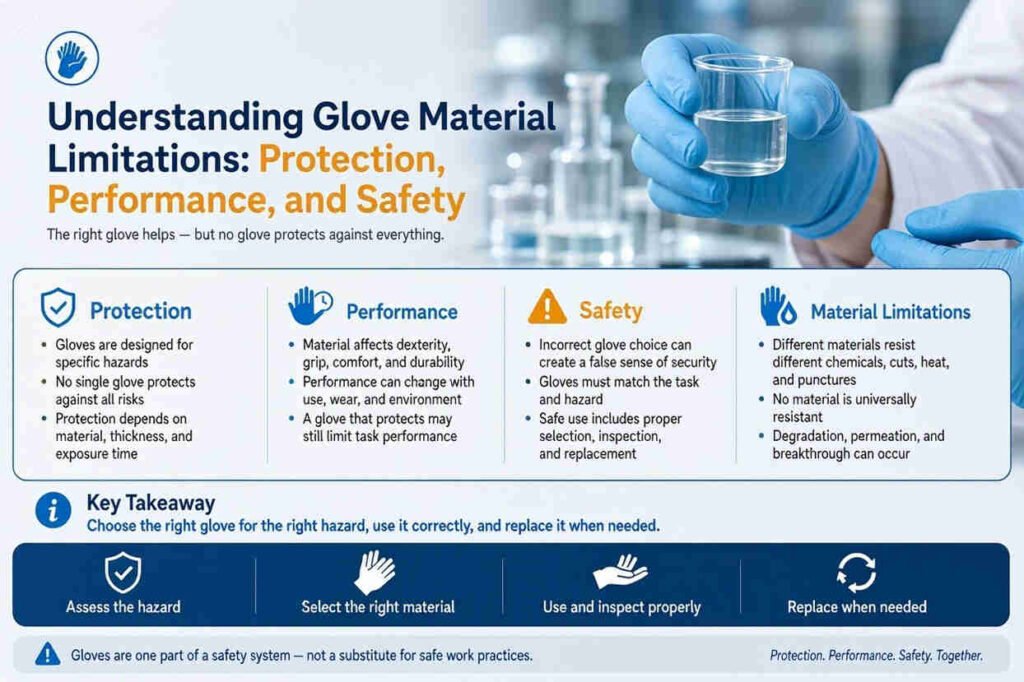
Understanding Glove Material Limitations: Protection, Performance, and Safety – Protective gloves play an essential role in workplace safety across industries such as manufacturing, construction, healthcare, chemical processing, automotive maintenance, and food production. They help protect workers from hazards, including chemicals, sharp objects, heat, abrasion, and biological contaminants. However, not all gloves provide the same level of protection. Each glove material has specific strengths and limitations that influence its performance in different working environments.
Understanding glove material limitations is important when selecting suitable personal protective equipment (PPE). Choosing the wrong material can reduce protection, increase the risk of workplace injuries, and create a false sense of security. By understanding the characteristics of common glove materials, businesses and workers can make better decisions about safety, comfort, and durability.
1. Why Glove Material Selection Matters
Glove materials determine how effectively a product protects against particular workplace hazards. Some materials offer excellent chemical resistance, while others are designed to withstand mechanical damage, high temperatures, or repeated handling.
For example, a glove suitable for handling cleaning solutions may not provide adequate protection when working with sharp metal components. Similarly, gloves designed for mechanical protection may not be appropriate for exposure to aggressive chemicals.
Several factors should be considered when selecting protective gloves:
- Hazard exposure: Identify whether workers face chemical, thermal, mechanical, electrical, or biological risks.
- Material compatibility: Ensure the glove material is suitable for the substances or conditions encountered.
- Durability: Consider resistance to punctures, cuts, abrasion, and repeated use.
- Comfort and flexibility: Select gloves that allow workers to perform tasks without unnecessary restrictions.
- Working conditions: Evaluate temperature, moisture, exposure duration, and required grip.
A proper assessment helps ensure that gloves provide appropriate protection without compromising productivity.
2. Common Glove Materials and Their Limitations
Different glove materials are designed for specific applications. Understanding their advantages and disadvantages helps users identify the most appropriate option.
Natural Rubber Latex
Latex gloves are widely used in healthcare, laboratories, cleaning, and light industrial applications. They provide excellent elasticity, flexibility, and tactile sensitivity, allowing users to perform tasks that require precise hand movements.
However, latex has several limitations. Some individuals experience allergic reactions to natural rubber proteins, making latex unsuitable for certain workplaces. Additionally, latex gloves may offer limited resistance to certain oils, organic solvents, and aggressive chemicals.
Their durability can also decrease when exposed to incompatible substances or harsh environmental conditions. Therefore, latex gloves should be selected according to the specific application and chemical compatibility requirements.
Nitrile Gloves
Nitrile gloves are manufactured from synthetic rubber and are commonly used in automotive workshops, laboratories, healthcare facilities, and industrial environments. They offer good resistance to many oils, greases, and chemicals while providing better puncture resistance than many comparable disposable latex gloves.
Despite these advantages, nitrile is not universally resistant to every chemical. Certain solvents and highly aggressive substances can penetrate or degrade nitrile, depending on their concentration and exposure duration.
Nitrile gloves may also provide less elasticity than latex products, potentially affecting comfort during extended use. Selecting the correct thickness and formulation is essential for achieving the required protection.
PVC Gloves
Polyvinyl chloride (PVC) gloves are frequently used in cleaning, food processing, light chemical handling, and general industrial work. They are relatively economical and provide resistance to many acids, alkalis, and aqueous solutions.
Nevertheless, PVC gloves have limitations when exposed to certain organic solvents, oils, and extreme temperatures. Their flexibility may also decrease in cold environments, making hand movements more difficult.
Although PVC can provide useful protection for specific applications, users should always verify chemical compatibility before handling unfamiliar substances.
Neoprene Gloves
Neoprene gloves are valued for their flexibility and resistance to various chemicals, including selected acids, alkalis, and oils. They are used in laboratories, industrial maintenance, and chemical processing.
However, neoprene does not resist every chemical equally. Strong oxidizing agents and certain solvents may damage the material. Its protective performance also depends on glove thickness, formulation, and exposure conditions.
For applications involving multiple chemicals, checking manufacturer compatibility information is particularly important.
Leather Gloves
Leather gloves are commonly used in construction, welding, material handling, and mechanical operations. They provide useful protection against abrasion, friction, and certain mechanical hazards.
However, leather is not inherently waterproof or chemically resistant. It can absorb liquids, become stiff when wet, and lose some of its protective properties after prolonged exposure to moisture or contaminants.
Leather gloves should not be considered suitable for chemical handling unless specifically designed and tested for that purpose.
3. Chemical Resistance Does Not Mean Complete Protection
One common misunderstanding is that chemical-resistant gloves provide universal protection against hazardous substances. In reality, chemical resistance varies significantly depending on the material and the chemical involved.
Three important factors influence chemical protection:
- Permeation: This occurs when chemicals pass through glove material at a molecular level, even when no visible damage is present.
- Degradation: Chemical exposure can change the physical properties of glove materials, causing swelling, cracking, discoloration, or reduced strength.
- Penetration: Chemicals can enter through small holes, damaged areas, seams, or manufacturing defects.
Workers should consult chemical resistance charts, safety data sheets (SDS), and manufacturer recommendations before choosing gloves. Relevant testing standards, such as EN ISO 374, can also help evaluate chemical protective performance.
4. Physical and Environmental Limitations
Glove performance is influenced not only by chemical exposure but also by physical working conditions.
Cut-resistant gloves, for example, can reduce the risk of injuries from sharp materials, but they do not necessarily provide protection against punctures or extreme temperatures. Similarly, heat-resistant gloves may withstand certain temperatures but may not protect against chemical splashes or prolonged direct flame exposure.
Environmental conditions can also affect material performance. High temperatures may accelerate material degradation, while cold conditions can reduce flexibility. Excessive moisture can weaken some materials and reduce grip.
Workers must therefore consider the complete working environment rather than relying on a single protective feature.
5. Comfort, Dexterity, and Productivity
Protection is essential, but comfort should not be overlooked. Gloves that are too thick, stiff, or poorly fitted can reduce dexterity and make detailed tasks more difficult.
For example, thick industrial gloves may provide stronger mechanical protection but limit finger movement. Lightweight disposable gloves offer better tactile sensitivity but may not withstand demanding mechanical operations.
Proper sizing, ergonomic design, surface texture, and material flexibility all contribute to effective glove performance.
Employers should balance protection requirements with the practical needs of workers. Comfortable gloves encourage consistent use and can help improve workplace safety.
6. How to Choose the Right Protective Gloves
Selecting suitable gloves requires a systematic approach. Start by identifying workplace hazards and evaluating the level of protection needed for each task.
Next, compare available materials based on their chemical compatibility, mechanical resistance, thickness, and intended application. Consider whether disposable or reusable gloves are more appropriate.
Check relevant product certifications and technical specifications. For chemical applications, review permeation and degradation data rather than relying solely on general material descriptions.
Finally, establish proper inspection and replacement procedures. Gloves should be replaced when they show signs of damage, contamination, deterioration, or reduced protective performance.
7. Conclusion
Understanding glove material limitations is essential for maintaining effective workplace protection. Latex, nitrile, PVC, neoprene, and leather each offer different benefits, but none provides universal protection against every hazard.
The best glove selection depends on the specific application, exposure conditions, material compatibility, and required performance. By evaluating these factors carefully, businesses can reduce workplace risks, improve worker comfort, and support safer operations.
Ultimately, protective gloves should be viewed as part of a comprehensive safety program rather than a universal solution. Proper selection, correct usage, regular inspection, and timely replacement are key to ensuring reliable hand protection in demanding working environments.
Article properties by, nicearticles.com, published by: pabrik sarung tangan – Mitrasaruta