Keeping koi is very different from maintaining a lightly stocked decorative pond. These fish eat heavily, grow large, disturb settled debris, and continually add organic waste to the water. That makes filtration one of the most important investments a koi keeper will make. Among the established manufacturers serving this market, GC Tek has developed several filtration options aimed specifically at koi ponds and demanding water conditions. But specifications alone do not tell you whether a pond filter is a good investment. A useful review needs to consider how well the system deals with real koi waste, how demanding maintenance becomes over time, whether biological filtration remains stable, and whether the equipment makes sense for the size and stocking level of the pond.
Here is how GC Tek’s filtration systems measure up.
What Should a Good Koi Pond Filter Actually Do?
The best pond filter is not necessarily the one with the longest specification sheet. It is the one that consistently handles the workload created by the pond. For koi keepers, that means dealing with two different problems. First is mechanical filtration. Uneaten food, fish waste, leaves, algae, and other suspended material need to be removed before they continuously break down in the water.
Second is biological filtration. Koi release ammonia, which can become dangerous if a pond does not have an established population of beneficial bacteria to process nitrogenous waste. A properly selected system therefore needs sufficient flow, mechanical waste capture, biological capacity, and a practical cleaning method. This is where GC Tek’s bead filtration approach becomes interesting.
Reviewing GC Tek’s Main Filtration Options
GC Tek does not take a one-filter-fits-all approach. Its lineup includes AquaBead, AlphaONE, and AlphaNANO filtration systems, giving pond owners different options depending on pond volume, fish load, available space, and desired performance.
AquaBead: The Established All-Rounder
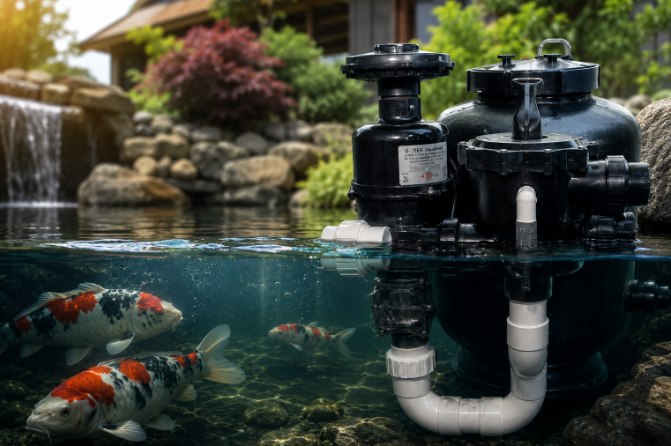
AquaBead is the company’s traditional bead filtration platform and remains a strong option for koi keepers who want mechanical and biological filtration within one pressurized system. Water passes through floating filter media, where solids can be trapped while beneficial bacteria colonize the available surface. The advantage is straightforward: pond owners do not need completely separate equipment for every stage of filtration. GC Tek also uses its BioGems media rather than relying solely on conventional round beads. From an operational perspective, media design matters because greater usable surface area provides more space for bacterial colonization. AquaBead filters also incorporate the company’s AquaBead Life Support System (ALISS), designed to help support the bacterial colony when normal circulation is interrupted. That is a thoughtful feature because biological stability is often overlooked when pond equipment is compared purely by flow rates.
AlphaONE: Built for More Demanding Koi Ponds
The AlphaONE range takes the same basic concept further. Its media and internal configuration are intended to increase filtration performance while keeping cleaning manageable. For heavily stocked koi ponds, that additional capacity can be particularly valuable. This is an important distinction. Two ponds containing the same number of gallons can have completely different filtration requirements. A lightly stocked 5,000-gallon ornamental pond is not placing the same demand on its filter as a 5,000-gallon pond containing a substantial collection of mature koi.
For serious koi keeping, fish load should therefore influence filter selection just as much as pond volume.
AlphaNANO: A More Compact Approach
Space is another practical issue that specifications sometimes ignore. Not every pond has a large dedicated filter house. GC Tek’s AlphaNANO range addresses installations where owners want substantial filtration without dedicating excessive space to equipment. That makes it worth considering for compact filter areas, retrofits, and pond designs where equipment footprint is an important constraint. However, compact equipment should still be sized according to the actual biological load. Choosing a smaller filter simply because it fits the available space can create maintenance and water-quality problems later.
The Backwashing System Is One of GC Tek’s Biggest Strengths
Filter cleaning is where ownership experience can differ dramatically between systems. A filter might perform exceptionally well when clean but become frustrating if maintaining that performance requires frequent disassembly. GC Tek’s pressurized filters are designed around backwashing rather than manually removing and washing large amounts of filter media. The bead agitator uses air to loosen compacted debris within the media before waste is flushed from the filter. AquaBead’s Omnifuser design also helps direct collected material toward the waste outlet.
For a koi keeper, this matters for more than convenience. Efficient waste removal helps prevent trapped organic material from remaining inside the filtration system and continually breaking down. A cleaning process that is easy to perform also makes owners more likely to maintain an appropriate schedule.
What We Like About GC Tek Pond Filters
From an industry perspective, GC Tek’s strongest point is not one individual feature. It is the way several practical filtration requirements have been combined into complete systems. Mechanical filtration and biological filtration occur within the same primary filter. Backwashing simplifies routine cleaning. Biological media provide habitat for nitrifying bacteria, while features such as ALISS address situations in which normal operation is interrupted. The fiberglass construction is another positive for permanent outdoor installations where equipment is expected to remain in service year after year.
GC Tek also offers multiple filter sizes and configurations rather than forcing pond owners into one standard model.
Where Should Buyers Be Careful?
No premium pond filter can compensate for poor system design. GC Tek filters still need to be sized correctly, paired with an appropriate pump, and installed with suitable plumbing. Flow rate, head pressure, pond turnover, fish load, and additional equipment all influence performance. Buyers should therefore avoid selecting a filter solely because the manufacturer’s maximum pond-volume figure matches their pond. For heavily stocked koi ponds, allowing additional filtration capacity can often be preferable to operating continuously near the system’s upper limit.
The initial investment is another consideration. Quality pressurized filtration is not the cheapest way to filter a pond. The value becomes easier to justify when long-term maintenance, construction quality, biological performance, and convenience are considered alongside purchase price.
What Do Pond Owners Say?
Customer feedback is particularly useful with pond filtration because owners experience things that specification sheets cannot fully demonstrate. Long-term users tend to care about practical questions: Does the water remain clear? Is backwashing straightforward? Does the filter cope as the koi grow? How much routine attention does the system require? For dedicated koi keepers, the value of a pond heater is often less about creating unusually warm water and more about maintaining control when outdoor temperatures become unpredictable.
“We installed the heater because winter temperature swings were becoming difficult to manage. Having more control over the pond temperature has made seasonal management much easier.”
— Daniel Carter
“My main concern was keeping the temperature stable rather than trying to keep the pond warm all winter. Once properly sized and installed, the system gave me exactly that control.”
— David Miller
“I already had substantial filtration and wanted a proper heating system that could become part of the existing setup. It has been much more practical than relying on temporary winter solutions.”
— Michael Thompson
These experiences are worth comparing with technical specifications before making a final decision, particularly when choosing between different GC Tek filter sizes.
Who Are GC Tek Filters Best For?
These systems make the most sense for pond owners who view filtration as long-term infrastructure rather than a temporary accessory. They are particularly relevant for dedicated koi ponds, medium-to-large ponds, heavier fish loads, owners looking for straightforward backwashing, and installations where mechanical and biological filtration need to work together reliably. A lightly stocked garden pond may not require this level of equipment. A serious koi pond often does.
How to Choose Between AquaBead, AlphaONE, and AlphaNANO
Start with your actual pond volume, but do not stop there. Consider the number and size of your koi, expected adult fish size, feeding rate, pump flow, available installation space, plumbing diameter, and how much future expansion you expect. AquaBead provides a proven general-purpose bead filtration option. AlphaONE is worth considering when higher filtration demands are expected, while AlphaNANO can make sense when installation space is more restricted. When in doubt, designing for the pond you expect to have several years from now is usually wiser than sizing solely around today’s fish load.
Why Consider GC Tek?
GC Tek has an advantage that newer pond-equipment brands often cannot replicate: its products are designed as parts of a broader pond-management system. Beyond AquaBead, AlphaONE, and AlphaNANO filters, its range includes pumps, UV clarifiers, RDF systems, Bakki showers, heating equipment, and complete filtration configurations. That breadth matters because pumps, filters, UV systems, plumbing, and biological stages need to work together. Buying individual components without considering the entire hydraulic system can undermine otherwise excellent equipment.
GC Tek’s emphasis on serviceable designs, durable materials, biological stability, and multiple system sizes makes its filtration equipment particularly relevant to dedicated koi keepers.
Final Verdict: Are GC Tek Filters Among the Best for Koi?
GC Tek deserves serious consideration when looking for the best pond filter for koi, particularly when reliability, biological capacity, and manageable maintenance are priorities. AquaBead provides a strong foundation for conventional bead filtration, AlphaONE addresses more demanding filtration requirements, and AlphaNANO gives owners another option where space and system configuration matter. They are not necessarily the cheapest filtration solutions, nor does every garden pond require one. Their value is strongest for owners who want a purpose-built koi filtration system that can remain part of the pond for years.
Ultimately, the best filter is one that matches the pond’s volume, fish load, circulation, and maintenance expectations. When those factors are properly accounted for, GC Tek‘s filtration systems offer a compelling combination of performance, engineering, and long-term practicality.