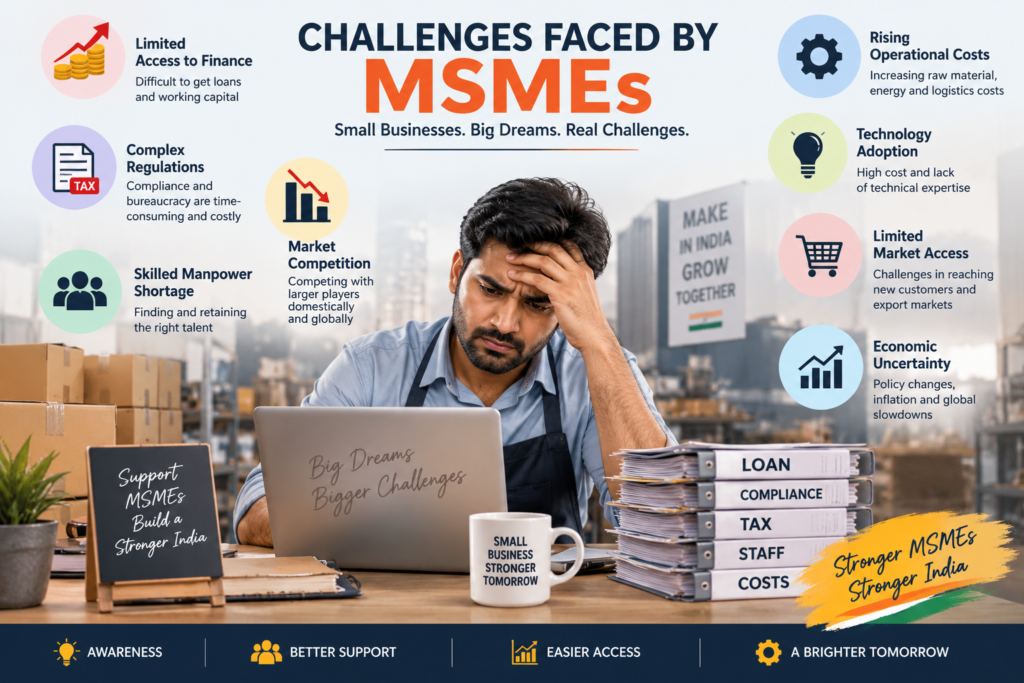
Micro, Small, and Medium Enterprises (MSMEs) are an essential part of the business economy. They contribute to employment, production, innovation, trade, and regional development. Despite their importance, many MSMEs face financial, operational, technological, and market-related difficulties. Understanding the challenges faced by MSMEs can help business owners identify risks and implement practical solutions for sustainable growth.
What Are MSMEs?
MSMEs are businesses operating across various sectors, including manufacturing, retail, trading, services, technology, logistics, food processing, and professional services. Their smaller size often allows them to respond quickly to customer needs, but limited resources can make it difficult to manage unexpected business challenges.
Major Challenges Faced by MSMEs
1. Limited Access to Finance
Access to adequate funding is one of the major challenges faced by MSMEs. Businesses often require capital for inventory purchases, salaries, equipment, expansion, marketing, and daily operating expenses.
Some MSMEs may struggle to obtain financing because of limited credit history, insufficient financial documentation, inconsistent cash flow, or lack of suitable security.
Solution: Maintain accurate financial records, improve creditworthiness, prepare a clear business plan, and evaluate financing options that match the business requirement and repayment capacity.
2. Cash Flow and Working Capital Problems
Cash flow problems can affect even profitable businesses. Delayed customer payments, rising operating expenses, seasonal demand, and unexpected costs can create pressure on available funds.
When money remains tied up in unpaid invoices or inventory, businesses may struggle to pay suppliers and manage routine expenses.
Solution: Prepare regular cash flow forecasts, establish clear payment terms, follow up on overdue invoices, control inventory, and maintain an appropriate working capital reserve.
3. Increasing Competition
MSMEs compete with large companies, established brands, online businesses, and other local enterprises. Larger competitors may have greater financial resources, marketing budgets, and distribution networks.
Solution: Focus on product quality, specialized services, competitive pricing, personalized customer support, faster service, and a strong value proposition.
Read also: RKS London: Your Trusted Partner for Fire Protection and Security Solutions
4. Lack of Skilled Workforce
Finding and retaining employees with suitable technical, digital, sales, and management skills can be difficult for small businesses. Limited budgets may also make it harder to compete with larger organizations for experienced professionals.
Solution: Invest in employee training, provide opportunities for skill development, create a supportive work environment, and use technology to automate repetitive tasks.
5. Technology Adoption Issues
Technology can improve productivity, accounting, inventory management, communication, sales, and customer service. However, some MSMEs delay technology adoption because of cost, lack of expertise, or concerns about implementation.
Solution: Adopt technology gradually. Businesses can begin with practical tools such as accounting software, inventory management systems, CRM platforms, cloud applications, digital payment solutions, and cybersecurity tools.
6. Marketing and Customer Acquisition
Generating a consistent flow of customers is another common challenge. Many MSMEs have good products or services but lack the marketing resources needed to reach their target audience.
Solution: Develop a comprehensive digital marketing strategy using SEO, social media marketing, content marketing, online business listings, referrals, email marketing, and targeted advertising.
7. Supply Chain and Inventory Management
Supplier delays, fluctuating raw material costs, transportation problems, and inventory shortages can disrupt business operations. On the other hand, excessive inventory can tie up working capital.
Solution: Build relationships with reliable suppliers, monitor inventory levels, maintain appropriate stock, compare sourcing options, and use inventory management software when appropriate.
Read also:
8. Regulatory and Compliance Challenges
MSMEs may need to manage taxation, accounting, registrations, employment requirements, industry-specific regulations, and other compliance responsibilities. Managing these requirements can be time-consuming for small businesses.
Solution: Maintain organized records, create compliance calendars, use accounting and business management tools, and seek professional advice when necessary.
9. Rising Operating Costs
Increasing costs for raw materials, transportation, salaries, utilities, rent, technology, and other business requirements can reduce profit margins.
Solution: Review expenses regularly, negotiate supplier terms, improve operational efficiency, reduce unnecessary spending, and monitor profitability across products and services.
10. Limited Online Presence
Customers increasingly search online before choosing products and services. MSMEs without a strong digital presence can lose potential customers to competitors.
Solution: Develop a professional website, optimize local business listings, maintain active social media profiles, publish useful content, and encourage genuine customer reviews.
Causes Behind MSME Business Challenges
The causes of MSME difficulties can vary by industry and business size. Common causes include limited financial resources, inadequate planning, changing customer preferences, insufficient technology adoption, increasing competition, delayed customer payments, supply chain disruptions, and shortage of skilled employees.
Understanding the root cause is important because applying a temporary solution without addressing the underlying problem may only provide short-term relief.
How MSMEs Can Overcome Business Challenges
Overcoming the challenges faced by MSMEs requires a structured approach. Business owners should regularly review their financial performance, operating costs, customer acquisition, inventory, employee productivity, and market position.
Businesses can also create short-term and long-term goals and measure their progress using practical performance indicators. Better planning allows MSMEs to identify potential problems before they significantly affect operations.
Importance of Financial Planning
Strong financial management is essential for MSME stability. Businesses should maintain accurate accounting records, prepare budgets, monitor receivables and payables, and regularly review cash flow.
Separating business and personal finances can also make financial management easier and provide a clearer picture of actual business performance.
Role of Digital Transformation
Digital transformation can help MSMEs reduce manual work, improve efficiency, and make better decisions. Accounting systems can simplify financial management, while CRM and inventory solutions can improve customer and stock management.
Cloud-based tools can also support remote collaboration and provide access to business information from different locations. However, technology should be selected according to actual business needs rather than adopting unnecessary tools.
Building Long-Term Business Stability
MSMEs should focus on building a sustainable business model rather than depending only on short-term sales growth. Strong customer relationships, controlled costs, efficient operations, employee development, and continuous innovation can contribute to long-term stability.
Businesses should also monitor market trends and customer feedback. Adapting products, services, and marketing strategies according to changing market conditions can create new growth opportunities.
Key Strategies for MSME Growth
The following strategies can help businesses manage common MSME challenges:
- Maintain accurate financial and accounting records.
- Monitor cash flow and working capital regularly.
- Control unnecessary operating expenses.
- Improve customer retention and service quality.
- Invest in relevant technology.
- Train and develop employees.
- Strengthen online visibility and digital marketing.
- Build reliable supplier relationships.
- Monitor competitors and market trends.
- Review business performance regularly.
- Diversify products or services where appropriate.
Conclusion
The challenges faced by MSMEs include limited access to finance, cash flow problems, increasing competition, skilled workforce shortages, technology gaps, supply chain difficulties, rising operating costs, and regulatory responsibilities. These challenges can affect profitability and business growth when they are not identified and managed effectively.
By improving financial planning, adopting suitable technology, strengthening marketing, developing employees, controlling costs, and focusing on customer satisfaction, MSMEs can become more resilient. A proactive approach to identifying causes and implementing practical solutions can help small and medium businesses achieve greater stability and sustainable growth.